


QUIRKY SCIENCE

Molecules On Comet
Organic molecules never previously observed in comets, a relatively varied structure on the surface but fairly homogeneous interior, organic compounds forming agglomerates rather than being dispersed in the ice: these are just some of first results provided by Philae on the surface of comet Churi. This work, carried out as part of ESA's Rosetta mission, involved researchers from the CNRS, Aix-Marseille Université, Université Joseph Fourier, Université Nice Sophia Antipolis, UPEC, UPMC, Université Paris-Sud, Université Toulouse III -- Paul Sabatier and UVSQ, with support from CNES. They are published on July 31, 2015 as part of a set of eight articles in the journal Science. These in situ findings, which contain a wealth of completely new information, reveal several differences in comparison with previous observations of comets and current models.

The landing of the Philae module provided the cometary rendezvous mission Rosetta with an exceptional opportunity: that of studying in situ a cometary nucleus (from its surface to its internal structure), 67P/Churyumov-Gerasimenko (aka Churi). This is likely to shed light on these small celestial bodies that date back to the origins of the Solar System. The data collected by the lander's ten instruments on November 12-14, 2014 (during the 63 hours that followed Philae's separation from Rosetta) added to the observations carried out by the Rosetta orbiter1, while its bouncing touchdown on the comet was actually a source of extra information.
A Mimic of Nature
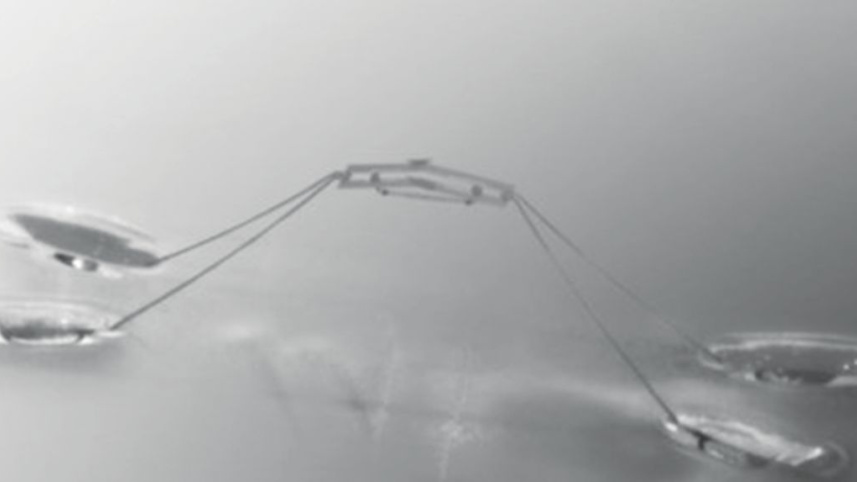
The concept of walking on water might sound supernatural, but in fact it is quite a natural phenomenon. Many small living creatures leverage water's surface tension to maneuver themselves around. One of the most complex maneuvers, skipping on water, is achieved by a species of semi-aquatic insects called water striders that not only skip along water's surface but also generate enough upward thrust with their legs to launch themselves airborne from it.
Now, emulating this natural form of water-based locomotion, an international team of scientists from Seoul National University, Korea (SNU), Harvard's Wyss Institute for Biologically Inspired Engineering, and the Harvard John A. Paulson School of Engineering and Applied Sciences, has unveiled a novel robotic insect that can jump off of water's surface. In doing so, they have revealed new insights into the natural mechanics that allow water striders to jump from rigid ground or fluid water with the same amount of power and height.
The water strider, whose legs have slightly curved tips, employs a rotational leg movement to aid it its takeoff from the water surface, discovered co-senior author Ho-Young Kim who is Professor in SNU's Department of Mechanical and Aerospace Engineering and Director of SNU's Micro Fluid Mechanics Lab. Kim, a former Wyss Institute Visiting Scholar, worked with the study's co-first author Eunjin Yang, a graduate researcher at SNU's Micro Fluid Mechanics lab, to collect water striders and take extensive videos of their movements to analyze the mechanics that enable the insects to skim on and jump off water's surface.
Source: sciencedaily.com
 For all latest news, follow The Daily Star's Google News channel.
Comments