


July Uprising: The day an autocrat fell
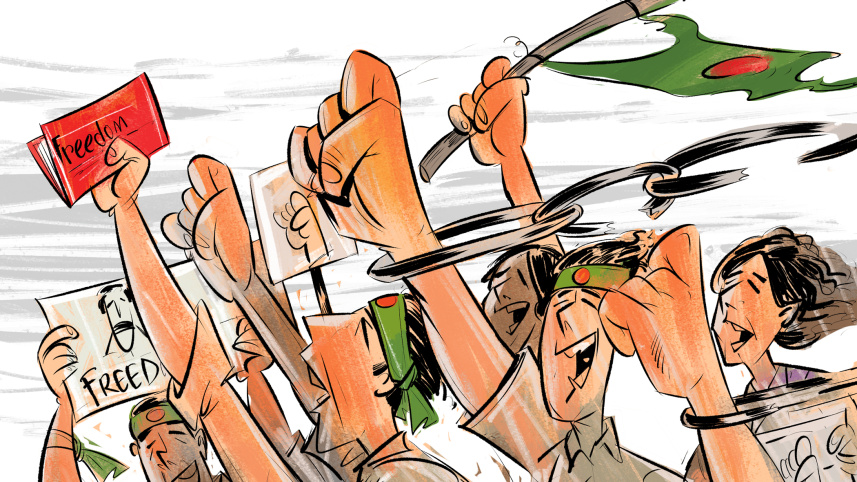
Around 11:00am on August 5, 2024, Sheikh Hasina was told what she had refused to believe: the protesters could no longer be stopped from reaching Gono Bhaban.
The prime minister, who had ruled Bangladesh for more than 15 years, was running out of options.

Hasina had earlier prepared to go to Bangabhaban and seek a declaration of a state of emergency. But as the “March to Dhaka” gathered momentum and protesters poured into the capital despite a curfew, the situation around the seat of government was rapidly slipping beyond the authorities’ control.
Senior security officials told her that they could no longer guarantee the safety of Gono Bhaban.
Hasina initially refused to leave. At one point, she reportedly wanted to be taken to Tungipara, her ancestral home. But security officials insisted that she be moved to the cantonment.
By around 1:30pm, the decision had been made.
Vehicles carrying Hasina and her younger sister Sheikh Rehana left Gono Bhaban through the lake road gate. They headed to the old Trade Fair ground, where the two sisters boarded a helicopter and were taken to the air force base at Kurmitola.
There was no triumphant farewell, no final address to the nation.
Instead, Hasina left Bangladesh.
Around 5:36pm local time, she reached India’s Hindon Air Force Base near New Delhi.
By then, the political order she had dominated for a decade and a half had already begun to collapse.
In Dhaka, hundreds of thousands of people poured onto the streets. Crowds entered Gono Bhaban, once one of the most heavily guarded addresses in the country. People walked through rooms, climbed onto furniture, took photographs, and raised flags and slogans.
The scenes were extraordinary precisely because the building had for years represented the enormous power of the Awami League government.
But August 5 was not simply a day of celebration.
At least 66 people were killed in Dhaka that day. Violence continued in several parts of the country, with attacks on police stations, government establishments, and Awami League offices.
By evening, the country had entered an entirely new political reality.
In June last year, August 5 acquired an official name: July Mass Uprising Day. The government declared it a public holiday, and the second anniversary is being marked today with state ceremonies, tributes to martyrs, and programmes across the country.
At the centre of this year’s observance are the families of those killed and injured during the uprising.
Acting President Hafiz Uddin Ahmad, in a message, called for building a democratic, just and humane Bangladesh where authoritarianism and extremism would have no place. He said the sacrifices of the July fighters would remain an enduring source of inspiration.
Prime Minister Tarique Rahman described August 5 as a day of victory and a day of the restoration of democratic political rights for all those who cherish freedom and democracy. He called for the country to repay its debt to the martyrs’ families by establishing equality, human dignity and social justice.
 For all latest news, follow The Daily Star's Google News channel.
 He also urged political parties to preserve the unity forged during the uprising, warning that differences of opinion must not descend into hostility.
Leader of the Opposition Shafiqur Rahman, in a message, described August 5 as a “glorious and unforgettable” chapter in Bangladesh’s history. Paying tribute to those killed and injured, he said the movement’s central goal was to build a discrimination-free, democratic and justice-based Bangladesh.
He urged people to remain united and work towards fulfilling the aspirations for which the martyrs sacrificed their lives.
Meanwhile, Dhaka has been placed under heightened security for today’s programmes, with additional patrols and checkpoints, plainclothes intelligence personnel, CCTV and drone surveillance, and specialised units deployed at major gathering points.
To mark the day, Tarique Rahman will inaugurate the July Mass Uprising Memorial Museum, which was earlier known as Gono Bhaban, at 9:00am.
According to an official notification, the minister, state minister, secretary, officials and employees of the Ministry of Liberation War Affairs, along with people from different walks of life, will place wreaths at the July Martyrs’ Memorial in Shahbagh at 6:01am.
Later, at 12:00pm, a reception will be accorded to the families of the July martyrs and the July fighters at the Bangladesh-China Friendship Conference Centre in the capital’s Purbachal. Hafiz Uddin Ahmad will attend the function as the chief guest, where the significance of the day will also be highlighted through a discussion.
Besides, Dhaka University will commemorate the day with a series of programmes, including laying the foundation for a July Memorial and a dedicated July Corner in the Central Library.
A discussion will be held at the TSC where five families of July martyrs will be honoured, and a prayer session will be held after Asr prayers at the Central Mosque, seeking eternal peace for the martyrs.
Comments