


Labour Rights

Books exploring workers’ rights in South Asia
In order to understand the background of the labour movements in South Asia or the plight of workers, here are some books to add to your reading list.
2 May 2023

5 books to read for International Workers’ Day
Concentrating on women workers from Bangladesh, Nepal, India and Pakistan, Women and Work in South Asia also tackles the advancement of individual corporate sectors due to the involvement of women workers.
1 May 2023

Essential service ACT: Draft tugs at right to go on strike
The cabinet yesterday gave the nod to the draft of the Essential Service Act, 2022, including a clause that criminalises strikes in organisations whose services are declared essential -- in a development that stands to set back the country’s labour rights.
1 November 2022

Changes in Labour Rules will actually reduce maternity benefits
Laws and policy frameworks must be sensitive towards the rights of maternity protection
31 October 2022

“Don’t force me to take to the streets for tea workers’ wage”
Acclaimed poet Nirmalendu Goon has demanded that the daily wage of tea workers be raised to Tk 300.
22 August 2022

Does anyone care about the jute mill workers?
At a time when the demand for jute products in the world is increasing, and new private jute mills are being established, government workers are being handed over to the private mills.
30 April 2022
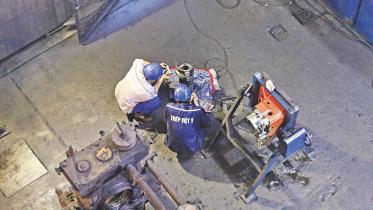
Working for a brighter future in Asia
With nearly two decades of strong economic growth, the world’s highest employment ratios and lowest unemployment rates, and massive technological innovation, some say “Asia is the future” or even “The future is Asia”.
30 April 2019

Health issues of RMG workers need attention
Garment workers have received a fair share of attention over the last few years due to their poor working conditions, low wages and benefits, and inadequate facilities at their factories of employment.
2 April 2019

Ensuring labour rights can tackle human trafficking
Hundreds of millions of dollars are spent every year on counter trafficking efforts, mostly on investigation and criminal prosecution, raids to "rescue" irregular migrants and sex workers who are thought to be potential victims and trainings to raise awareness among those who might possibly experience or encounter human trafficking.
29 July 2018
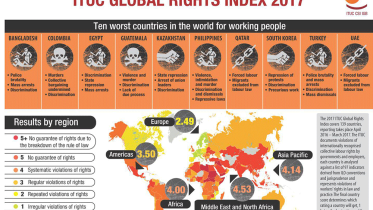
ITUC report on workers' condition
We would hope that the government would not approach the issue in the usual cavalier manner and dismiss the report offhand. The matter demands to be addressed seriously.
23 June 2017
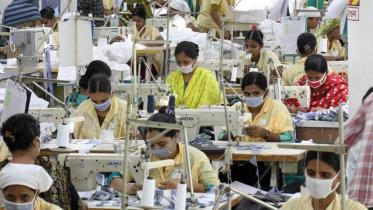
Pave way for unionisation in garments: HRW
Bangladesh government should urgently remove legal and practical obstacles to unionization in garment industries, Human Rights Watch says.
21 April 2016

Bangladesh failed at times to control security forces: US
The United States has said the government of Bangladesh took 'limited measures' to investigate and prosecute cases of abuse and killing by security forces. The US, in its 2015 Country Reports on Human Rights Practices, claimed authorities failed at times to maintain effective control over security forces.
14 April 2016
New Saudi regulations to protect workers’ rights
The Saudi Arabian government announces new labour regulations to protect the workers’ rights by bringing the employers under strict rules including financial fines.
23 October 2015
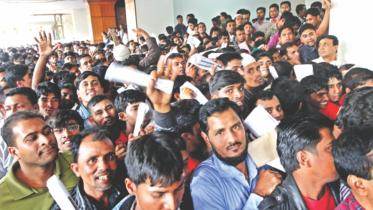
The delusion of Bangladesh's cheap labour
Within no time, this demographic dividend may spell a demographic disaster with teeming multitudes of disillusioned, jobless men and women devoid of high skills needed to survive in an environment of cut-throat competition.
12 June 2015

May Day: A day in the life of a restaurant worker
Employees at different hotels and restaurants in Pabna are forced to work 12 to 15 hours a day. And despite this long hours of work, they are poorly paid.
30 April 2015
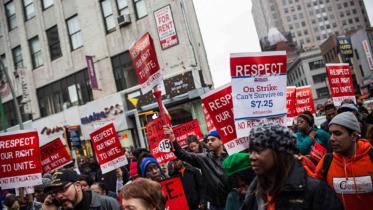
Bangladesh can improve its labour rights, but so can the United States
RECENTLY, the Office of the United States Trade Representatives (USTR) called on the government of Bangladesh to improve on its labour rights, and in particular to allow for increased unionisation before it would consider restoring trade benefits. In Bangladesh, it now seems to be increasingly accepted that unionisation or some worker constituted collective will help to improve workplace standards. Of course, labour advocates have been arguing this for years, but Rana Plaza provides a tragic reminder that unions play a critical role in improving workplace safety and labour rights. Therefore, freedom of association has been a key criteria in Bangladesh's review on trade benefits. This is a welcome development.
16 February 2015