


Jürgen Habermas, the mason of reason

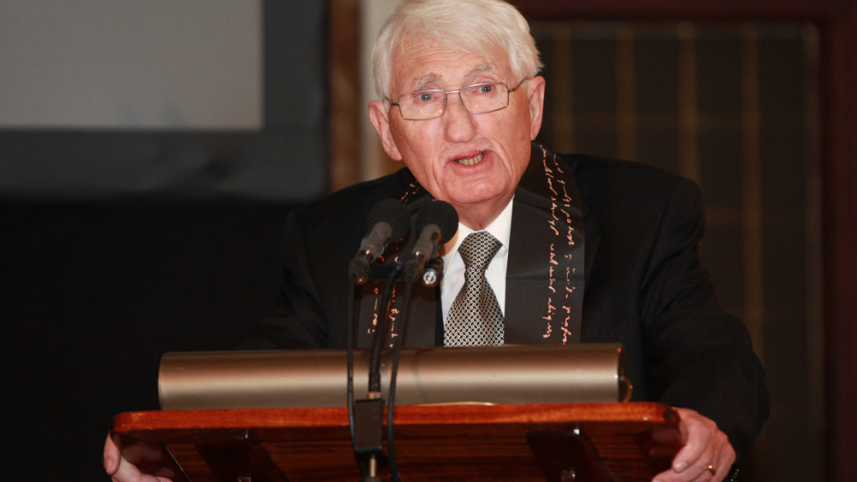
Few philosophers of the twentieth century exerted an influence as quietly pervasive yet intellectually formidable as Jürgen Habermas, who passed away yesterday.
Where many thinkers courted notoriety through abstraction or ideological fervour, Habermas preferred the austere discipline of argument. His life’s work can be read as a sustained defence of one deceptively simple proposition -- that democratic societies endure not by force or myth, but by the fragile yet resilient practice of rational conversation.

I first encountered Habermas in the pages of “The Structural Transformation of the Public Sphere (1962)” a decade ago while working as a copywriter at an ad agency, tasked with crafting copy for a high-profile politician and a minister’s personal event. The exercise demanded a keen sensitivity to perception, nuance and the invisible currents of public sentiment.
Habermas’s insights were revelatory. The notion that public opinion is neither spontaneous nor monolithic but shaped in spaces where ideas are deliberated, critiqued and negotiated offered an intellectual compass for navigating the fragile theatre of influence and reception.
His argument that the public sphere is a crucible for rational-critical debate provided a mirror for the advertising world I inhabited, where messaging is designed to catalyse reflection and action. It was a lesson in the choreography of attention -- how audiences, whether reading a manifesto or an advertisement, construct meaning collectively, and how the careful framing of ideas can shape perception without coercion.
If philosophy occasionally resembles a cathedral of speculation, Habermas spent more than six decades strengthening its foundations. His intellectual enterprise sought to rescue reason from the wreckage of modern history and restore faith in the possibility that citizens, speaking freely and listening earnestly, might yet govern themselves through discourse rather than domination.
A mason of reason
Habermas’s enduring genius lies in his meticulous mapping of the mechanisms through which societies communicate and rationalise. For him, democracy is not merely procedural but dialogical -- the legitimacy of power rests not on fiat but on the capacity of citizens to reason together.
His work is both structural and aspirational. It diagnoses the decline of deliberative spaces even as it sketches the architecture for their renewal. Habermas famously distinguished between the “system” and the “lifeworld” -- the former governed by strategic interests and bureaucratic imperatives, the latter by shared meanings, cultural traditions and communicative action.
In doing so, he illuminated the creeping colonisation of the lifeworld by instrumental rationality. In advertising, politics or media, this tension is visible every day -- the pull between authentic discourse and the strategic manipulation of perception.
His framework now appears strikingly prescient. Social media, with its cacophonous forums and echo chambers, reflects many of the challenges he diagnosed -- the fragility of reasoned debate, the commodification of attention and the subversion of dialogue by systemic pressures. Decades before algorithmic feeds and viral outrage, Habermas had already discerned the perils of a public sphere vulnerable to manipulation.
His most ambitious philosophical contribution came with his theory of communicative action. Its premise was deceptively simple -- human beings are not merely strategic actors pursuing advantage; they are also communicative beings seeking mutual understanding. Language itself, in this view, contains an implicit moral architecture.
Communicating consciousness
Habermas’s voice carried unusual authority because it was neither partisan nor aloof. He embodied the ideal of the public intellectual who believed that reasoned argument still had a place in political life.
In postwar Germany he argued tirelessly for a reckoning with the crimes of Nazism. One of his most enduring philosophical disputes was with postmodern thinkers who declared the Enlightenment’s faith in reason exhausted.
Figures such as Michel Foucault and Jacques Derrida emphasised the entanglement of knowledge with power, casting suspicion on universal claims to truth. Habermas accepted aspects of the critique but rejected the conclusion. Modernity, he argued, was not a failed experiment but an unfinished project.
Perhaps the most striking feature of his influence is its persistence. In an age often tempted by populist theatrics or authoritarian shortcuts, his philosophy reminds us that democracy is not merely a mechanism for choosing rulers. It is, more fundamentally, a culture of argument.
Habermas’s enduring message is neither utopian nor naïve. Democracy is not sustained by ballots alone. It survives through conversation -- difficult, imperfect and sometimes exasperating -- in which citizens recognise one another as partners in a shared search for truth.
In the end, his legacy may be distilled into a single conviction -- that the fate of freedom depends less on the power of institutions than on the vitality of public reason.
And that reason, like democracy itself, remains an unfinished argument.
 For all latest news, follow The Daily Star's Google News channel.
Comments