


A locally assembled laptop, ‘Taalpata’ is production-ready. Will it ever hit the market?
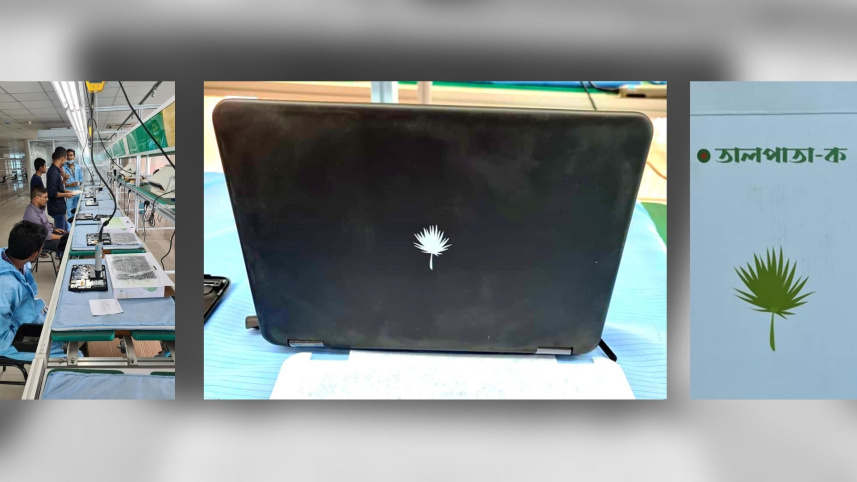
'Taalpata' – the latest addition to the race of 'Made in Bangladesh' laptops, assembled locally by Datasoft Manufacturing & Assembly Inc Limited (DMA), at Hi-Tech Park in Bangabandhu Hi-Tech City of Kaliakoir, is somewhat of a sitting duck, with 500 units of laptops produced but no plans for commercial production as of yet.
According to Hasan Rahman, Managing Director at DMA, high excise duty on computer parts import and a complicated bureaucratic process are to be blamed for this.

"Under the current infrastructure, it is not feasible for independent manufacturers like us to compete with big brands in the local hardware manufacturing market," he says. "We are trying to convince the related authorities to work together for a feasible solution to this issue."
Hasan Rahman says the lack of coordination among bureaucratic services and the lack of one-stop solutions in the Hi-Tech Park is detrimental for small to medium hardware manufacturers to thrive in the market against established brands. He also mentions that small enterprises like Datasoft were promised tax exemptions on imports when setting up factories at Hi-Tech Park, but in reality, no such exemptions were made from the National Board of Revenue (NBR).
According to Rahman, local laptop assemblers or manufacturers need incentives and benefits to thrive in this market, the same way local mobile phone manufacturers do.
When contacted, Bikarna Kumar Ghosh, Managing Director at Bangladesh Hi-Tech Park Authority, admitted the shortcomings in the long and complicated bureaucratic services. "We still have works left to do in this department," he said. However, he denied the accusations of foiled promises of tax exemptions.
"When an entity sets up a factory at Hi-Tech Park, the Park authorities can recommend a tax exemption for that entity to the NBR. This, however, does not guarantee an exemption as the final decision is up to the NBR committee who evaluates and decides whether an entity is eligible for exemption or not."
He also added that as with any bureaucratic process, there are steps that are to be followed in certain orders and that anyone who checked all the boxes and followed all the steps have received such tax exemptions.
This, however, is not the first time DMA has tried to float its 'Taalpata' brand in the market. Reports from 2019 reveal that 'Taalpata' had produced two models of laptops experimentally in late 2018 and was supposed to hit the market later that year. Citing a lack of proper investment at the time, DMA then had a revised plan of launching the laptops in the market in April 2019.
With no luck in April 2019, the current attempts in late 2021 would make it DMA's third attempt to launch its 'Taalpata' brand in the market successfully.
However, with no plans to go into commercial productions anytime soon, DMA has given away 300 units of its 'Taalpata' laptops to a school in Chandpur to be used for its students. The laptops are currently priced at a range of Tk. 25,000 to Tk. 30,000 per unit, for anyone who wants to buy them commercially.
The 360-degree foldable 'Taalpata' has a multi-touch screen, sized 11.6-inches, a U 3polymer 7.4V battery, 128 GB storage and 8 GB of RAM. The laptop can run on both Windows and Linux-based operating systems and it houses an Intel N4000 processor.
In the race for 'Made in Bangladesh' laptops, state-run Telephone Shilpa Sangstha (TSS) Ltd was the first to assemble laptops locally in Bangladesh. The laptop, called 'Doel' was first launched in 2010. In 2017, the production was suspended completely owing to low demand and low supplies of parts. However, TSS started assembling 'Doel' again in 2018. In the fiscal year 2019-20, TSS sold 740 units of 'Doel' laptops. Government organisations and agencies remain its primary customers.
Other than TSS, Walton has also been assembling laptops locally in its own factory. Except for Walton, TSS, and now DMA, no other manufacturers have yet entered the local laptop production market.
 For all latest news, follow The Daily Star's Google News channel.
Comments