


Sanctuary in name, settlement in reality

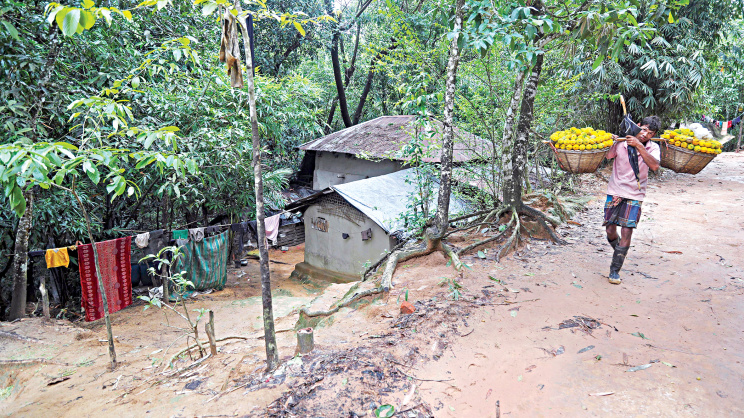
Like every other day, farmer Abul Kalam was carrying water in two tin jars from an artesian tube well to his betel leaf garden. The garden, roughly 0.8 acres in size, is enclosed on all sides with dried reeds and lies on a hillside slope in Jungle Chambal inside Chunati Wildlife Sanctuary in Chattogram’s Banshkhali upazila.
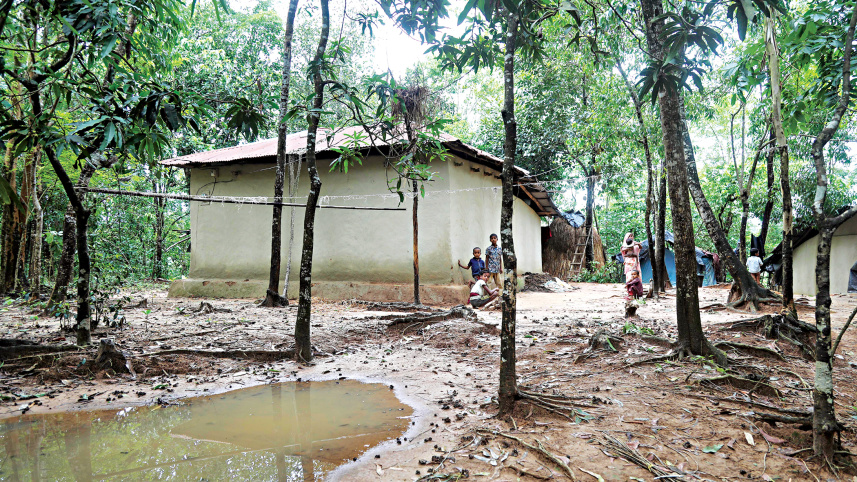
Kalam is not alone. Hundreds of others are engaged in similar agricultural activities inside the sanctuary and adjacent forest areas. Many have built houses and settled there permanently, defying the laws meant to protect the forest’s wildlife and rich biodiversity.

Forest Department data show that 41,889 people have built 6,991 houses and are now living within the boundaries of Chunati forest.
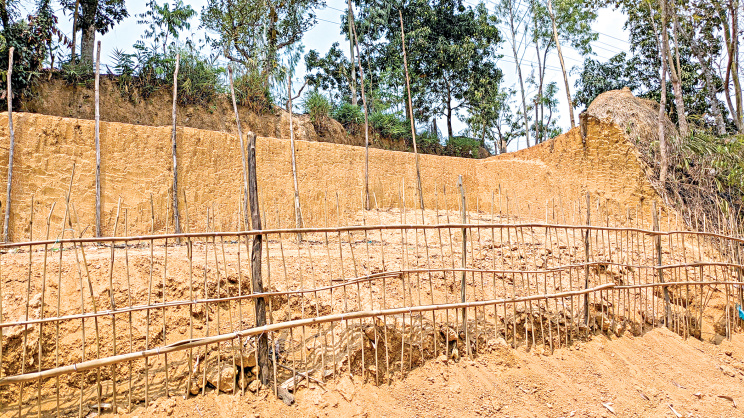
At least 1,870 acres of the sanctuary’s core forest area have already been converted into settlements and agricultural land by encroachers.
There are also 18,899 betel leaf gardens, 1,550 acres under paddy cultivation and 23 fish farms within the sanctuary.
“These changes did not happen overnight. Encroachers gradually expanded over the years, starting from small clearings that eventually turned into permanent settlements and farming areas,” said Abu Naser Mohammad Yasin Newaz, divisional forest officer of the Chattogram Wildlife Division.
The original Chunati forest area is 37,182 acres. To protect the core forest, the government declared around 19,200 acres between Chattogram and Cox’s Bazar as Chunati Wildlife Sanctuary in 1986.
The area is recognised as a biodiversity hotspot, containing some of the last remaining dense forest patches in the region. These patches are essential for maintaining ecological balance and providing food, shelter and breeding space for a wide range of species.
“Encroachment has already taken over around 10 percent of this forest. This is alarming for both environmental sustainability and wildlife conservation. The ongoing encroachment is not only disrupting wildlife movement but also destroying their habitat and food sources,” said Abu Naser.
After witnessing widespread degradation, the Forest Department has classified Chunati as one of Bangladesh’s worst-affected forest zones.
EXTENSIVE ENCROACHMENT
Encroachment in Chunati Wildlife Sanctuary is accelerating, with Forest Department data showing a sharp increase in illegally occupied forest land in recent years. The sanctuary is divided into Chunati Forest Range and Jalde Forest Range.
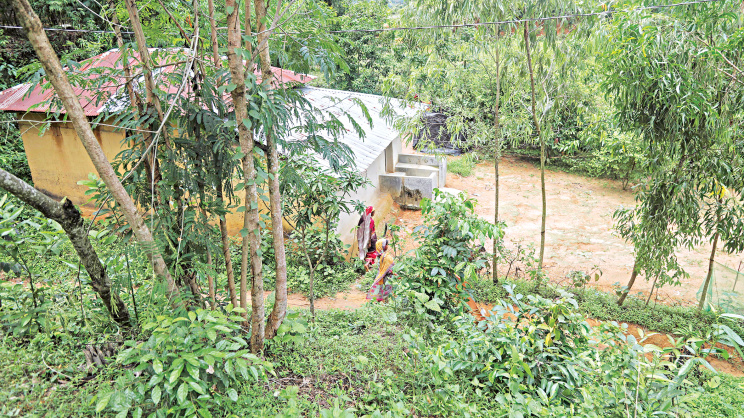
During a recent visit to several points in the Chambal forest beat under the Jalde range, mud houses, semi-brick structures and tin-shed dwellings were seen on forest land. Lemon gardens, betel leaf vines and vegetable plots were also found there. Residents have already set up electricity connections inside the Chunati range.
In the Jalde range alone, the encroached forest area jumped from 645 acres in 2023 to 1,018 acres by July 2025. These areas now have 845 betel leaf gardens and 2,744 houses. Around 70 acres of forest land have also been converted into lemon gardens and 80 acres into agricultural land through illegal occupation.
Besides, around 28 kilometres of power lines have been installed within the area, with hundreds of poles set up to support the network.
Mohammed Sekander, also known as Sona Meah from the Gani Pukur area of Jungle Chambal, said, “I’m from a coastal area of Banshkhali. After the sea swallowed my ancestral land, I moved here in 2021 and built a mud house.”
Another resident, Abdul Baten, said he has been cultivating land there for six years to support his six-member family. “I have no land of my own for cultivation. That is why I came here for livelihood.”
After talking to encroachers, forest officials and local residents, The Daily Star learned that most of the occupiers are landless people who moved there to build houses and survive.
Forest official Anisuzzaman Sheikh said many people displaced by coastal erosion have migrated to the area. They are sometimes assisted by relatives or local land grabbers. In this way, settlements are gradually expanding inside Chunati.
Forest officials said they have been taking action against the occupiers.
 For all latest news, follow The Daily Star's Google News channel.
 “We regularly file cases against encroachers. But a group of grabbers do not care about these cases and continue encroaching on forest land for personal gain,” said Anisuzzaman Sheikh, ranger of the Chunati forest office under the sanctuary.
According to government data, seven cases were filed in 2022-23, nine in 2023-24, 25 in 2024-25 and 26 in 2025-26 over illegal occupation in the Chunati range.
Forest officials said perpetrators remain undeterred despite being sued for land grabbing. They blamed slow trials, low priority given to such cases by courts, and weak case statements that allow suspects to secure bail after serving minimal jail terms, sometimes even without punishment.
According to Abu Naser, there has been no eviction of human settlements from the wildlife sanctuary since 1986.
Human-elephant conflict has become common in the area, as elephants often enter cultivated paddy fields inside the forest, triggering frequent confrontations between people and wildlife.
According to Wildlife Division data, 3 people were killed and 12 injured in elephant attacks in Banshkhali in 2025.
Over the past decade, between 2015 and 2025, 17 elephants died unnaturally in the same area.
Chunati was once a dense forest that provided an ideal habitat for wildlife. The denser the forest, the richer the food supply for wild animals.
Now, only about 15 to 17 patches of dense forest remain. These shrinking patches once ensured food for wildlife, but that is no longer the case. As a result, wild animals are increasingly moving out of the forest into nearby human settlements in search of food, intensifying human-wildlife conflict.
“Destruction of food sources, habitat loss and fragmentation have disrupted traditional elephant movement corridors, forcing them into closer contact with humans and fuelling conflict,” said Prof MA Aziz, elephant expert at Jahangirnagar University.
A herd of around 35 to 40 resident elephants is now found in the sanctuary and its adjacent areas, forest officials confirmed.
“The elephant herds in Chunati are at risk due to the habitat crisis and corridor destruction,” said Anisuzzaman Sheikh, forest ranger of the Chunati Wildlife Range.
DEV PROJECTS MAKE MATTERS WORSE
The Chattogram-Cox’s Bazar railway line, which began operation in December 2023, has also raised concerns after an elephant was killed by a train in October 2024.
To facilitate the railway project, 207 acres of Chunati forest land were de-reserved in 2018, while around 240,000 trees were felled and several hills were levelled, according to Wildlife Division data.
Meanwhile, a proposed expansion of the Chattogram-Cox’s Bazar highway into a six-lane road along a 63-kilometre stretch has raised fresh concerns over further habitat fragmentation.
The Forest Department has identified around 20 elephant crossing points in and around the sanctuary, warning that animals face increasing risk of being struck while crossing roads and rail tracks.
Chunati is one of the most important elephant breeding areas in Bangladesh. It plays a critical ecological role as part of a major wildlife corridor connecting forest landscapes in the southeastern part of the country.
Through this corridor, elephants and other wildlife move across fragmented habitats in search of food, shelter and breeding grounds across Chattogram, Bandarban and Cox’s Bazar.
According to government data, Chunati is home to 40 species of mammals, 25 species of birds, 54 species of reptiles and 26 species of amphibians.
It also hosts rich biodiversity, including 240 tree species, 102 shrub species, 211 herb species and 106 vine species.
“There is no alternative to protecting Chunati Wildlife Sanctuary from deforestation, encroachment and increasing human pressure,” said Md Kamal Hossain, a professor of forestry and environmental sciences at Chittagong University.
Chunati also holds international importance as the only Monitoring the Illegal Killing of Elephants site in Bangladesh. The globally supported initiative tracks elephant deaths and helps combat illegal killing and poaching.
As a result, Chunati is not just a local forest area, but a nationally and internationally significant landscape for elephant conservation and biodiversity protection.
Abu Naser said a limited-scale project has been undertaken under the Climate Trust Fund to conserve the forest. It includes afforestation activities and eviction drives against encroachment.
However, he said these efforts alone are not enough to save the forest. A coordinated and comprehensive government initiative is essential to ensure the long-term protection and survival of Chunati, he added.
AT A GLANCE
41,889 people now live inside Chunati, with 6,991 houses built on forest land
About 1,870 acres of core forest already been converted into settlements, farms
Wildlife pressure is increasing as only 15–17 dense forest patches remain, disrupting elephant movement, food sources
Comments