


Nato 'fundamental bedrock' for US
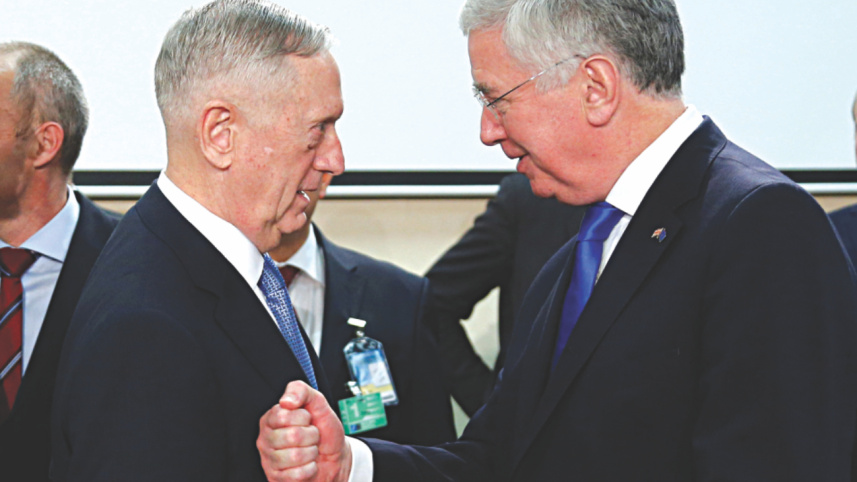
US Defence Secretary James Mattis hailed Nato as the "fundamental bedrock" of transatlantic security yesterday as he sought to reassure allies about President Donald Trump's commitment to the alliance.
Mattis, who has been on the job less than a month, spoke as a scandal over White House officials' ties to Russia gripped the Trump presidency and claimed the job of the national security adviser.

"The alliance remains a fundamental bedrock for the United States and for all the transatlantic community, bonded as we are together," Mattis said as he met his counterparts in Brussels for the first time.
"As President Trump has stated, he has strong support for Nato," said Mattis, a former Marine general who has himself previously served with Nato.
Mattis however stressed that the Trump administration, like the Obama administration before it, expected Nato allies to boost their defence spending.
"It's a fair demand that all who benefit from the best defence in the world carry their proportionate share of the necessary cost to defend freedom," he added.
The 28-member organization is trying to portray unity after Trump's previous comments that the alliance was "obsolete."
Since his inauguration, Trump has taken a more orthodox stance on Nato and reaffirmed long-standing US commitment to the alliance.
Mattis has consistently voiced support for Nato and has been tougher on Russia than his boss, whose views worry the alliance's eastern European member states in particular.
Nato chief Stoltenberg insisted the Flynn scandal was not a further cause for concern for the alliance, which has underpinned transatlantic security since the aftermath of World War II.
"I am absolutely certain that the message from this meeting will be a message of transatlantic unity," Stoltenberg said when asked about Flynn's resignation.
Stoltenberg said the ministers will also stress "the importance that we stand together and protect each other and a very strong commitment of the United States to Nato."
Mattis meanwhile praised the alliance for its enduring help for the United States in Afghanistan. "This has been the most successful alliance in military history," he said.
Also hanging over the meeting was a New York Times report that Moscow had deployed a new cruise missile, raising fears it would violate the Intermediate Range Nuclear Forces Treaty (INF).
Like the US State Department, the NATO chief said he would not comment on intelligence matters but warned that "any non-compliance of Russia with the INF treaty would be of serious concern for the alliance."
Washington has long insisted that NATO members should spend two percent of their GDP on defence, a goal that few meet despite agreeing on it at a summit in Wales in 2014.
 For all latest news, follow The Daily Star's Google News channel.
Comments