


Ceasefire takes hold after Trump rebukes
- Iran claims 'victory' as Netanyahu says 'all objectives' achieved
- Trump says he does not want 'regime change' in Iran
- Calls for Gaza ceasefire grow
- Iran likely to exit NPT
A fragile ceasefire in the Iran-Israel war appeared to be holding yesterday, after 12 days of strikes that saw Israel and the United States pummel the Islamic republic's nuclear facilities.
After US President Donald Trump, who had first declared the ceasefire, angrily berated both sides for violating it, Iran announced it would respect the truce if Israel did, while Israel said it had refrained from further strikes.

Israel, in announcing it had agreed to Trump's plan, said it had achieved all its military objectives.
Later, Iranian President Masoud Pezeshkian announced the "end of the 12-day war" imposed by Israel, in a message to the nation carried by the official IRNA news agency.
He also said Iran was ready to return to negotiations with the United States to settle the issues. However, he said his country would continue to "assert its legitimate rights" to the peaceful use of atomic power.
Meanwhile, Israel's chief of staff Lieutenant General Eyal Zamir said the country's focus will now shift back to its fight against Hamas in Gaza.
"Now the focus shifts back to Gaza -- to bring the hostages home and to dismantle the Hamas regime," chief of staff Lieutenant General Eyal Zamir said in a statement shared by the army.
The statement came as there were reports of violations of the ceasefire, hours after it went into effect.
Explosions rang out in Tehran from Israeli airstrikes hours after Trump said Israel had called off strikes at his command.
Prime Minister Benjamin Netanyahu's office acknowledged that Israel had struck a radar site near Tehran in what it said was retaliation for Iranian missiles fired three-and-a-half hours after the ceasefire started.
Tehran denied it had launched any missiles after the ceasefire.
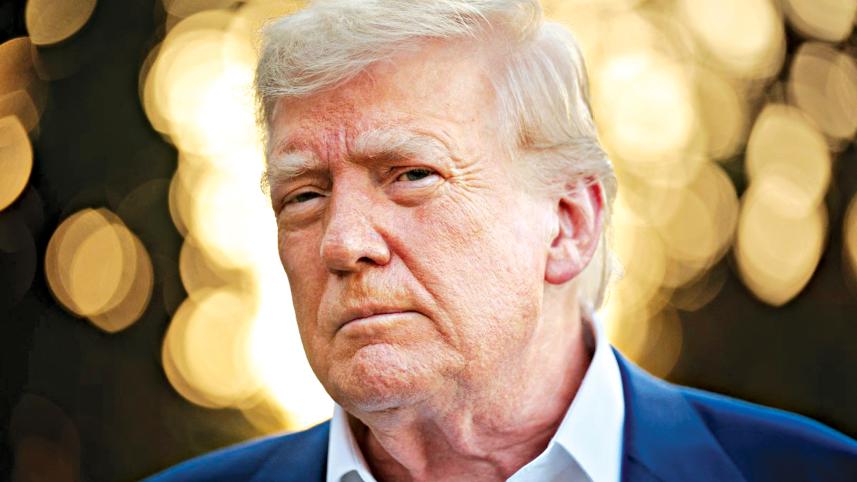
"Israel, as soon as we made the deal, they came out and they dropped a load of bombs, the likes of which I've never seen before... I'm not happy with Israel."
According to Israel, two Iranian ballistic missiles were launched toward Israel. At the White House, Trump later described it as "one rocket that didn't land -- that was shot -- perhaps by mistake, that didn't land."
Israel later said it decided to refrain from further attacks following a call between Netanyahu and Trump, but did not explicitly say whether the strike on the radar site took place before or after they spoke.
Oil prices fell and share markets were lifted around the world at the prospect of an end to the biggest ever confrontation between the Middle East foes, lifting a threat of disruption to Gulf oil supplies.
Trump, en route to a Nato summit in the Netherlands, had rebuked Israel with an obscenity in an extraordinary outburst at an ally whose military campaign he had joined two days earlier.
"All planes will turn around and head home, while doing a friendly 'Plane Wave' to Iran. Nobody will be hurt, the Ceasefire is in effect!" Trump said in a post on Truth Social.
That followed a post in which he had said: "Israel. Do not drop those bombs. If you do it, it is a major violation. Bring your pilots home, now!"
Before departing the White House, Trump told reporters he was unhappy with both sides for violating the ceasefire, but particularly unhappy with Israel, which he said had "unloaded" shortly after agreeing to the deal.
 For all latest news, follow The Daily Star's Google News channel.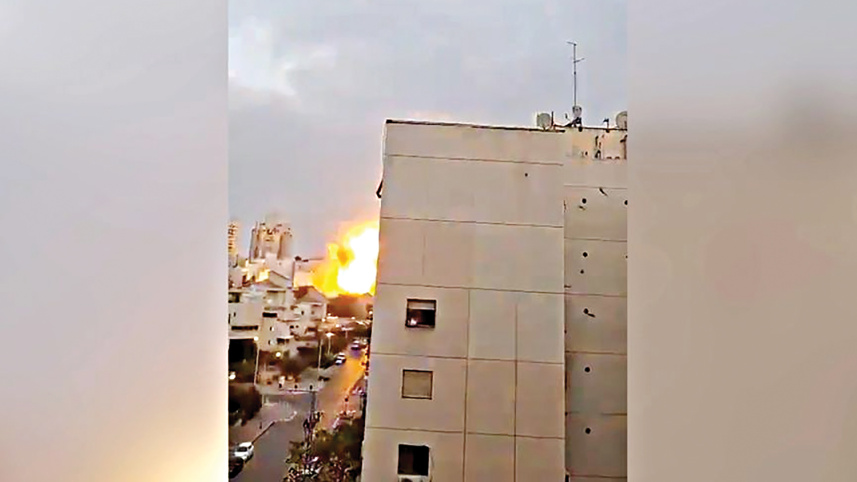
"I've got to get Israel to calm down now," Trump said. Iran and Israel had been fighting "so long and so hard that they don't know what the f*** they're doing."
A reporter for Axios said Netanyahu had told Trump that Israel would scale back the bombing mission rather than cancel it.
Media reports said that Qatar played a role in brokering the truce, despite being targeted by a "coordinated missile attack" by Iran on a US base in its territory.
Both Israel and Iran appeared to claim victory following the ceasefire announcement.
The Israeli government said Netanyahu had convened his cabinet "to announce that Israel had achieved all the objectives of Operation Rising Lion and much more".
It added that it had removed "an immediate dual existential threat: nuclear and ballistic", while vowing to respond forcefully to any violations of the ceasefire.
Iran's top security body, meanwhile, said the Islamic republic's forces had "compelled" Israel to "unilaterally" stand down.
Its Revolutionary Guards also hailed a missile salvo fired at Israel "in the final moments before the ceasefire", saying it taught "a historic and unforgettable lesson to the Zionist enemy".
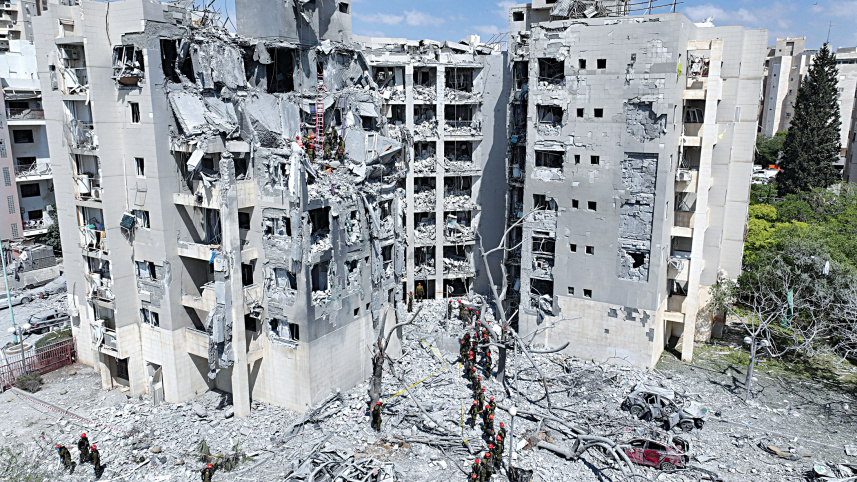
Israeli rescuers reported four people killed when a missile struck a residential building in the southern city of Beersheba early yesterday.
In Iran, state television said an overnight Israeli strike in the north killed nuclear scientist Mohammad Reza Seddighi Saber, who was under US sanctions.
Israel first launched its campaign against Iran on June 13, hitting nuclear and military sites as well as residential areas, and prompting waves of Iranian missile attacks on Israel.
While Iran and Israel have been locked in a shadow war for decades, this has been by far the most destructive confrontation between the arch-foes.
The war also saw US strikes on Iranian nuclear facilities using massive bunker-busting bombs, followed by an Iranian missile attack targeting a US military base in Qatar.
Calling for de-escalation, Trump said Tehran had given advance notice of the barrage, and announced the contours of the ceasefire just hours later.
Iran's National Security Council confirmed having targeted the base "in response to the US aggressive and insolent action against Iran's nuclear sites and facilities".
It added that the number of missiles launched "was the same as the number of bombs that the US had used" against Iran.
Ali Vaez, Iran project director for the International Crisis Group, told AFP: "This was calibrated and telegraphed in a way that would not result in any American casualties, so that there is an off ramp for both sides."
Israeli strikes on Iran have killed at least 610 civilians and wounded more than 4,700, according to the health ministry.
Iran's attacks on Israel have killed 28 people, according to official figures and rescuers.
The international community reacted with cautious optimism to news of the truce.
Saudi Arabia and the European Union welcomed Trump's announcement, while Kremlin spokesman Dmitry Peskov said Russia hoped "that this will be a sustainable ceasefire".
China's foreign ministry said it supported Iran in "achieving a genuine ceasefire so that people can return to normal life".
Rafael Grossi, the head of the UN's nuclear watchdog, said he hoped to meet Iranian Foreign Minister Abbas Araghchi soon, hoping to resume cooperation between the IAEA and Iran.
Meanwhile, Foad Izadi, a professor at the University of Tehran, told Al Jazeera that Iran has been cooperating with the International Atomic Energy Agency (IAEA) because it is a member of the nuclear Non-Proliferation Treaty, but this collaboration has not benefited Tehran.
So, Iran is likely to use Article 10 of the treaty, which allows countries to leave it, "in the coming days and weeks", he said. "You don't have to be a member of that treaty, there are many countries that are not members. Israel, for example, is not a member," Izadi noted.
Meanwhile, French President Emmanuel Macron warned there was an "increased" risk that Iran would attempt to enrich uranium secretly following the US and Israeli strikes on nuclear sites.
Some turned their sights to the ongoing fighting between Israel and Hamas in the Gaza Strip, arguing it was time to bring an end to that war too.
Israel's opposition leader and the families of Israeli hostages held in Gaza yesterday called for an end to the war in the Palestinian territory after a ceasefire was announced with Iran.
"And now Gaza. It's time to finish it there too. Bring back the hostages, end the war," opposition leader Yair Lapid of the centre-right Yesh Atid party wrote on X.
The Hostages and Missing Families Forum, the main group representing the families of those abducted by Hamas, also called on Netanyahu to seek a Gaza ceasefire.
The soaring death toll in the Palestinian territory has prompted months of international criticism of Israel's conduct of the war, even from staunch allies.
German Chancellor Friedrich Merz yesterday said that "the moment has come to conclude a ceasefire for Gaza", adding that his country supported Israel but reserved the right to "critically question what Israel wants to achieve in the Gaza Strip".
Comments