


Trump floats regime change in Iran
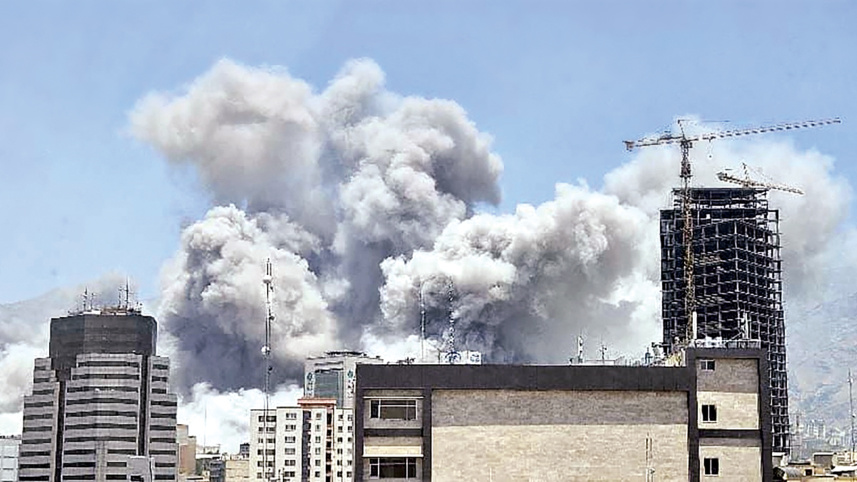
Iran and Israel yesterday kept up attacking each other for the eleventh day as US President Donald Trump raised the question of regime change in Iran following US strikes against nuclear sites a day earlier.
Israel yesterday hit Revolutionary Guard sites and the notorious Evin prison in Tehran, calling them its most powerful strikes yet on the Iranian capital. Iran, in turn, fired missile barrages at Israel and vowed retaliation against the United States for the strikes.

Loud explosions rocked the Iranian capital, where Israeli Defence Minister Israel Katz said the military hit "regime targets" with "unprecedented force", adding to speculation that Israel may seek to topple Iran's clerical leadership.
The targets included Evin prison, which Katz said "holds political prisoners and regime opponents", as well as command centres of the domestic Basij militia and the powerful Islamic Revolutionary Guard Corps.
The Israeli military said in a statement that the targets belong to Iranian forces "responsible... for defending the homeland security, suppressing threats, and maintaining the regime's stability".
Iranian media and the Israeli military said Israel also struck Fordow, a key nuclear enrichment facility buried deep in the mountains south of Tehran.
The military said it had struck Fordow "in order to obstruct access routes" to the site, which the United States had hit the previous day with "bunker buster" bombs.
The Israeli attacks followed after Israeli Prime Minister Benjamin Netanyahu said it was "very, very close" to achieving its goals in Iran.
On Sunday, the US hit three Iranian nuclear facilities – Fordow, Natanz and Isfahan – with aircraft and missiles in a military operation dubbed "Midnight Hammer".
Trump boasted the US strikes had "obliterated" Iran's nuclear capabilities, but other officials said it was too soon to assess the impact on Iran's nuclear programme, which Israel and some Western states consider an existential threat.
A day after the US top leaders tried to distance the strikes from an effort to regime change in Iran, Trump raised the question in a social media post.
"It's not politically correct to use the term, "Regime Change," but if the current Iranian Regime is unable to MAKE IRAN GREAT AGAIN, why wouldn't there be a Regime change??? MIGA!!!" Trump wrote on his social media platform.
US Vice President JD Vance and Defence Secretary Pete Hegseth, after the strikes, stressed they were not working to overthrow Iran's government, but warned against attacking any US interests and accepting "peace' that Trump offered.
Yesterday, sirens sounded across Israel, and AFP journalists reported blasts were heard over Jerusalem.
Katz said the Israeli military was "carrying out strikes of unprecedented force against regime targets and agencies of government oppression in the heart of Tehran".
Iranian media said Israel's strikes hit a power supply system in Tehran, triggering temporary outages.
In Israel, the national electricity company reported "damage near a strategic infrastructure facility" in the south that disrupted power supply, without naming the location or specifying the cause.
Some details of the damage in Israel are barred from publication due to military censorship rules.
An AFP photographer in Tel Aviv saw people rush to a bomb shelter after sirens sounded.
 For all latest news, follow The Daily Star's Google News channel.
 Israeli strikes on Iran have killed more than 400 people, Iran's health ministry said. Iran's attacks on Israel have killed 24 people, according to official figures.
After the US strikes, global markets reacted nervously, with oil prices jumping more than four percent early yesterday but dipping later in the day.
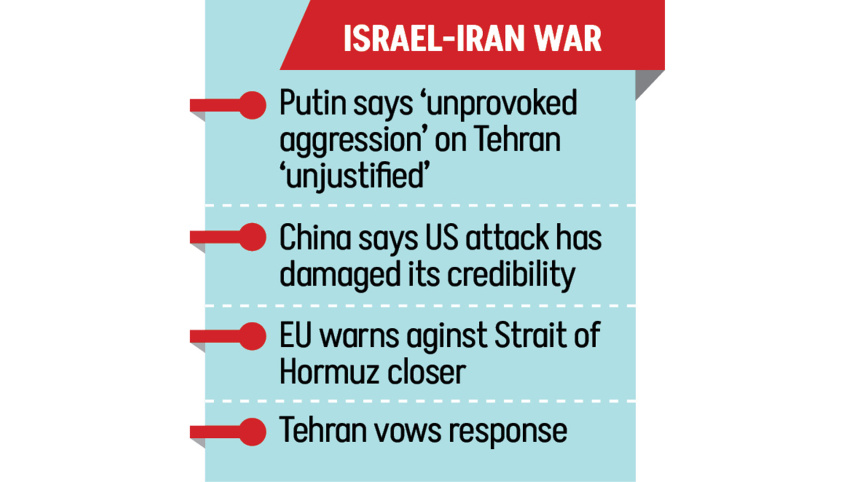
Meanwhile, Russian President Vladimir Putin yesterday said that "unjustified" US attacks on Iran's nuclear sites were pushing the world towards great danger and promised to try to help the people of the Islamic Republic, though he gave no specifics.
Putin received Iranian Foreign Minister Abbas Araqchi in the Kremlin yesterday alongside his Foreign Minister Sergei Lavrov, Kremlin foreign policy aide Yuri Ushakov and Igor Kostyukov, the head of Russia's GRU military intelligence agency.
"The absolutely unprovoked aggression against Iran has no basis and no justification," Putin told Araqchi, adding that he wanted to speak about ways to calm the crisis. "For our part, we are making efforts to assist the Iranian people."
Araqchi was due to deliver a letter from Khamenei to Putin, seeking more help from Russia, a senior source told Reuters. There was no confirmation of that from Moscow, though Araqchi passed on best wishes from Iran's supreme leader and president.
Iran has not been impressed with Russia's support so far, Iranian sources told Reuters, and the country wants Putin to do more to back it against Israel and the United States.
Putin, whose army is fighting a major war of attrition in Ukraine, has shown little appetite for a confrontation with the US over Iran, just as Trump seeks to repair ties with Moscow.
Meanwhile, China urged both Iran and Israel to prevent the conflict from spilling over, warning of potential economic fallout.
China's UN Ambassador Fu Cong said parties should restrain the "impulse of force, avoid exacerbating conflicts and adding fuel to the fire," according to the state broadcaster CCTV.
Fu said parties, especially Israel, "should immediately cease fire to prevent the situation from escalating and avoid the spillover of war."
Iran was hurt "but the United States' credibility was also damaged - both as a country and as a participant in any international negotiations," Fu added.
Iranian armed forces spokesman Ebrahim Zolfaghari said on state television that the US "hostile act", following more than a week of Israeli bombardments, would "pave the way for the extension of war in the region".
"The fighters of Islam will inflict serious, unpredictable consequences on you," he warned.
Oman, a key mediator in the stalled Iran-US nuclear talks, condemned the US strikes and called for calm.
US Secretary of State Marco Rubio called on China to help deter Iran from closing the Strait of Hormuz, a chokepoint for one-fifth of the world's oil supply.
The European Union's foreign policy chief Kaja Kallas said closing the strategic strait would be "extremely dangerous".
With Iran threatening US bases in the region, the State Department issued a worldwide alert cautioning Americans abroad.
Rafael Grossi, director of the International Atomic Energy Agency (IAEA), told an emergency meeting of the UN Security Council that craters were visible at the Fordo facility, but it had not been possible to assess the underground damage.
"Armed attacks on nuclear facilities should never take place," he added.
Iran has consistently denied seeking an atomic bomb, and Grossi has said there was no evidence to suggest so despite the Islamic republic's advanced uranium enrichment and other activities.
The IAEA yesterday said Tehran had informed it of "special measures to protect nuclear material" when the Israeli campaign began.
The US agency also said it was seeking access to Iranian nuclear sites to "account for" stockpiles of highly enriched uranium.
Comments