


US warns China against ‘coercion’
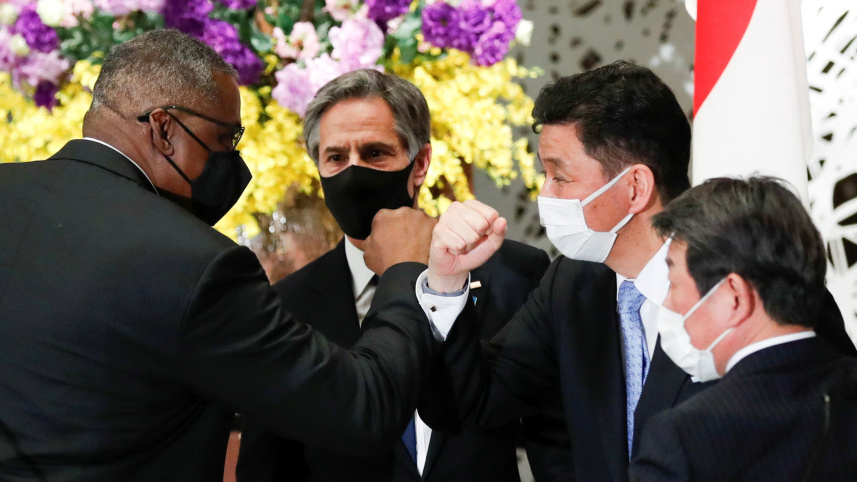
US Secretary of State Antony Blinken yesterday warned China against using "coercion and aggression" as he sought to use his first trip abroad to shore up Asian alliances in the face of growing assertiveness by Beijing.
China's extensive territorial claims in the East and South China Seas have become a priority issue in an increasingly testy Sino-US relationship and are an important security concern for Japan.

"We will push back, if necessary, when China uses coercion and aggression to get its way," Blinken said.
His visit to Tokyo with Defense Secretary Lloyd Austin is the first overseas visit by top members of President Joe Biden's cabinet. It follows last week's summit of the leaders of the Quad grouping of the United States, Japan, Australia and India.
Blinken's comments come ahead of meetings in Alaska on Thursday that will bring together for the first time senior Biden administration officials and their Chinese counterparts to discuss frayed ties between the world's top two economies.
Washington has criticised what it called Beijing's attempts to bully neighbors with competing interests. China has denounced what it called US efforts to foment unrest in the region and interfere in what it calls its internal affairs.
In the statement issued with their Japanese counterparts, Blinken and Austin said, "China's behavior, where inconsistent with the existing international order, presents political, economic, military and technological challenges to the alliance and to the international community."
The two countries committed themselves to opposing coercion and destabilizing behavior towards others in the region that undermines the rules-based international system, they added.
The meeting was held in the "2+2" format with Japanese Foreign Minister Toshimitsu Motegi and Defense Minister Nobuo Kishi as hosts.
The ministers also discussed Washington's "unwavering commitment" to defend Japan in its dispute with China over islets in the East China Sea and repeated their opposition to China's "unlawful" maritime claims in the South China Sea.
They also shared concerns over developments such as the law China passed in January allowing its coast guard to fire on foreign vessels.
In Beijing, Chinese foreign ministry spokesman Zhao Lijian told a regular news briefing that US-Japan ties "shouldn't target or undermine the interests of any third party," and should boost "peace and stability in the Asia-Pacific".
 For all latest news, follow The Daily Star's Google News channel.
Comments