


Bollywood at it again, tells Bangladesh’s story without Bangladesh

Popular culture has a habit of returning to certain historical events -- not to rediscover them, but to reassert a particular vantage point.
The Bangladesh Liberation War is one such event. More than five decades on, it keeps showing up in Indian films and series -- as a narrative real estate reshaped, reframed, and almost always centred on India.

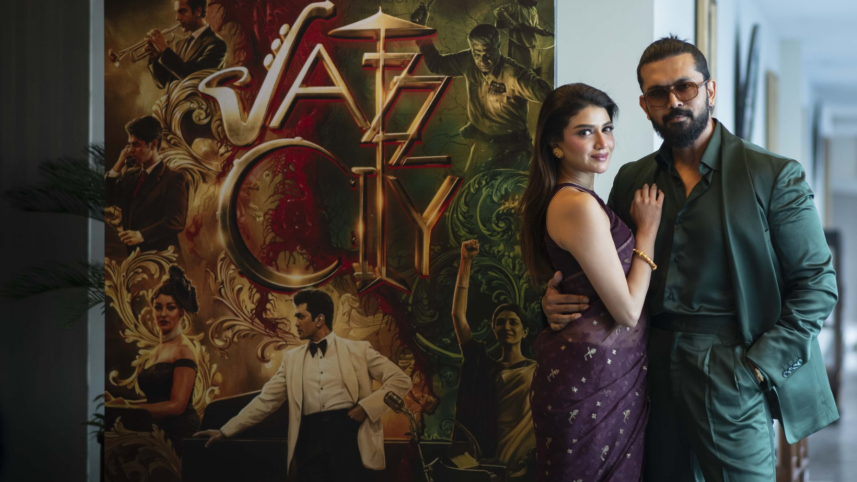
The question isn’t just what stories are told. It is rather who gets to tell them, who drives them, and whose perspective dominates. And it’s here that the new web series Jazz City, created, written and directed by Soumik Sen, released on March 19 on Sony LIV, becomes telling.
Set in 1971, Jazz City follows Jimmy Roy, a Bangladeshi refugee and nightclub owner in Kolkata, who is pulled into a covert “Indian mission” and tasked with aiding “Bangladeshi rebels” fighting for independence.
The show isn’t just uneven in tone. Its problem runs deeper. Its historical imagination feels instantly familiar. Bangladeshi characters are essentially reduced to background décor, while the story pivots on Indian urgency, intelligence, and moral heroism.
Even the protagonist Jimmy, played by Bangladesh’s very own Arifin Shuvoo in a standout performance, tries to avoid conflict until circumstances drag him deeper into a world where every choice carries consequence.
The framing is subtle but unmistakable. History happens, but its momentum seems to come from elsewhere. If this feels like déjà vu, that’s because Bollywood has been doing this for decades. India’s role dominates the screen, while Bangladesh’s struggle fades into the background.
The political context, the nine-month ground war, the leadership that made independence possible -- these are reduced to scenery, while India’s military and strategic contribution takes centre stage.
Few films laid bare the consequences of this imbalance as starkly as Gunday (2014), the Bollywood action drama directed by Ali Abbas Zafar and starring Ranveer Singh, Arjun Kapoor, and Priyanka Chopra.
The film’s release set off rapid, unusually orchestrated outrage in Bangladesh. Its opening framed Bangladesh’s birth as the outcome of an India–Pakistan war, compressing the nine-month liberation struggle into a chaotic montage before relocating the story to Kolkata.
The backlash went far beyond social media. Coordinated boycotts tanked the IMDb rating, diplomatic protests followed, and production house Yash Raj Films was forced into a public apology. It was not merely this specific film that was being contested. It was rather the right to narrate 1971.
In this sense, Jazz City reproduces that same pattern as Gunday, but with more polish. Both place Bangladesh’s liberation in stories where India is the decisive power -- the rescuer, the strategist, the moral centre.
Other films follow with subtler storytelling: Raazi (2018) turns 1971 into a tale of Indian espionage and sacrifice, mostly silent on Bangladesh’s struggle; Pippa (2023) focuses on the eastern front but centres on Indian soldiers, portraying the Mukti Bahini as dependents rather than independent actors.
Even classics like Border (1997) helped codify the cinematic grammar of 1971 as a theatre of Indian heroism, spectacular and self-contained, largely ignoring Bangladesh’s own war.
More recent films, from Mission Majnu (2023) to IB71 (2023), continue this “intelligence leapfrog,” jumping from Indian strategy straight to victory, bypassing the nine months of bloodshed in Bangladesh entirely.
What unites these films isn’t just subject matter, but it’s narrative gravity or, rather, the lack of it. Time and again, Bangladesh’s birth keeps popping up, yet rarely is allowed to stand on its own. The vast sweep of history is glimpsed in parts, but always kept on the margins.
That’s where Bollywood’s fascination with 1971 becomes clear. The war offers rare narrative certainty: a morally unambiguous conflict, a decisive victory, and a story where India’s regional role can be affirmed.
But this comes at a cost. Bangladeshi agency is reduced or erased entirely.
As Gunday showed, omissions like this can provoke outrage. Because for Bangladesh, 1971 is more than history. It is identity. To see it repeatedly reframed from the outside is to confront a hierarchy of memory that is not your own.
However, Jazz City most certainly will not stir up the same uproar. It isn’t as on-the-nose as Gunday, and, perhaps more crucially, who’s really paying attention when a bigger theatrical release like Dhurandhar 2 is hogging the headlines?
 For all latest news, follow The Daily Star's Google News channel.
 Still, placed alongside Gunday and the wider corpus of Bollywood war films, Jazz City makes one thing clear. The story of Bangladesh’s birth continues to be told in Indian cinema -- sometimes compellingly, sometimes carelessly -- but rarely from within.
Perhaps it’s time we started telling 1971 our way.
Comments