


The ekushey filter
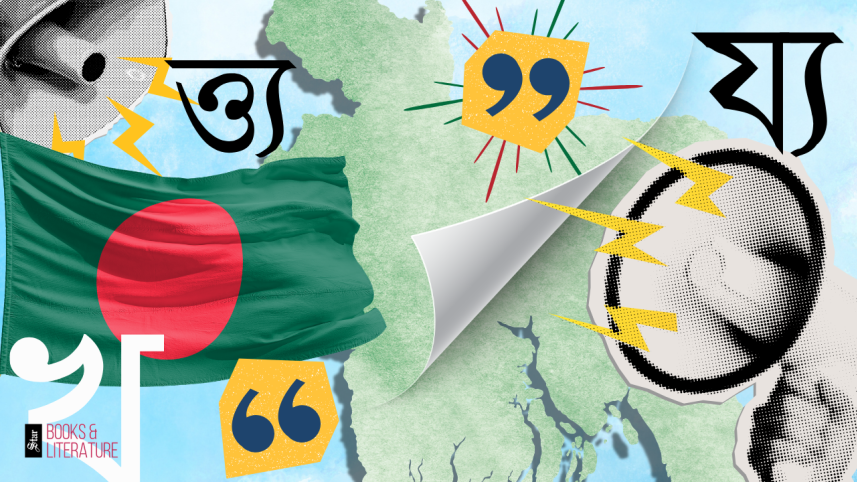
The copper-stained skies over Dhaka look more like rust than sunset. From his rooftop in Azimpur, Niloy Reza listens to the Ministry of Technology’s drones humming between half-constructed apartment buildings. They blink like engineered fireflies—mechanical eyes scanning windows, rooftops, lives.
Below, the alleyways thrum with sound and motion: street vendors shouting, tea cups clinking, rickshaws jostling forward. And above it all, a flat mechanical voice from the drones repeats on loop: “Shuddho Bhasha, Shuddho Chinta. Use the Ekushey Filter—build a united Bangladesh.”

Niloy pulls his hoodie tighter and slips downstairs, careful to avoid his nosy landlord. Inside his one-room apartment—past a chaotic mess of tangled wires and cracked monitors—his inbox blinks. One new message. No subject. No text. Just a file, sent from an anonymous handle.
He opens it.
A girl’s voice spills into the room—breathy, hesitant. A subtle Sylheti lilt touches her vowels, softening every phrase. There are no overlays; no background music; no state-approved hashtags. Her sari is wrinkled. The lighting is uneven.
And her accent… it’s real.
He hits play again.
She hasn’t filtered her dialect.
She hasn’t even tried.
She’s dangerous.
Her name, he learns later, is Fatema Begum—a 19-year-old TikToker from Narayanganj. Her regular uploads? They are polished like red and white synthetic sarees and voiceovers dipped in “Dhaka-standard” Bangla. That version of her earns thousands of followers.
But the real her? She’s kept hidden—scrubbed away by the Ekushey Filter.
The Filter erases dialects, swaps backdrops, whitens skin, lifts pitch—an algorithm that functions as both beautician and censor.
But this time, she speaks unfiltered. And she sends it to him.
Niloy uploads the video to Shobdopoth, his underground server—built from fragments of long-forgotten Bangla dialect databases and salvaged firmware from before the Filter became law. No clouds. No surveillance tags.
His broadcasts travel by shortwave radio—ancient tech no one bothers to track anymore. That’s his weapon: soundwaves.
Tomorrow is February 21st—Ekushey February—Language Martyrs’ Day.
And Niloy has something to say.
At the Ministry of Cultural Harmony, Inspector Mahbub scrolls through the day’s flagged content. The fluorescent lights buzz overhead, cold and sterile. The air smells sharply of lemon disinfectant. A junior officer steps forward, nervous.
“Sir. Another unfiltered post. Origin: Narayanganj. Trace pings back to Azimpur.”
 For all latest news, follow The Daily Star's Google News channel.
 Mahbub exhales. “Again?”
He taps the screen. Fatema’s voice fills the room.
The accent hits him like a memory.
His grandmother once sang to him in Comilla dialect. That voice is buried now—paved over by protocol, polished out by training, choked by duty.
“Prepare arrest orders,” he says, too quickly. “One for the girl. One for the source.”
That night, in Narayanganj, Fatema sits cross-legged on her bed, her eyes fixed on the glow of her phone. Her mother sleeps nearby on the floor, one arm draped over a pillow stitched with old election slogans.
The police came earlier. They questioned the neighbors.
She knows what’s coming.
But she also knows Niloy played the video.
Somewhere is out there; someone has heard her real voice.
And for the first time in years, she feels seen.
Morning arrives. Dhaka wakes to red roses and black ribbons. Posters of national heroes hang beneath digital garlands. Every phone screen pulses with AR overlays pushing filtered slogans: “Amar Bhasha, Amar Gorbo—through the Ekushey Filter.” But beneath the curated noise, another voice breaks through Fatema’s. Unfiltered. Dialect-thick. Alive.
People stop.
A shopkeeper in Uttara freezes mid-wrap over a customer’s parcel. A child in Chittagong tugs at her mother’s sleeve and asks, “Ma, what does Shobdopoth mean?”
In Rajshahi, old men at a tea-stall weep quietly, as long-erased dialects fill the air once more—spoken through dusty speakers, carried on static and memory.
Even inside the Ministry, the voice slips through—bleeding from a guard’s headphones.
Inspector Mahbub looks up at the ceiling and doesn’t move. He knows they’ve lost control—not just of the Filter, but of something deeper.
By noon, they raid Niloy’s rooftop. He doesn’t run. He stands by his transmission rig—wires snaking like veins, a nest of salvaged satellite dishes—and speaks into the microphone one last time: “Tumi jodi ekhono chao bhasha shuddho thakuk, tahole prothome, hridoy shuddho koro.” (If you still want pure language, purify your heart first.)
Then—silence. The broadcast dies.
A year goes by.
The Filter still exists. It still smoothes skin, sterilises tone, straightens vowels.
It still erases.
But cracks have formed.
In Mymensingh, an old woman teaches children to speak in Mandi.
In Noakhali, schoolteachers whisper riddles in forgotten tongues before class begins.
In Khulna, fishmongers dare to haggle in unfiltered phrases.
And in Bogura, in a faded tea-stall, someone plays a recording again and again.
It’s Fatema’s voice—soft, real, unchanged and alive.
The fringe no longer fades quietly. It speaks back—bit by bit—through the cracks.
Unfiltered words keep it alive. They breathe life into what mainstream Shuddho Bangla tried to kill.
And it all began, with one voice—unpolished and true.
Haroonuzzaman is a translator, novelist, poet, researcher, and essayist. Besides teaching English in Libya and Qatar for about 12 years, he has had 20 years of teaching experience in English Language and Literature at Independent University, Bangladesh (IUB).
Comments