


The spark of ‘Red Spark’
Though human beings speak in prose in everyday life, the astonishing truth is that poetry is humanity’s first artistic love. In the 16th century, the English poet and writer Philip Sidney said that poetry was the first of the arts, coming before philosophy and history. In other words, the artistic journey of human civilisation began with poetry. Yet the irony is that poetry has no fixed definition—and perhaps that is why everyone loves poetry, and in one way or another, everyone attempts to write it. Although Jibanananda Das famously said that not everyone is a poet, only some are, he could not clearly define the essential elements that transform a piece of writing into poetry. What he did say was this: In the poet’s heart, there must be imagination, and within that imagination must exist a distinctiveness of thought and experience. However, Jibanananda never fully explained the nature of imaginative genius itself.
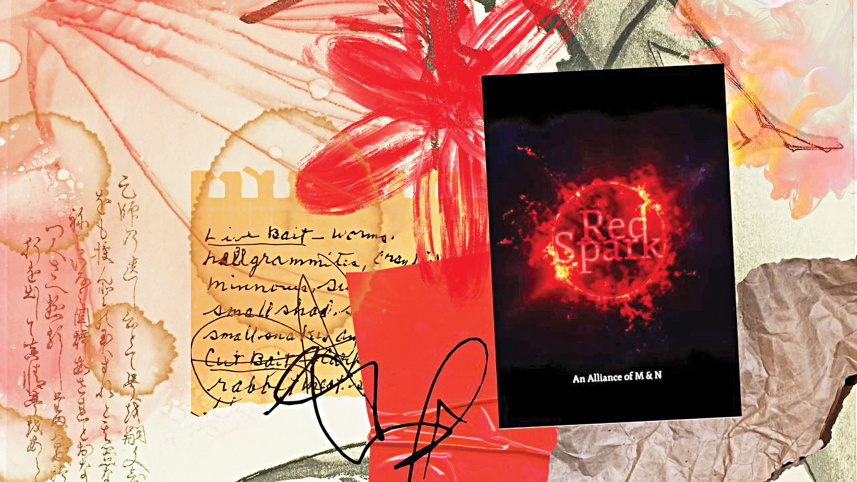
We know imagination does not arise solely from romantic love; many different sources and materials may shape it. And it is the work of this kind of romantic imagination that forms this English poetry collection, Red Spark, by the secretive alliance between M & N.

When I first held this book in my hands, the thought that arose immediately was this: beauty has no boundary, no line that says this far and no further; this is the height of aesthetics, and none may go beyond it. The book’s production is beautiful in every sense and deeply pleasing to the eye. Not only that, it is also reader-friendly, because the very elegance of its design draws one instinctively toward reading, especially due to its cover, its abstract ornamentation, and its tasteful harmony of colors.

The book is titled Red Spark. I am, by training, a student of literature, but professionally a teacher of linguistics. Therefore, I would like to reflect briefly on the linguistic significance of this title. One important area of linguistics is the semantics of colour, the inherent meanings associated with colors, a concept present since the earliest days of human civilisation. Different colors have long been used as symbols of different meanings.
So what does red mean? Linguistics tells us that red is often associated with passion, energy, and action. Red can evoke strong emotions such as love and anger—two extremes of human feelings. Red carries additional meanings as well. It is used as a warning signal for danger—and in that sense, love itself can be a sign of danger. Another word in the title is Spark. The collocation of red with spark is itself a domain of linguistics, for collocation concerns how words naturally intertwine with one another. Let us then consider the meaning of “spark”. Semantically, a spark is a very small burning fragment that flies out from a fire. Naturally, if red signifies love or passion, then fire must exist, and fire never exists without leaving something to burn.
That the poetry book is essentially about love is affirmed by the title of its Preface, “The Journey of Love”. I was particularly moved by the final sentence of that Preface: “The Journey of Love is more than a collection of poems—it is a love letter written in fragments of the soul, a map of longing traced across the heart, and a reminder that even when love can no longer be spoken, it continues to live, endlessly, within us”. In my view, perhaps that continuous state of living within us is precisely the burning fragment—the spark that flies out of love.
In this context, my thoughts inevitably turn to Pablo Neruda whenever love poetry is mentioned. Twenty Love Poems and a Song of Despair (1924) comes unbidden to mind, where he writes: “love is short but forgetting is long.” And thus, love transcends into an “eternal journey”. That’s why the writers of the present love poems of Red Spark, an Alliance of M & N, say: “Love does not vanish—it only changes form, waiting to be seen again,/ in a glance, a touch, a forgotten smile.”
The collection contains 22 poems, each exploring different phases of love. There is the infinity of love, the pledge of devotion to the beloved, the purity of love, its wonder, separation, depth, measurement, blindness, and recklessness. These are, undeniably, the timeless dimensions by which love has always been understood. But beyond all this, the collection also speaks of love’s hunger, the body’s longing, the desire for touch, and at this very point, I am reminded of Neruda’s line from his Love Poems: “Body of woman, white hills, white thighs,/ you look like the world in your posture of surrender.” Similarly, the alliance of M & N speaks of bodily desire: “I crave your face, your voice, your hair./ Silent and starving, I wander the streets./ Bread cannot feed me…” Or the poem “Red Spark” itself, from which the collection takes its name: “Your beauty, your charm,/ Your captivating smile, and touch of your deep eyes—/ They awakened a feeling in my heart,/ Like a sudden flash of red lighting across the sky.”
“Longing Across the Miles” echoes the same emotion: “Not seen you for so, so long./ yet in my heart, you still belong./ I dream of you all the time,/ your voice, your smile, your gentle rhyme.” The final poem of the collection speaks of physical experience: When I touch you, my whole body trembles./ As love speaks silently,/ Your breath stops at the touch of my fingers./ My heart sways to the melody of your heart.
Notably, Red Spark reveals a blending and coexistence of the physical and the metaphysical. Just as M & N echo John Donne in proclaiming the sovereignty of love: “Busy old fool, unruly Sun,/…Shine here to us, and thou art everywhere;/ This bed thy center is, there walls thy sphere”; they also speak, like Neruda, with elemental force: “My savage peasant body digs through you/ and makes the son leap from the depth of the earth.”
Yet the poem that touched me most deeply is “I Love to Love You: I Live to Love You”:
“I love to love you—/ like the dawn loves the first golden light,/ like the stars love the velvet night./ Every heartbeat sings a single tune,/ a melody that begins and ends with you. . . . I love to love you—/ for loving you is my sweetest art./ I live to love you—/ for you are the very beat of my heart.”
Thus, one may conclude, echoing the Preface of the collection: “Love is eternal—a quiet miracle that drifts through time, changing its form but never losing its power.”
Abdus Selim is an eminent academic and translator. He can be reached at selim70plus@gmail.com.
 For all latest news, follow The Daily Star's Google News channel.
Comments