


Social safety net budget: Pro-poor schemes to get less than 40%
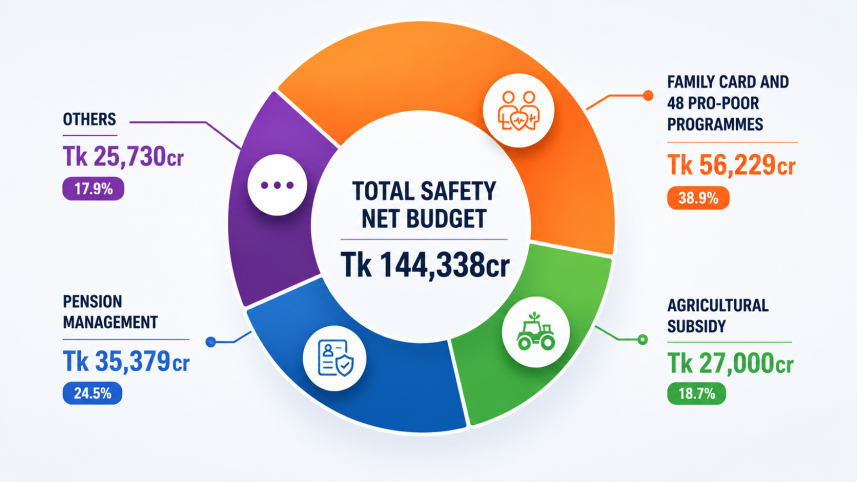
As much as 43.2 percent of the allocation under the social safety net overhead for the next fiscal year will go towards government employees’ pensions and agricultural subsidies.
Some Tk 27,000 crore has been allocated for agricultural subsidies -- which is the same as in the current fiscal year -- and Tk 35,379 crore for pension management in the safety net budget.

Each year, a specific amount is allocated in the budget to provide social protection for the ultra-poor, poor and low-income groups.
However, to make the budget appear larger, certain allocations are also shown under the safety net budget that are not actually spent on the poor.
Previously, interest on savings certificates and various paper-based block allocations were included in the safety net budget, raising the number of programmes to 145.
This fiscal year, this number was reduced to 95, with interest on savings certificates separated from the safety net budget.
For the upcoming fiscal year, the number has been brought down to 90 and will be reduced even more in the coming years.
Only pensions for low-income employees are shown in the safety net budget, said finance ministry officials.
In the upcoming fiscal year, Tk 56,229 crore has been allocated for pro-poor programmes, which is less than the allocations for agricultural subsidies and pension benefits.
“The main objective of the safety net is to support the poor and vulnerable people -- from that perspective, including the benefits given to pensioners in the safety net budget is not justifiable in any way,” said Selim Raihan, executive director of South Asian Network on Economic Modelling.
Similarly, showing agricultural subsidies under the safety net budget is also inappropriate, he said.
The government is setting aside Tk 144,338 crore in the next fiscal year’s programme for social safety net schemes, up 13.89 percent year-on-year, with about 9.7 percent of the sum going towards the BNP’s flagship Family Card programme.
Fiscal 2026-27’s social safety net allocation is 2.1 percent of GDP and around 15.39 percent of the proposed budget. This year, 2.02 percent of GDP or 16.04 percent of the budget went towards the social safety net.
Of the 90 programmes, 48 will be categorised as pro-poor, with allocations of just over Tk 56,229 crore. This fiscal year, there are 38 such programmes with allocations of Tk 39,000 crore.
The Family Card programme will get Tk 14,500 crore and cover 41 lakh households.
Those selected for the Family Card programme cannot be beneficiaries of other social safety net programmes.
To prevent duplication of beneficiaries, the finance ministry and the social welfare ministry are implementing the Dynamic Social Registry, a database containing the names, addresses and contact information of beneficiaries.
About Tk 1,400 crore will go towards the distribution of 42.5 lakh Farmers’ Card, another flagship programme of the BNP. Each beneficiary would receive a yearly payment of Tk 2,500.
As many as 16,513 victims from the July uprising would get allowances ranging from Tk 10,000 to Tk 20,000 every month based on three categories of injury, while the families of 844 July martyrs would receive Tk 20,000 every month as honorariums.
Allocation will also be given for monthly honorariums and festival allowances to religious leaders of different faiths, one of the election pledges of the BNP to promote religious and social harmony.
 For all latest news, follow The Daily Star's Google News channel.
 The programme will have 2.6 lakh beneficiaries next fiscal year, including imams, muezzins, khadems, priests, monks and caretakers of temples, churches and monasteries.
A new programme under the Vulnerable Group Feeding (VGF) scheme will provide cash equivalent to 110,000 tonnes of rice to 15 lakh poor working people under an integrated policy.
Another programme will provide 15,000 unemployed workers with a monthly allowance of Tk 5,000 for up to three months, which will cost about Tk 25 crore.
Among the existing programmes, the number of beneficiaries of old-age and widow allowances is being increased by 100,000 each, and the allowance is being raised by Tk 50 to Tk 700 per month. Currently, 61 lakh people receive old-age allowance and 29 lakh receive widow allowance.
The disability allowance is being increased by Tk 100 to reach Tk 1,000 per month. On the other hand, the number of beneficiaries is being increased by about 250,000 to 38 lakh.
The education allowance for students with disabilities is being increased from Tk 1,000 to Tk 1,400.
In addition, the number of beneficiaries under the mother and child support programme is being increased by more than 100,000. However, the allowance remains at Tk 850.
In the upcoming budget, the allocation for financial assistance in the treatment of serious diseases like cancer, kidney and liver ailments will be increased to Tk 700 crore, and the maximum assistance may rise to Tk 1 lakh from the existing Tk 50 thousand.
For freedom fighters, the number of beneficiaries and allowances will remain the same, but only the categories of Bir Shreshtha, Bir Uttam, Bir Bikram and Bir Protik will see their allowances increase by Tk 5,000.
Currently, these allowances range from Tk 20,000 to Tk 35,000 per month. At present, 589 individuals across the four categories receive allowances.
“The next fiscal year’s social safety net programme appears more expansive than transformative. It recognises many of the right problems: fragmentation, targeting errors, urban gaps, ageing, climate vulnerability and weak linkage with employment,” Raihan said.
But the proposed solution still depends heavily on administrative reform within a system that remains spread across many ministries and programmes.
“The next fiscal year’s programme is therefore a useful step, but not yet a decisive break from the old model.”
Its success will depend less on the announcement of new cards and more on targeting integrity, benefit adequacy, fiscal protection and the political willingness to make social protection a right rather than a favour, said Raihan, also a professor at the University of Dhaka’s economics department.
“The existing social protection system in the country is neither sufficiently responsive to contemporary needs nor sustainable in the long term,” said Finance Minister Amir Khosru Mahmud Chowdhury in his budget speech.
The BNP-led government is committed to establishing a humane, equitable and social protection framework founded on dignity under which the state will play a responsible role in safeguarding the lives and livelihoods of all citizens, he said.
In this regard, programmes will be implemented following a life-cycle approach, ensuring that every stage of a citizen’s life from birth onwards is brought within the ambit of the social protection system.
“Guided by the core philosophy of our government’s social protection framework ‘Economic empowerment and self-reliance’, we are committed to ensuring the economic freedom and empowerment of every citizen,” Khosru added.
Comments