


Bangladesh getting smaller hilsa due to aggressive fishing
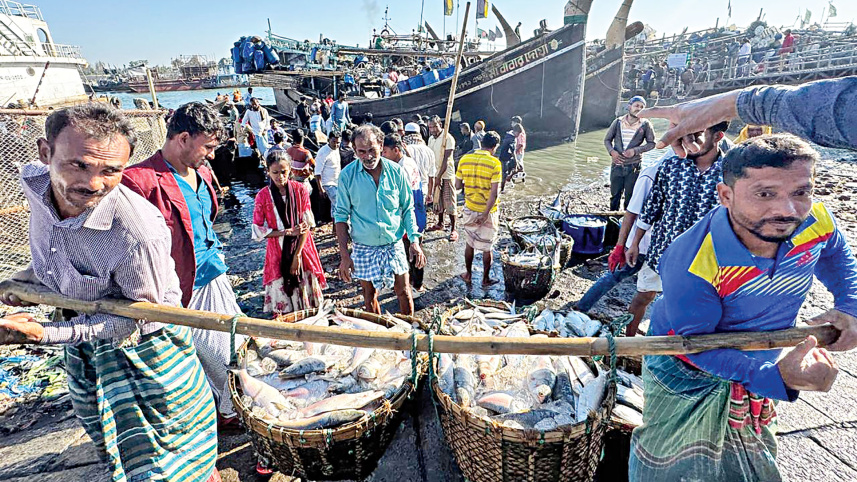
Overfishing, use of illegal nets, and capturing juvenile hilsa -- locally known as jatka -- contribute towards lowering the average size and egg production of hilsa, a fisheries expert said yesterday.
Intense fishing in the rivers significantly reduces the population size of larger fish, whittling the pool down to only contain smaller fish. In comparison, hilsa in the sea can complete their lifecycle without such interference, resulting in improved growth and reproduction. Lower pollution levels in the sea also help in the process.
 For all latest news, follow The Daily Star's Google News channel.
 Mohammad Ashraful Alam, senior scientific officer at Bangladesh Fisheries Research Institute, said that a variation in hilsa size is perceived across regions, which is primarily linked to environmental conditions and migration patterns.
He made the remarks during his presentation at a seminar marking Jatka Conservation Week 2026, April 7-13, observed under the theme: “Stop catching jatka, and rivers and seas will be full of hilsa,” held at the Bangladesh Agricultural Research Council Auditorium in Dhaka.
The average length of hilsa has shown fluctuations over the years, the presentation showed. It remained steady at 35.7 cm in the fiscal years 2019-20 and 2020-21, then increased to 37.0 cm in 2021-22 and 37.2 cm in 2022-23.
However, the trend reversed in the following years, with the average length declining to 36.6 cm in 2023-24, 34.7 cm in 2024-25, and further dropping to 34.0 cm in 2025-26.
Alam said that the overall decrease in average hilsa length in recent years is the result of multiple combined factors, including overfishing, catching jatka, human interventions, environmental changes, declining water quality, and reduced food availability in rivers.
In areas like Cox’s Bazar, where fish can complete their full lifecycle in the sea, they reach greater maturity, resulting in higher average length and weight, he said.
The largest hilsa in the country are found in the Cox’s Bazar region, with an average length of 38.5 centimetres (cm) and an average weight of 780 grams.
In contrast, the smallest hilsa are found in the Rajshahi region, with an average length of 29 cm and an average weight of 340 grams. Here, fish are confined to river systems, where growth conditions are less favourable, he added.
High intensity of fishing in the rivers, as well as the use of illegal nets, leads to frequent capture of larger fish, while smaller ones remain. Over time, this selective removal causes a decline in the population of large-sized fish in river systems, he added.
During migration from the sea to the rivers, overfishing in coastal areas further reduces the number of mature fish, as many are caught before they can reproduce, he said.
Rising levels of pollution and scarcity of food in the rivers also negatively affect hilsa growth and development.
Meanwhile, the estimated egg production of hilsa has increased over the years, starting at 599,720 kg in 2015, rising steadily to 786,314 kg in 2021, 805,515 kg in 2023, 811,711 kg in 2024, and reaching 884,802 kg in 2025.
However, projections for 2025 show a mixed trend, with one estimate reaching 884,802 kg, indicating an increase, while another estimate of 791,564 kg reflects a decline.
The recent drop in projected egg production is linked to the same underlying causes explained before, as the reduction in large, mature breeding fish directly affects reproductive output, Alam added.
Fisheries, Livestock and Agriculture Minister Mohammad Aminur Rashid said that scientists need to engage more actively in research and work systematically to maximise jatka production and accurately induce egg hatching in hilsa to increase their numbers.
The minister said that scientists must explore ways to boost hilsa production while preserving their taste and quality, ensuring the country’s demand is met.
Terming hilsa shortage as a nationwide problem, he stressed that production must be increased to make this fish accessible to the general public.
In his speech as a special guest, State Minister for Fisheries and Livestock Sultan Salahuddin Tuku said that when jatka fishing is completely stopped, hilsa production will increase significantly, which can contribute greatly to the country’s economic prosperity.


Comments