Living as a stranger in the West: Rethinking the ‘migration crisis’

In December 2021, when I was returning to Bangladesh from the Netherlands after completing my higher studies amidst the corona pandemic, I had a connecting flight from Istanbul. After waiting six hours at the airport, when I finally got on the airplane, I discovered that the whole plane was filled with Bangladeshis. I found that the passenger next to me was a Bengali, but to my utmost surprise, he did not wear a mask. Out of an imagined fear, I did not want to start a conversation with him except for a few nodding. At some point, he said his name was Ashraful Alam and told me that he was returning to Bangladesh for three months after 11 years of living in Italy.
Initially, I thought that lack of money for travel fare stopped him from visiting his family for so long, but to my surprise, Alam Bhai told me, “I came to Italy in a different way. I became documented last year. Now, I am legal in Italy.” That was the first time I became aware of a different story about the Bangladeshi in Italy. After almost a decade of struggle, hide and seek with the police, Alam Bhai managed to become ‘documented’ by the Italian authorities. But not everyone is lucky like him. Just a few days ago (30 March), twenty-two Bangladeshi migrants, hoping to reach Europe from North Africa, died in the Mediterranean after six days at sea in a rubber boat. The news immediately sparked my memory of a long conversation with Alam Bhai I had in the plane.
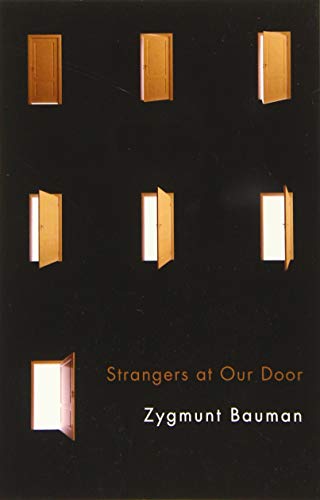
Think about those migrants who have been entering Europe, either legally or irregularly, from the Global South. For them, a harsher struggle has just begun. Zygmunt Bauman, the eminent sociologist of ‘liquid modernity’, calls them ‘strangers’. They have become a source of moral panic in European societies and politics. In this piece, I reflect on these ‘strangers’ and the so-called ‘migration crisis’ in Europe through Bauman’s slim book, Strangers at Our Door (Polity Press, 2016). Bauman wrote this book in a specific context, when refugees from Syria were forced to migrate to European countries during 2014–15. This piece is not a panoramic review of the book; rather, I would prefer to take some of the questions Bauman raises and reflect on the ‘migration crisis’ at large, combining my understanding on anti-immigration politics in the UK.
(2)
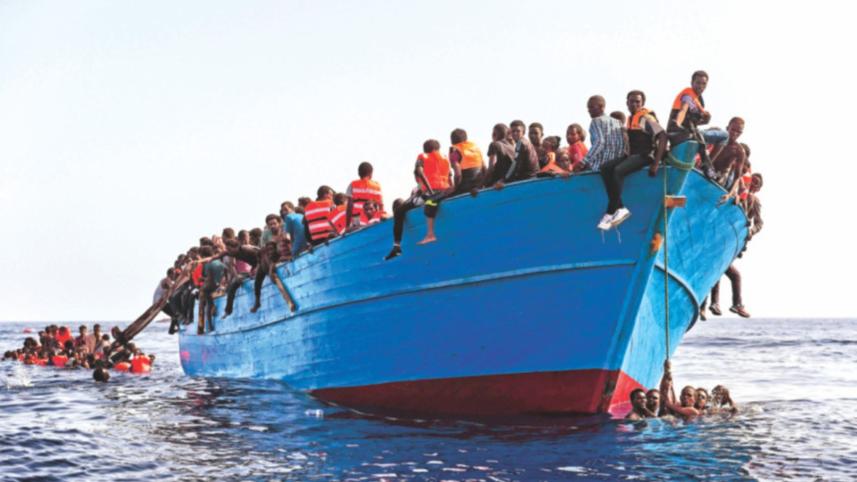
Human society is a product of migration. The first migration of our ancestors is believed to have been confined to the African continent, almost 100,000 years ago. It is the diffusion and migration of humans that creates cultures and societies. Bauman claims that for most of our history, we knew only people who knew most of us. Then colonialism, modernity, globalisation accelerated the flows of culture and humans in the last few hundred years. All societies produce their strangers. There is no doubt that voluntary and involuntary human migration has been producing strangers from time immemorial. Since the West has various economic resources and is filled with opportunities for a better life, it has become a destination as a ‘pull-factor’ for human mobility. Bauman rightly points out that the ‘migration crisis’ is also the product of pointless, foolishly myopic, miscalculated destabilisation of the ‘Middle Eastern’ region by the military venture of Western powers. The UK, the US, and France contributed to escalating the Syrian Civil War, which caused a massive refugee influx into Europe. Even we can consider the ongoing US-Israel invasion of Iran. More and more refugees and asylum seekers, alongside ‘economic migrants’, have been knocking at the Western doors.
All the strangers are different in terms of colour, race, religion and culture. It is very crucial how the host society perceives its ‘strangers’. Before asking this, Bauman brings the role of the state and politicians in this issue. He criticises the way the government makes the ‘migration problem’ into a ‘security issue’. He cites examples of how the Hungarian prime minister Viktor Orbán declared without hesitation, ‘all terrorists are migrants’. Politicians use this kind of anti-immigration sentiment to fuel their politics in their respective countries. Turning migrants into a ‘security problem’ immediately reminds me of French anthropologist Didier Fassin’s Enforcing Order: An Ethnography of Urban Policing where he shows that law enforcement agencies always have violent encounters with disadvantaged, poor, ethnic and racial neighbourhoods in France, who are mostly non-White migrants from the global south.
How do strangers attempt to integrate themselves into the host society? Bauman suggests that this is a dual process which involves both parties. Humiliation from one side leads to self-concealment and self-denial of the other side. The stigmatised strangers then feel insulted, pained, suffered, hence sometimes seeds revenge in the mind. The outcome is either the person cuts off from the society and live in their own imagination about the host society at large. This might be a useful thought on why such exclusion leads European Muslims to radicalisation. Bauman suggests that in order to eradicate radicalisation, the West should use its greatest weapons such as social investment, inclusion and integration.

Bauman argues that sharing culture and places with strangers, despite differences, would determine the future of an entangled world. Take the example of Sanjay Subrahmanyam’s ‘Connected History’ (2022) where he argues that bringing together historical phenomena that have all too often been artificially separated by historiographical convention. Both Europe and the rest of the world have been bounded together from a long time. English journalist Jeremy Paxman’s interesting book, ‘Empire: What Ruling the World Did to the British’ (2012) shows how the empire’s history is embedded in the everyday life of British society. Therefore, we already have the ‘glue’ to create social solidarity.
(3)
Anti-immigrant sentiments in the UK have been growing day by day. It is encouraged by negative framing in the media and political discourse where migrants are persistently being depicted in terms of ‘crime’ and ‘illegality’. In September 2025, a massive anti-immigrant protest took place in the streets of London, the biggest in the history of the UK. More than 110,000 people took part in the street protest organised by the activist Stephen Yaxley-Lennon, known as Tommy Robinson. People like Elon Musk, French far-right politician Éric Zemmour, were invited to speak, effectively fuelling the gatherings. Both speakers targeted people from the Global South and Muslims, who are supposedly the cause of ‘rapidly increasing erosion of Britain’. However, on that day, I had to reschedule my journey to London for a conference out of an imagined fear.
In a very recent book, Suicide of a Nation: Immigration, Islam and Identity (2026), Mat Goodwin, a right-wing politician, argues that Britain is falling because of its governance failure to tackle the issues indicated in the subtitle of the book. It can be assumed that, like Liz Truss’ Ten Years to Save the West (2024), Suicide of a Nation is going to be a bestseller. Despite heavy criticism, even from the politicians and academics, (political writer Andy Twelves has made his case that Suicide of a Nation is likely AI-assisted), these books are good fodder for the masses, normalising hostility against the migrants on several fronts.
Upon my arrival in the UK in 2023, I occasionally visited cities like London and Manchester several times. Even in a small north-east town like Durham where I am based, we received an email from the Department in the summer of 2024 to avoid the city centre for two days when an organised protest against immigration by a far-right platform would take place. To my surprise, one of my PhD colleagues, who was English, reached out to me via WhatsApp, saying, “I am glad you are informed about it. It is absolutely shameful for those of us in England who have completely opposite views. I feel embarrassed that people from other countries are experiencing such hate here. Most of us are decent, caring people!” That text melted my heart in every true sense.
This small gesture brings me back to Immanuel Kant. Bauman repeatedly mentions with great passion on Kant’s appeal to hospitality instead of hostility for a ‘perpetual peace’ which might be an attempt to reconcile between morality and politics. I believe this is the most difficult job for all, from politicians to ordinary citizens. Still, we should not stop promoting hospitality. In The Stranger as my Guest: A Critical Anthropology of Hospitality (2021), anthropologist Michel Agier advocates a better understanding of hospitality to develop more sustainable, prosocial and empathic approaches to global migration. One of the intriguing claims Agier makes is that even the most agile advocates of ‘universal hospitality’ are ‘politically cosmopolitan’ but ‘epistemologically nationalist’. It is true that many ‘progressive’ people vehemently support open borders and protection for the immigrants through various policies but still sometimes might prefer a nationally-framed politics and knowledge system, thereby exposing how commitments to hospitality often remain limited by nationalist ways of knowing.
But, still, I believe small, quotidian hospitality works in a very subtle way. This cannot be found in any policy document or political speeches. On a windy or sunny morning, as I walk, I am greeted with a gentle ‘good morning’ and a smile by elderly local English men and women. It may seem insignificant in a political climate where migrants are frequently framed as ‘problems’ and it does not dismantle the platform of exclusion at all, yet it unsettles my own sense of being a ‘stranger’, even if temporarily. We should also not forget that about 5,000 counter-protesters from trade unions and anti-fascist groups marched in a separate route when the largest anti-immigrant protest took place in London last September.
Fahmid Al Zaid is Associate Professor in the Department of Anthropology, University of Dhaka, and a PhD candidate at Durham University, UK. He can be reached at fahmidshaon@du.ac.bd
Send your articles for Slow Reads to slowreads@thedailystar.net. Check out our submission guidelines for details.

What death teaches us about life

How to help children fall in love with reading

Why Christopher Nolan's The Odyssey disappoints in its portrayal of women

10,000 steps a day: Health myth or medical fact?
Why Dhaka University should rethink its rules for female students

Inherited Memories / One railwayman's line-box, three eras of history

The strange grief of seeing our parents age
After the PhD: The loneliness nobody talks about
The Palestine lesson from Spain's World Cup victory