


Bangladesh repays more foreign loans than it receives
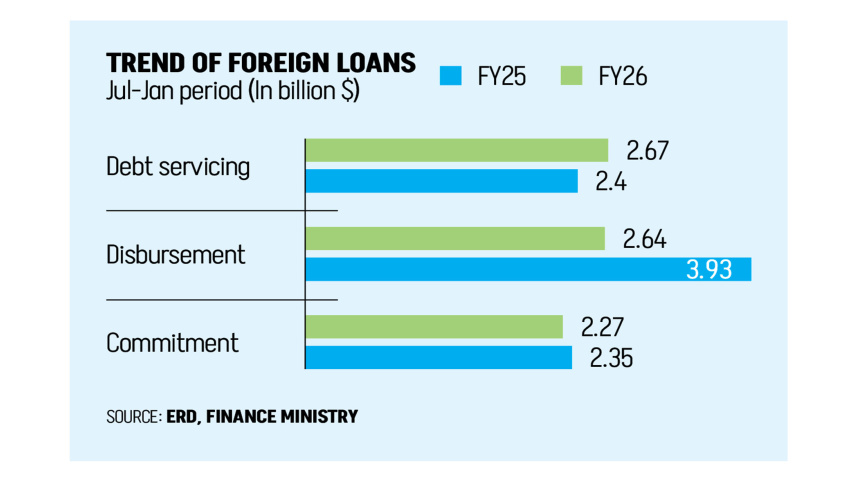
Bangladesh’s foreign debt servicing crossed the amount of loans it received from international lenders in the first seven months of the ongoing fiscal year (FY) 2025-26 amid the slow pace of foreign-funded projects executed under the Annual Development Programme (ADP).
The country repaid $2.67 billion in the first seven months of the current fiscal year, according to data released by the Economic Relations Division (ERD) of the finance ministry.

Meanwhile, foreign loan disbursement dipped 33 percent year on year to $2.4 billion during July-January of this fiscal year, which an economist said is a warning sign.
“The fact that debt servicing has exceeded fresh foreign loan inflows is a warning sign,” said Ashikur Rahman, principal economist at the Policy Research Institute (PRI) of Bangladesh.
“It indicates that Bangladesh is now transferring more resources outward than it is receiving, which tightens both fiscal and external liquidity conditions,” he said.
“This reflects not only maturing debt obligations but also weak project implementation, slower disbursements, and limited export dynamism. While it is not yet a crisis, it reduces policy space and highlights the urgency of strengthening revenue mobilisation, export competitiveness, and a prudent external borrowing strategy.”
Data by the Implementation Monitoring and Evaluation Division under the Ministry of Planning showed that in the July-January period of this fiscal year, the implementation of foreign-funded ADP was 36 percent, marginally higher than in the same period a year ago.
During this period, commitment by foreign lenders, namely the World Bank and the Asian Development Bank, as well as Russia, China, Japan, and India, declined 3 percent year on year to $2.27 billion.
The decline in both commitment and disbursement against a spike in the repayment of foreign loans comes at a time when revenue collection has continued to fall short of the target, and government borrowing from the banking system has risen.
Tax collection by the National Board of Revenue, the main generator of revenue for the state, increased 13 percent in the July-January period of this FY from a year ago. However, the NBR missed its target by 27 percent, a shortfall of Tk 60,110 crore, for the period, according to provisional data.
During the period, the government’s net borrowing from the banking sector crossed Tk 48,800 crore, nearly five times the Tk 10,558 crore it borrowed in the same period a year earlier, according to Bangladesh Bank’s provisional data.
“The borrowing for debt repayment increased significantly,” said Towfiqul Islam Khan, additional director (Research) at the Centre for Policy Dialogue (CPD), in a paper on macroeconomic benchmarks for the new government presented at a briefing of Citizen’s Platform for SDGs.
He said the government’s fiscal space -- the ability to provide resources for a desired purpose without jeopardising the sustainability of its financial position or the stability of the economy, and the ability to spend for unforeseen events -- is diminishing.
Bangladesh’s foreign debt repayment has been increasing for the last several years. It paid $7 billion to multilateral and bilateral lenders in FY25, up from $6 billion a year ago.
Rahman said structural economic reforms are no longer optional.
“Enhancing Bangladesh’s international competitiveness, diversifying exports, improving the investment climate, and mobilising domestic resources more effectively are fundamental to building a stable and resilient economic architecture,” he said.
“Without these reforms, external vulnerabilities will continue to resurface, constraining growth and macroeconomic stability.”
 For all latest news, follow The Daily Star's Google News channel.
Comments