


Bangladesh spot LNG nears $30, three times pre-war rates

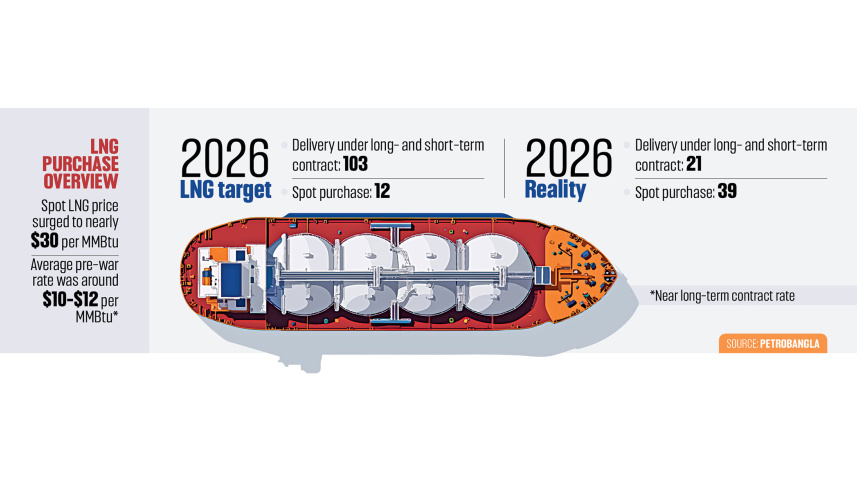
Bangladesh is now paying nearly $30 per million British thermal units (MMBtu) for liquefied natural gas from the spot market, almost three times what it typically paid before the war in the Middle East, as the government scrambles to secure supplies amid a prolonged gas crisis.
The Cabinet Committee on Government Purchase on Sunday night approved one LNG cargo from Singapore-based Vitol Asia at $29.795 per MMBtu and another from UK’s TotalEnergies Gas & Power Ltd at $28.95.

A standard LNG cargo contains about 3.36 million MMBtu. At an exchange rate of around Tk 123 to the dollar, the TotalEnergies cargo will cost about Tk 1,200 crore and the Vitol cargo about Tk 1,230 crore.
Both cargoes are scheduled for October.
The latest purchases mark another increase in Bangladesh’s LNG import costs, which had already more than doubled from $10-$12 per MMBtu before the US-Israel’s war on Iran.
A BP Singapore cargo for September 4-5 was approved at $21.778 per MMBtu, followed by September cargoes from Posco International and TotalEnergies at $24.625 and $24.25 respectively.
Emergency purchases later rose to $26.67 per MMBtu from Vitol and $27.54 from Aramco Trading before a BP Singapore cargo crossed $28 earlier this month. The latest Vitol purchase has now pushed the price close to $30.
The surge in LNG prices comes as Bangladesh tries to make up for supplies disrupted by the Middle East war and the suspension of long-term deliveries from Qatar, the largest LNG supplier to Bangladesh.
With less contracted gas available, Petrobangla has had to rely more heavily on the volatile spot market.
The inflated LNG bills are adding to the cost of keeping the country’s gas network running. The Iran war has already sharply increased the country’s LNG subsidy requirement, with Petrobangla estimating that the conflict added Tk 10,600 crore to the burden in the fiscal year 2025-26.
Yet price is only part of the problem. Bangladesh has also been struggling to secure cargoes on time.
At the same meeting on Sunday, the government approved four more LNG cargoes through the direct procurement method (DPM) at substantially lower prices. Two are from US-based Darab Inc at $17 per MMBtu and two from Mind Mingle LLC at $19. The comparatively cheaper purchases come despite serious delivery problems in the previous round of direct procurement.
In August, the government approved 22 LNG cargoes in two rounds without a tender. Fourteen were approved in the later round, with two cargoes each from seven companies, while another eight were cleared earlier under emergency direct procurement.
At least eight of the cargoes scheduled for August did not arrive on time, according to officials involved in LNG imports.
The missed deliveries aggravated the gas shortage and forced Petrobangla back to emergency spot tenders just as international LNG prices were rising sharply.
The disruption became so severe that Excelerate Energy’s floating storage unit stopped regasification on August 19 because there was no gas left in storage, even though the terminal was technically ready to resume operations. The next cargo was not expected until August 23.
Petrobangla and Rupantarita Prakritik Gas Company Ltd officials said the missing DPM cargoes were a major reason LNG supply could not be restored even after the terminals returned to operation following repairs to a technical glitch.
The government turned to direct procurement on the grounds that it could secure LNG more quickly and at lower prices during the supply emergency.
The latest approvals again involve relatively little-known US trading companies. Neither Darab Inc nor Mind Mingle LLC has a publicly documented record of supplying LNG cargoes to Bangladesh or an established international LNG supply track record that The Daily Star could independently verify.
That leaves a striking price difference between the two procurement routes. The latest DPM cargoes cost $17-$19 per MMBtu, compared with $28.95-$29.795 for the latest spot purchases.
 For all latest news, follow The Daily Star's Google News channel.
 But Bangladesh’s recent experience has shown that a lower quoted price does not necessarily mean gas will arrive when it is needed.
Meanwhile, Petrobangla expects supply to improve from today as September LNG requirements have already been secured.
According to the company’s supply plan, total gas availability is expected to rise to about 2,550 million cubic feet per day (mmcfd), close to the level seen before July 21, when disruption at an LNG terminal pushed overall supply below 2,100 mmcfd.
Supply has recovered to around 2,300 mmcfd from mid-August and is expected to rise by another 200-250 mmcfd, according to officials.
Comments