


Big duty cuts to power up API supply chain: pharma leaders

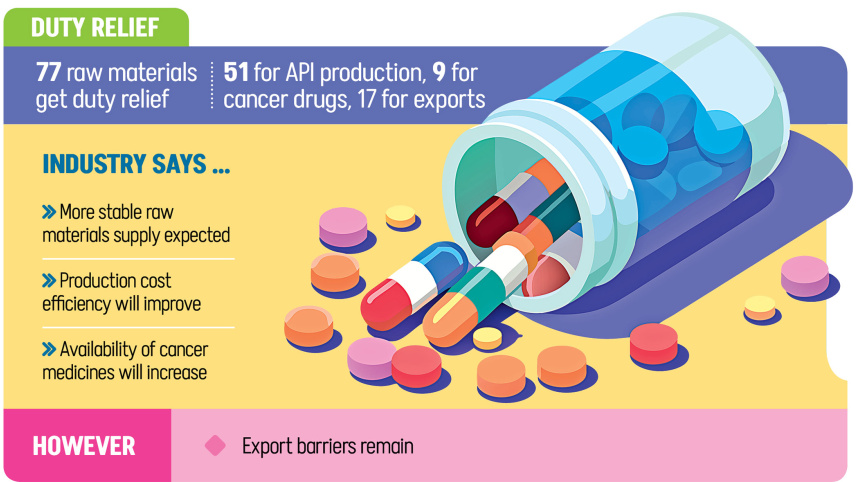
Bangladesh’s pharmaceutical manufacturers are hoping for a more stable supply of active pharmaceutical ingredients (APIs) and improved production efficiency under the proposed budget for fiscal year 2026-27, which expands duty-free access to a wide range of raw materials used in medicine production.
Industry leaders say the inclusion of 77 raw materials under new or expanded duty concessions will help reduce procurement uncertainties, support the production of new molecules and strengthen local manufacturing capacity.
 For all latest news, follow The Daily Star's Google News channel.
 Presenting the budget proposals on June 11, Finance Minister Amir Khosru Mahmud Chowdhury said the incentives are designed to support local API production, lower dependence on imported finished products and enhance the competitiveness of Bangladesh’s pharmaceutical sector.
To further support medicine production in high-cost therapeutic segments, the minister proposed adding nine new raw materials used in cancer drug manufacturing to the existing concessionary facility, with import duty and VAT on these items reduced to zero.
Another 17 pharmaceutical raw materials have also been added to the existing concessionary list under the proposals, with import duty on these items reduced to zero, specifically to sustain the country’s pharmaceutical export growth in international markets.
Industry insiders say the measure will help companies maintain uninterrupted production and improve overall cost management.
The budget further proposes reducing the existing 25 percent import duty on Biological Safety Cabinets to 1 percent, and the duty on Sandwich Panel Rooms from the existing 5 percent to 1 percent -- both critical components of modern pharmaceutical manufacturing facilities.
Zahangir Alam, chief financial officer of Square Pharmaceuticals, said the inclusion of additional APIs and raw materials under duty exemptions would help manufacturers secure a more reliable supply chain for newly introduced molecules.
“Many new molecules are not specifically covered under the existing duty structure, which creates complications for manufacturers. Updating the list and extending duty benefits is a positive move,” he said.
According to Alam, the measures will help pharmaceutical companies maintain a stable supply of inputs, reduce procurement uncertainties and improve cost efficiency across production operations.
He noted that Bangladesh’s healthcare sector has expanded significantly over the years, increasing demand for a wider range of medicines and therapeutic products. Ensuring timely access to raw materials, he said, has become increasingly important for sustaining growth.
Alam also highlighted the industry’s export potential, saying that reducing production costs through duty support could help Bangladeshi manufacturers compete more effectively in international markets.
However, he noted that regulatory requirements and market-entry costs continue to pose challenges for exporters.
“Export growth requires long-term investment. Additional policy support could help the industry expand its global footprint more rapidly,” he added.
According to him, the duty benefits are expected to improve the availability of medicines for patients suffering from chronic illnesses, particularly cancer and kidney diseases.
Abdul Muktadir, chairman and managing director of Incepta Pharmaceuticals Ltd and president of the Bangladesh Association of Pharmaceutical Industries (BAPI), said the inclusion of additional raw materials reflects the industry’s evolving manufacturing needs.
“Whenever a company starts producing a new API, it informs the authorities and the required raw materials are added to the duty-free list,” he said.
According to him, the addition of 51 API raw materials and 17 other essential inputs will support manufacturers as they continue to develop new medicines and expand local production.
Md Abu Zafor Sadek, pharmacist and deputy general manager of UniMed UniHealth Pharmaceuticals, said the duty relief measures would help ease pressure from rising input costs and strengthen the availability of medicines used to treat cancer and other chronic diseases.
“These measures will help ease some cost pressures, but medicine prices are influenced by a range of factors beyond raw material costs,” Sadek said.
However, he said, despite these positive steps, a significant reduction in the prices of medicines in general may remain challenging in the short term.


Comments