


Bottled soybean oil becomes scarce



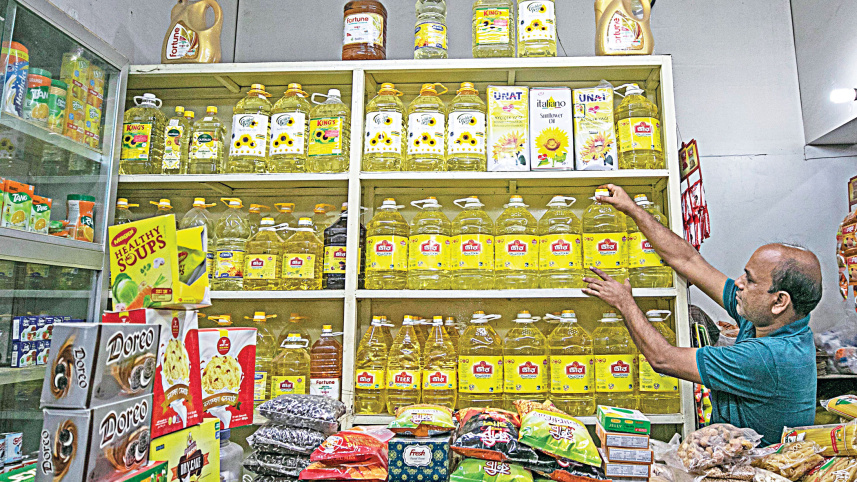
A shortage of soybean oil that began in early March shows little sign of easing, pushing retail prices above the government fixed rate, with customers now paying up to Tk 15 more per litre.
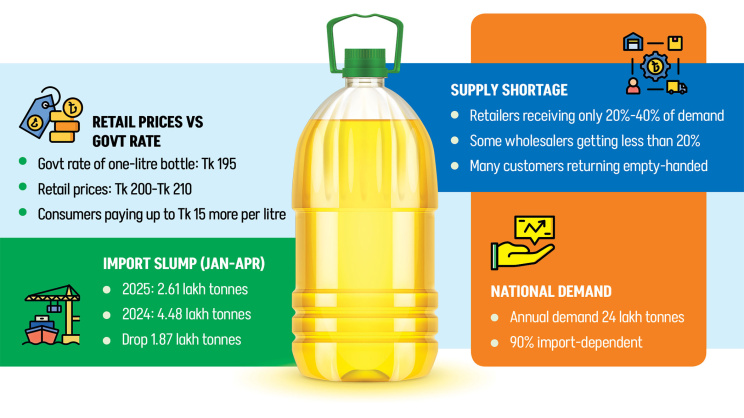
The government has set the price of a one-litre bottle at Tk 195. However, retailers across the country are charging between Tk 200 and Tk 210.
 For all latest news, follow The Daily Star's Google News channel.
 Small shopkeepers, supermarket chains and wholesalers say they are receiving less than half of their usual daily demand for the cooking staple, most of which Bangladesh imports.
Refiners have not said clearly whether they have reduced supply. However, official data show soybean oil imports fell sharply in the January-April period compared with the same period last year.
Refiners say global prices and freight costs have increased, but authorities have yet to approve their proposal to raise local rates. They say it is no longer possible to import and sell the product at a loss.
Nurul Alam Sikder, a shopkeeper in Dhaka’s Pallabi area, said he last received bottled soybean oil from dealers about three weeks ago. Dealers are saying that there is a supply shortage, so they are unable to provide it.
Firoj Alam, manager of retail chain Daily Shopping, which has 115 outlets nationwide, said bottled soybean oil has not met demand since the beginning of April.
Currently, only about 30 percent to 40 percent of the required amount is being supplied, said Alam.
Speaking on condition of anonymity, a senior official at another supermarket chain said importers have failed to supply enough bottled soybean oil since the last week of February. At present, only 25 percent to 30 percent of the required supply is available.
The official said many customers are returning empty-handed when they come to buy oil. They are expressing frustration with them over not being able to get it.
Abu Bakar Siddique, an edible oil wholesaler at Karwan Bazar, one of Dhaka’s largest kitchen markets, said the squeeze has also cut dealer commissions because the maximum retail price has not increased.
DEALERS CUT BACK SUPPLIES
During a visit to kitchen markets in Chattogram yesterday, it was found that 1 litre and 2 litre bottles were available at some shops, while 3 litre and 5 litre bottles were largely missing from shelves.
Retailers were selling bottled soybean oil at Tk 5 to Tk 7 above the maximum retail price printed on the packaging. Traders say they are receiving less than 20 percent of their usual supply.
Abul Hashem, a retailer in the port city, said limited deliveries from distributors have disrupted sales and forced them to ration stock.
Hashem said retailers are not receiving edible oil in line with demand. Dealers said their commission has also been reduced.
“As a result, we are buying oil at Tk 1 to Tk 2 higher than the maximum retail price printed on the bottle. If we do not add at least Tk 5 per litre, we incur losses,” he added.
In Sylhet, retailers reported a similar picture.
Ashis Das, a retailer at Bagbari area, said, “Dealers have stopped providing supplies for over a week. Wholesalers in Kalighat are also almost out of stock, so we are having to run our shops without oil.”
Another retailer, Kapil Ray, said, “No company has provided oil for several days. We have managed to source small quantities of oil from a wholesaler at the printed MRP. I am selling these to my regular customers without any profit just to maintain our relationship.”
A wholesaler in the same area, who asked not to be named, said supplies from the company depot are not even close to 20 percent of demand.
He said, “After paying the price in advance, we received only 300 litres of oil last Thursday. Today [Tuesday], we will receive another supply of 300 litres, but now with a condition to purchase an equal amount of bottled water.”
At Shaheb Bazar in Rajshahi, shopkeeper Sumon Hossain described the edible oil market situation as “very bad”.
“There is almost no supply now. Prices have also increased. We have to buy a two-litre bottle for Tk 388 and sell it for Tk 390. That is only Tk 2 profit on a two-litre bottle,” he said.
“On top of that, we have to send our own people to collect the oil from dealers because they do not deliver it. There are transport costs. Retailers are actually facing losses,” said Hossain.
IMPORTS PLUNGE
Commerce ministry data show soybean oil imports fell sharply in the January-April period compared with the same period last year.
Soybean oil imports dropped from 4.48 lakh tonnes in January-April last year to just 2.61 lakh tonnes this year.
Importers say they cut shipments because domestic prices have not been adjusted in line with international rates. Selling at a loss is unsustainable, they say, despite repeated appeals to the current and previous interim government for a price increase.
World Bank commodities data show soybean oil sold at $1,154 per tonne in January. The price rose to $1,282 in February and to $1,482 in March.
The country’s annual demand for edible oil stands at 24 lakh tonnes, around 90 percent of which is met through imports, according to the Bangladesh Trade and Tariff Commission.
Mohammad Dabirul Islam Didar, head of finance and accounts at Bangladesh Edible Oil Limited, which markets Rupchanda brand soybean oil, said the company continues to sell bottled soybean oil at the maximum retail price and does not charge above it.
He said rising import and supply chain costs have put the company under pressure. It has applied to the Ministry of Commerce for a price adjustment to help maintain supply chain stability.
Didar said it is not possible to sustain operations at a loss. Discussions have taken place over possible VAT adjustments, but no action has been taken.
The Daily Star tried to contact Biswajit Saha, director of corporate and regulatory affairs at City Group, which markets the Teer brand of soybean oil, for comment but received no response.
[The Daily Star Rajshahi Correspondent Shohanur Rahman Rafi contributed to this report]
Comments