


Govt’s heavy bank borrowing to curb private credit: BEA
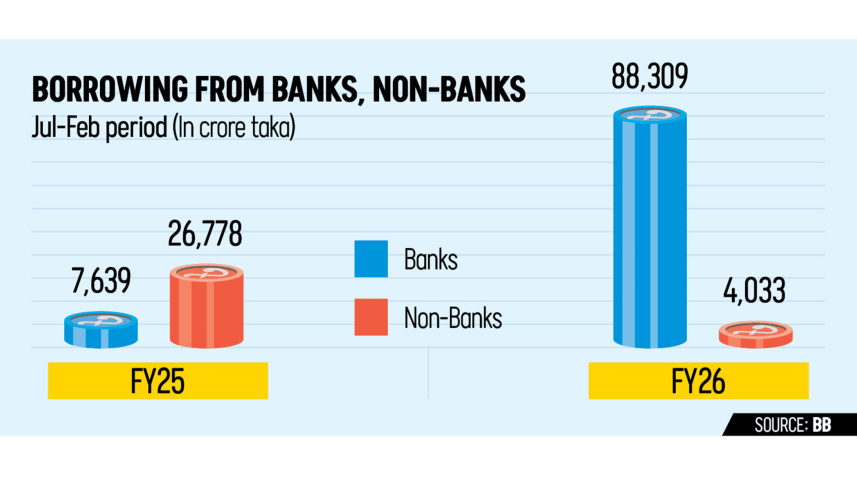
A widening revenue shortfall is driving the government toward heavy bank borrowing, raising concerns over tighter credit availability for the private sector and mounting fiscal pressure in the coming years, the Bangladesh Economic Association (BEA) said.
“If the revenue gap persists, the trend [of government bank borrowing] could deepen further in FY2026-27, amplifying a ‘crowding out’ effect where government demand for funds limits lending space for businesses,” said the association.
 For all latest news, follow The Daily Star's Google News channel.
 The economists’ body raised the issue yesterday during a pre-budget discussion with the National Board of Revenue (NBR) officials at its headquarters in Dhaka.
BEA estimates that government borrowing from banks may reach around Tk 1 lakh crore in FY26. The amount could rise to Tk 1.1 to 1.3 lakh crore in FY27, with the deficit remaining at 4.5 to 5 percent of GDP.
As of February in the current fiscal year, the government borrowed Tk 88,309 crore from the banking system and Tk 4,033 crore from non-banking sources, according to Bangladesh Bank data.
The BEA also said the upcoming budget will face pressure from political commitments, including pay-scale adjustments, family card programmes, agricultural support, and social safety-net expansion.
“Ensuring food security and stabilising prices of essential goods will further strain fiscal space,” said Mohammad Masud Alam, member of the BEA.
He also warned that global energy market volatility, especially rising tensions in the Middle East, could push up oil prices, increase import costs, and add pressure on foreign exchange reserves, posing additional risks to macroeconomic stability.
Speaking about raising revenue, he suggested urgently designing a comprehensive framework to bring Bangladesh’s fast-growing digital economy under the tax net to boost the country’s tax-to-GDP ratio.
At the event, Mahbub Ullah, convener of the BEA, said the NBR should take stronger action against tax evasion in the real estate sector, in cases of wealth tax, and cases of underreporting family and personal wealth.
In response, NBR chairman Md Abdur Rahman Khan said they are working on this issue.
Ahad Al Azad Munem, research associate of the Policy Research Institute (PRI) of Bangladesh, said that currently, about 28 percent of total revenue comes from customs or trade taxes.
“Such a high dependence on trade taxes is not considered international best practice.”
The NBR chairman said that since the country’s overall revenue collection is low, whenever any reform or change is proposed in major revenue sources, the decision-makers become hesitant.
“This reality must be acknowledged.”
The Centre for Policy Dialogue (CPD) urged the NBR to ensure tax justice, protect low-income groups, and take stronger measures to prevent tax evasion.
The Anti-Tobacco Media Alliance (ATMA) has proposed merging the lower and medium cigarette tiers and setting the price of a 10-stick pack at Tk 100, Tk 150 for the higher tier, and Tk 200 for the premium category.
It also recommended adding a specific excise duty of Tk 4 per pack.
According to their proposal, this could generate around Tk 44,000 crore in additional revenue compared to the current fiscal year and potentially prevent nearly 400,000 premature deaths in the long term.
Business Initiative Leading Development (BUILD) proposed that the government provide clear direction about the separation of the tax policy and tax administration.
Besides, the NBR should look into the gap between the registered companies and actual return submission numbers, it said.
The Bangladesh Society for the Change and Advocacy Nexus (B-SCAN), a volunteer organisation, demanded raising the tax-free income for differently abled people to up to Tk 6 lakh from the existing Tk 5 lakh.
Comments