


Conflicting data clouds picture of mobile network quality
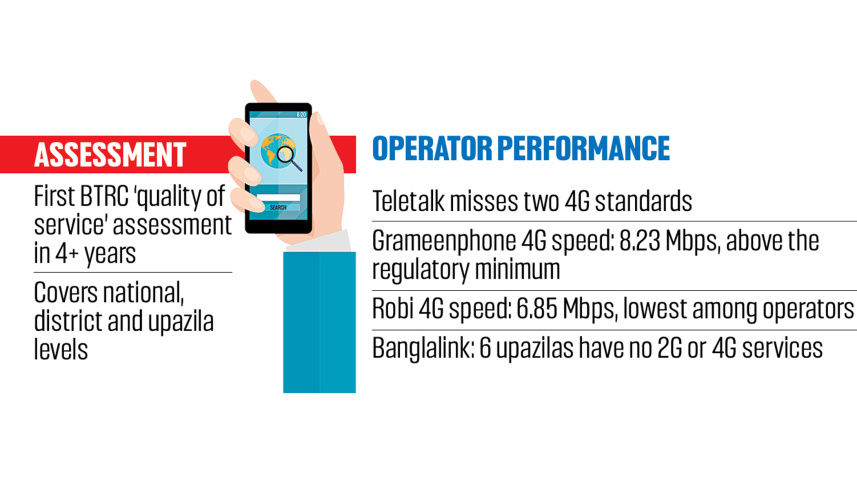
Bangladesh’s mobile network quality mostly met regulatory standards in July, but a long-delayed assessment by the Bangladesh Telecommunication Regulatory Commission (BTRC) found significant differences between operators’ reported figures and the regulator’s own measurements.
The assessment compared Quality of Service (QoS) data reported by the country’s four mobile operators -- Grameenphone, Robi, Banglalink and Teletalk -- with network data collected by the BTRC.

It was BTRC’s first QoS assessment in more than four years and the first to publish network performance data at national, district and upazila levels.
However, both BTRC and industry officials said the assessment used data from the regulator’s Telecom Monitoring System (TMS), rather than standard drive tests.
The two methods differ in how they measure network quality, collect data, select samples and cover different areas. Industry officials said TMS data may not always reflect customers’ experience, especially when operators have different levels of network coverage and different customer bases.
The assessment report found that most operators met key national benchmarks. However, differences between operators’ reported figures and BTRC’s measurements, the lack of raw data and uneven performance across locations raise concerns.
TELETALK MISSES TWO 4G STANDARDS
Teletalk was the only operator to fall below regulatory standards on two major 4G indicators in July.
Its 4G Radio Resource Control (RRC) success rate was 98.49 percent, below the required 99 percent. Its 4G data non-retainability rate was 0.64 percent, higher than the permitted 0.5 percent.
RRC success measures how often devices successfully connect to a 4G network, while non-retainability measures unexpected data disconnections.
BTRC could not independently verify Teletalk’s figures because its raw or binary files were incomplete. The report repeatedly marked the data as “Incomplete raw/binary file from Teletalk” at national, district and upazila levels.
Teletalk’s performance also varied sharply across locations. Its 4G RRC success rate met the regulatory standard in only 12 of the 64 measured upazilas. At the upazila level, just 136 of 537 measurements met the requirement.
Despite these weaknesses, Teletalk reported an average 4G download speed of 11.20 Mbps, well above the minimum requirement of 3.50 Mbps.
Its CSFB success rate -- the rate at which 4G devices successfully switch to older networks to make voice calls -- was 99.64 percent.
GRAMEENPHONE MEETS STANDARDS
Grameenphone remained within BTRC’s required standards, although the assessment found differences between some of its reported figures and the regulator’s measurements.
BTRC recorded Grameenphone’s 2G call drop rate at 0.33 percent, exactly matching the company’s figure. Its average 4G download speed was 8.23 Mbps, compared with 8.22 Mbps reported by the operator.
The largest gap was found in the VoLTE (voice over long-term evolution) call drop rate. BTRC measured it at 0.38 percent, while Grameenphone reported 0.04 percent. Both figures were below the regulatory limit of 0.5 percent.
Grameenphone’s CSFB success rate was 98.65 percent, above the required 98 percent.
The assessment also found notable differences in some upazilas, particularly in Bandarban and Rangamati.
 For all latest news, follow The Daily Star's Google News channel.
 Tanveer Mohammad, Grameenphone’s chief corporate affairs officer, said that improving QoS was an ongoing process and that the company remained committed to enhancing the customer experience.
“Grameenphone has met all BTRC QoS criteria in its latest reports, except in some areas of the Hill Tracts, where we are working to improve the network,” he said.
ROBI DATA FACES VERIFICATION PROBLEM
Robi also faced data and network quality challenges during the assessment.
BTRC measured Robi’s average 4G download speed at 6.85 Mbps. This was the lowest among the operators whose data BTRC could independently verify, but it was still above the 3.50 Mbps minimum.
Robi’s 2G call setup success rate was 99.29 percent, only slightly above the 99 percent benchmark. The assessment also found differences between Robi’s reported figures and BTRC’s measurements in several locations.
BTRC could not independently verify data from 41,819 Robi cells because the required raw or binary files were unavailable.
As operators generally keep such files for only seven days, BTRC used Robi’s processed data instead. The regulator said the problem would be addressed from the following month through daily data reconciliation.
Robi’s Chief Corporate and Regulatory Officer Shahed Alam, questioned the use of TMS data alone to assess network quality.
He said the results could be affected by the number and geographical spread of measurements. As a result, operators with limited coverage or smaller datasets could appear to perform better than those operating wider networks with more traffic and customers.
“Comparing operators solely based on TMS-derived QoS figures can lead to misleading conclusions,” he said.
Shahed also said there was no established international regulatory practice of using TMS data alone to determine or compare overall QoS.
“The credibility of any QoS assessment depends on the methodology, measurement coverage, sampling framework, transparency and representativeness of the underlying data,” he said.
BANGLALINK SHOWS MOST CONSISTENT RESULTS
Banglalink recorded the most consistent results across the key indicators measured by BTRC.
The regulator measured its 2G call setup success rate at 99.73 percent and its average 4G download speed at 8.61 Mbps.
Its 2G call drop rate was 0.36 percent, while its 4G RRC success rate was 99.84 percent. Its CSFB success rate stood at 99.19 percent and its SMS completion rate at 99.81 percent.
At the national level, the differences between Banglalink’s reported figures and BTRC’s measurements were generally small.
However, the assessment found that six upazilas, including several in Bandarban, had “No Service” on both 2G and 4G networks.
Comments