


Cooking oil, sugar prices rise on war shocks


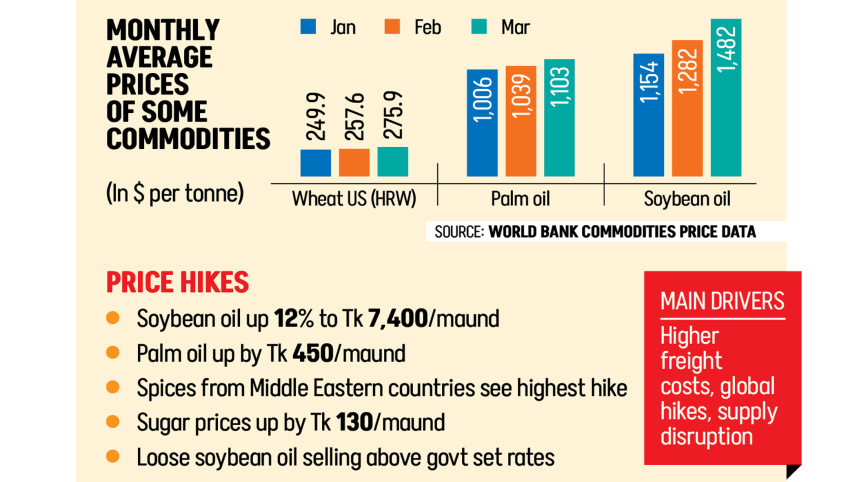
Prices of edible oil, sugar and spices have risen across major wholesale markets in Bangladesh over the past several weeks.
Traders attribute the increases to rising international commodity prices, higher freight costs and supply disruptions caused by the war in the Middle East.

According to them, these pressures have pushed up import expenses and, in turn, domestic prices.
At Khatunganj in Chattogram, one of the country’s largest wholesale hubs, traders said the market remained relatively stable during the last Ramadan thanks to adequate stockpiles.
However, conditions began to change after Eid as supply tightened.
Abdur Razzaq, a businessman at the market, said prices are becoming unpredictable, although there are no major shortages. “Prices of some products have risen abruptly as imports are being affected and costs have gone up.”
EDIBLE OIL
Among the edible oil category, soybean oil prices have recorded the most notable increases in recent weeks, according to traders.
At Khatunganj, according to Razzaq, a maund of soybean oil now sells for Tk 7,400, up from Tk 6,600 a week ago. Palm oil climbed to Tk 6,450 from Tk 6,000.
In Dhaka’s Karwan Bazar, bottled oil prices have remained largely unchanged, but loose soybean oil has risen by approximately Tk 1,200 per maund since Eid, reaching Tk 6,600-Tk 6,700, said Abu Bakar Siddique, a trader at the market
Loose soybean oil is reportedly selling at Tk 7–8 per litre above the government-set price, he added.
Bangladesh sources the bulk of its edible oil from outside the Middle East, according to the data from the National Board of Revenue (NBR) and traders.
Soybean oil and raw oilseeds are primarily imported from Brazil, Argentina and the United States. Palm oil, the country’s most consumed cooking oil, comes largely from Indonesia and Malaysia, according to data from the National Board of Revenue and traders.
A senior official at a leading commodity importing and processing company confirmed that none of these shipments transits through the Strait of Hormuz.
The price movements nonetheless reflect a broader surge in international commodity markets since the war started in late February.
According to the World Bank’s latest Pink Sheet, detailing commodity prices, published this month, palm oil averaged $1,103 per tonne in March, up from $1,039 in February and $1,005 in January.
Soybean oil rose more sharply, reaching $1,482 per tonne in March from $1,282 in February – a month-on-month increase of about 16 percent.
Soybean meal prices increased to $473 in March from $425 in February.
Amirul Haque, managing director of Delta AgroFood Industries, a major soybean meal-oil importer, said the situation is largely driven by rising global import costs.
He noted that oilseed prices had climbed from $435–$450 to nearly $500 per tonne within a month and a half and could rise further to $550.
 For all latest news, follow The Daily Star's Google News channel.
 He fears that soybean oil prices in the international market may exceed $1,300 per tonne, in line with trends at the Chicago Board of Trade.
Luthful Kabir Shaheen, director of business development at City Group, which markets the Teer brand of edible oil, said, “The reason is surging freight costs, which have gone up by 2-2.5 times since the war.”
Officials from Meghna Group, which markets Fresh-branded products and is among the country’s leading commodity importers, declined to comment.
Meanwhile, Golam Mawla, president of the Bangladesh Wholesale Edible Oil Traders Association, said the increase reflects ongoing market pressure rather than a sudden crisis.
“Products are available, but they are sold quickly upon arrival, creating a perception of tight supply,” he said.
Karwan Bazar’s retailer Siddique echoed the sentiment, saying panic buying had added further pressure. “The government has little control, and wholesalers in Khatungonj and Dhaka’s Moulvibazar are setting prices as they wish.”
SPICES AND SUGAR
At Khatunganj, the sharpest price increases have been recorded in spices and dry fruits, many of which are directly sourced from the Middle East and Central Asia.
Pistachio prices surged by more than 30 percent to Tk 4,100 per kg, while sour dried plums saw an exceptional spike of over 160 percent to Tk 1,320 per kg. Both of the items are largely brought in from Iran and Afghanistan.
Prices of raisins, cumin, nutmeg and mace have also risen significantly. Traders say supply chain disruptions linked to the Middle East can have an immediate impact on Bangladesh’s commodity market, given this concentration of sourcing.
Raisins arrive from Iran, Afghanistan, Turkey and Uzbekistan. Cumin is imported mainly from India, Syria and Turkey, while nutmeg and mace come predominantly from Indonesia.
Sugar prices have edged up modestly, with a maund now selling at Tk 3,550 compared to Tk 3,420 a week earlier. Bangladesh imports sugar mainly from Brazil, India and Thailand.
The World Bank data shows that sugar world prices increased slightly to $0.33 per kg in March from $0.31 in February. The global sugar prices have been on a downward trend since reaching $0.52 in 2023. Prices stood at $0.45 per kg in 2024 and 0.37 in 2025.
FREIGHT COSTS THE MAIN CULPRIT
While Bangladesh’s key commodity imports do not pass through the Strait of Hormuz, the broader disruption to global shipping has driven up freight costs considerably.
A senior official from a major commodities importing company said freight charges have risen from $35 per tonne before the conflict to $55 per tonne at present, an increase of more than 57 percent.
Major global shipping lines have introduced a series of emergency surcharges since early March. Maersk announced on March 3 an emergency freight increase for cargo to and from Gulf destinations – including the UAE, Qatar, Saudi Arabia, Bahrain, Kuwait, Iraq and Oman.
It set rates at $1,800 per 20-foot container, $3,000 per 40-foot container, and $3,800 for refrigerated units, citing higher operating costs and the need for alternative routes.
CMA CGM introduced a similar emergency conflict premium on March 2, at $2,000, $3,000 and $4,000, respectively, for the same container types. The company also announced an emergency fuel surcharge of $75 to $180 starting March 16 due to rising bunker costs.
MSC, meanwhile, imposed an emergency war surcharge of $500 to $1,000 per container from March 5 on cargo from the Indian subcontinent, including Bangladesh, to East Africa and the Indian Ocean.
On March 7, it introduced an additional emergency fuel charge of up to $200 on shipments from the Mediterranean and Black Sea to the Indian subcontinent and the Red Sea.
Comments