


Cost surge, weak demand squeeze plastic makers
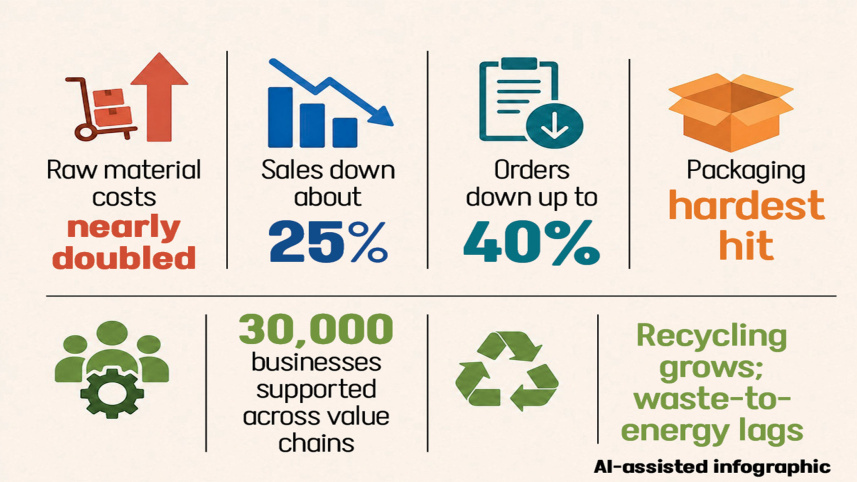
The country’s plastic industry has slowed sharply following the recent Middle East crisis, as rising raw material prices and weak consumer demand continue to hit manufacturers hard, industry leaders said.
The steep rise in the cost of imported plastic raw materials has severely affected producers, Shamim Ahmed, president of the Bangladesh Plastic Goods Manufacturers & Exporters Association (BPGMEA), told journalists at the association’s office in Dhaka’s Paltan yesterday.

Before the conflict, key raw materials were imported at around $800 to $900 per tonne. Prices have now increased to between $1,500 and $1,600 per tonne, he said.
“The sharp rise in raw material costs is putting immense pressure on the industry. Higher production costs are also driving up the prices of finished products,” Shamim said.
The country’s plastic and packaging industry, worth around Tk 60,000 crore annually, recorded monthly sales of about Tk 5,000 crore before the conflict. This has now fallen to around Tk 3,750 crore, a decline of at least 25 percent, according to the BPGMEA.
Shamim said at least 25 percent of customers have reduced their orders since the conflict began, while some segments have seen demand drop by as much as 40 percent.
The packaging segment, which accounts for about 40 percent of the industry, has been the worst affected as demand for fast-moving consumer goods weakens amid lower household spending, he added.
“We are not the end product; we supply other industries,” Shamim said. “When consumers buy less detergent, food or household products, demand for our packaging and plastic components drops immediately.”
According to him, Bangladesh has around 6,000 plastic manufacturing units, of which 4,000 to 4,500 supply products to other sectors, including garments, pharmaceuticals, food processing and beverages. The industry serves around 30,000 businesses in total.
“Many people still think plastic means buckets, mugs and kitchenware. But plastic has become an essential part of industrial production and supply chains,” he said.
He warned that any disruption in the sector would quickly affect the wider economy, as most manufacturing industries depend heavily on plastic packaging and components.
Shamim also alleged that customs authorities often assess imported raw materials at higher values than invoice prices to meet revenue targets, even though such materials are sourced from large international suppliers where under- or over-invoicing is unlikely.
On recycling, Shamim said Bangladesh has a relatively high plastic recycling rate in the region, but investment in waste-to-energy infrastructure remains behind neighbouring countries.
KM Iqbal Hossain, senior vice-president of BPGMEA, said manufacturers have been absorbing much of the increased production costs instead of passing them on to buyers.
“We are negotiating with our clients to raise prices because production costs have increased by at least 30 percent, but we have not yet fully adjusted our prices,” he added.
Industry leaders said higher costs and weak consumer demand are putting severe pressure on profit margins, with many firms struggling to stay viable.
Iqbal also said Bangladesh is lagging in developing waste-to-energy projects. “Countries like Indonesia are rapidly expanding waste-to-energy projects. In Bangladesh, we have been trying to set up even one large-scale waste-to-energy plant for the past five years,” he said.
Despite the slowdown in traditional plastic manufacturing, Shamim said the recycling segment continues to grow and is creating new jobs as businesses place greater focus on sustainability.
Iqbal criticised high industrial land prices, weak incentives and complex regulations, saying these factors are discouraging investment and job creation.
He questioned why industrial plots developed by the Bangladesh Small and Cottage Industries Corporation are sold at prices much higher than acquisition costs, forcing entrepreneurs to spend heavily on land instead of production.
 For all latest news, follow The Daily Star's Google News channel.
 Comparing with neighbouring countries, Iqbal said governments in India provide industrial land, utilities and incentives to support manufacturing and exports.
He also highlighted challenges faced by plastic and toy manufacturers, saying many key components must be imported because local production is not commercially viable. However, manufacturers still pay commercial import duties on these inputs, reducing competitiveness against producers in countries such as China and Sri Lanka.


Comments