


Economic activity hits 23-month low in Aug: PMI
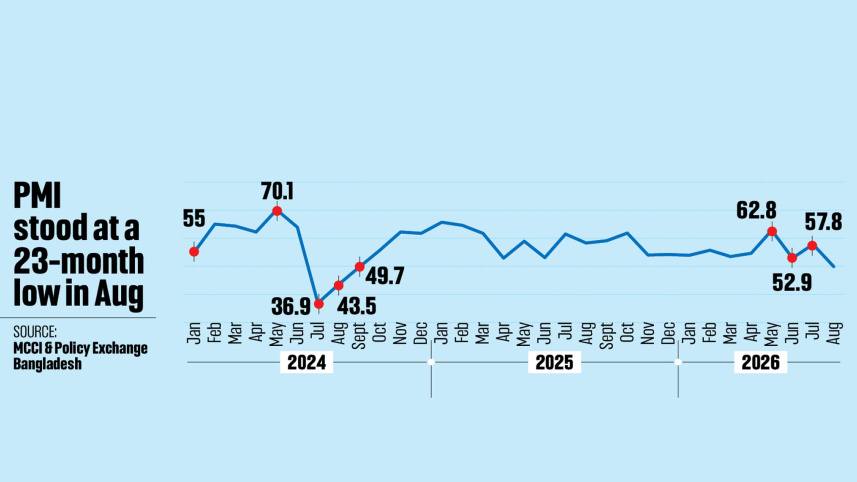
Bangladesh’s economic activity fell to a 23-month low in August, reversing July’s rebound, as exports weakened and energy disruptions weighed on manufacturing and services, according to the latest Purchasing Managers’ Index (PMI).
The headline Purchasing Managers’ Index (PMI) fell 7.9 points month-on-month to 49.9 in August, its weakest reading since September 2024.

The index, jointly developed by the Metropolitan Chamber of Commerce and Industry (MCCI) and Policy Exchange Bangladesh (PEB), last month dropped below the 50-point threshold that separates expansion from contraction.
The decline follows a sharp rise in July, when the index gained 4.9 points to 57.8 on a strong rebound in manufacturing alongside continued growth in agriculture and services.
Manufacturing had led July’s expansion, jumping 16.6 points to 65.4 – the strongest turnaround in the survey’s history. It reversed sharply in August, falling 18.0 points to 47.4.
New export orders, output, input purchases, imports and employment all fell back into contraction, while input prices continued to rise at a faster pace.
Services, which had expanded for 22 consecutive months, also slipped into contraction, falling 6.8 points to 49.2.
New business and business activity continued to grow but at slower rates, while employment contracted sharply.
In contrast, agriculture remained a bright spot, extending its expansion for the 12th straight month by rising 1.3 points to 56.5 in August from 55.2 in July.
Construction, which had stayed marginally in contraction throughout July at 49.3, moved into expansion in August, reaching 52.4.
Meanwhile, the Future Business Index, which had shown strong optimism across all sectors in July, indicated a slight decline in sentiment in August.
“The August PMI reading of 49.9 indicates that Bangladesh’s economic activity remained broadly near the neutral threshold, despite temporary pressures on manufacturing and services,” said M Masrur Reaz, chairman and CEO of PEB.
“Agriculture continued expanding, while construction returned to growth, highlighting underlying economic resilience.”
He said the moderation in manufacturing partly reflected weaker monthly exports and temporary energy disruptions associated with LNG infrastructure maintenance.
He added that improved energy availability, stronger export demand and supportive measures to restore business confidence could help the economy regain momentum.
 For all latest news, follow The Daily Star's Google News channel.
Comments