


Eid sales surge despite temporary slowdown
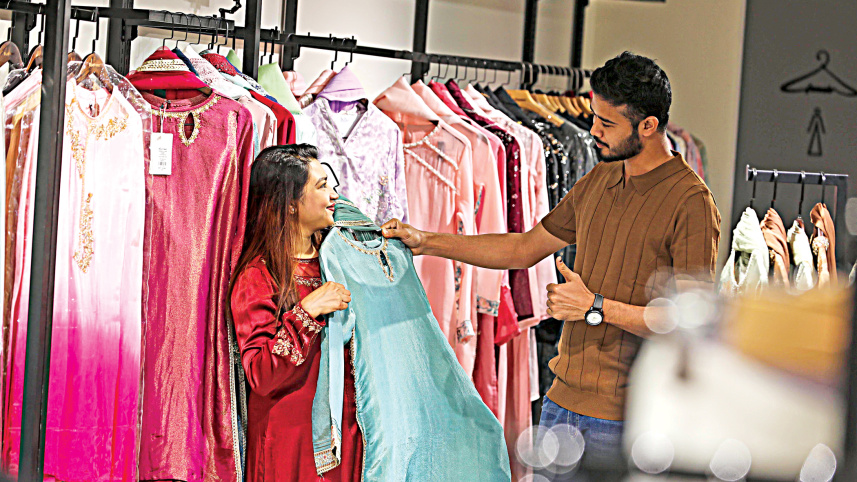
Clothing sales at fashion retailers started off strong before facing a slowdown over the last few days this Eid-ul-Fitr season amid broader economic uncertainty triggered by the United States and Israel’s war on Iran.
Most retailers, however, expect the season’s sales to finish better than last year with popular items such as panjabis, saris, salwar kameez and children’s wear being in high demand.

Eid remains the most crucial season for the apparel market, with fashion retailers estimating it accounts for roughly 35 to 40 percent of their annual clothing sales.
SM Khaled, managing director of Snowtex Group, whose fashion brand Sara Lifestyle operates 17 outlets nationally, said overall sales have improved compared to last year despite recent market anxiety. “We are seeing about a 10 to 15 percent year-on-year increase.”
The company has also lowered prices on many products and is targeting two to three times growth in online sales in 2026 compared to 2025.
“Until March, we achieved that,” he noted.
“We are gradually changing our strategy. Prices of many products have actually decreased compared to last year.”
Still, Khaled acknowledged that uncertainty in global markets has affected consumer sentiment.
“There is some impact due to uncertainty. But Bangladesh remains a stable country, and the business environment is gradually improving after the election,” he added.
Khalid Mahmood Khan, co-founder and chief executive of Kay Kraft, which operates 14 outlets nationwide, echoed the broadly positive outlook but said the past 10 days had been softer than expected.
“This year, the start was great. The first weeks of Ramadan, particularly after the election, were very good for sales,” he said, adding, “The last 10 days have not been as generous as expected.”
He attributed the recent slowdown partly to consumer sentiment, noting that global developments, including the ongoing war in the Middle East, had introduced an element of caution among shoppers.
Stating that the flow of customers usually increases significantly after the 15th of Ramadan, he said this year, customers might be feeling indecisive due to the fuel uncertainty and global developments. “The fashion retail market is largely psychology-driven.”
He expects a recovery in the final week of Ramadan and anticipates overall sales will surpass last year’s sales.
Retailers also noted that impulse buying and gift purchases remain a key component of Eid shopping. Handcrafted ornaments, leather bags, wall hangings and other decorative items are popular gift choices during the festive season.
Smaller boutique stores are also seeing positive demand, although sales vary by location.
Lanthon, a boutique at Aziz Super Market in the capital’s Shahbagh, said sales have been below expectations, with its founder Ujjal Akash citing the area’s association with political gatherings as a drag on footfall.
“Shahbagh has gained notoriety as a hub for political movements and processions, which is affecting our business,” he said.
He, however, noted strong demand for panjabis and the market’s draw for shoppers seeking distinctive designs. “In Aziz Super Market, every shop offers unique designs. That attracts a lot of buyers looking for something different.”
Women’s three-piece outfits and men’s T-shirts have also recorded strong sales, he added.
 For all latest news, follow The Daily Star's Google News channel.
 Jewellery is one segment that has not shared in the broader uptick. Aminul Islam Sahin, owner of Shiraj Jewellers at New Market, said gold purchases, typically buoyant before Eid, have remained weak this season due to elevated prices.
“Earlier, we usually saw a rise in gold purchases before Eid, but that is not the case now. People are only buying if there is an urgent need,” he said.
Banks and mobile financial service providers have sought to stimulate spending through promotional campaigns. bKash is offering discounts and cashback of up to Tk 10,000 across clothing, footwear, electronics and groceries through March 21, while Nagad is running a similar campaign covering February 19 to March 20.
Comments