


Factories reopen after riding out worst part of gas crunch

Workers returned to production lines yesterday as the dials on gas pressure gauges began ticking up across major industrial belts, offering some relief to apparel factories during this peak Christmas shipment season.
“We can run our spinning mills at 60 percent to 80 percent now which was as low as 40 percent last week,” said a top official of a large textile and garment group in Gazipur yesterday.

Requesting anonymity, the official said they expect the power supply situation to improve soon as well.
In the third week of July, one of the country’s two floating storage and regasification units (FSRUs) was damaged in an accident, cutting the nationwide supply of liquefied natural gas (LNG) by more than 17 percent.
The resulting gas shortage became acute. Households struggled to cook with piped gas, long queues formed at CNG filling stations, and factories cut production or shut down altogether in some areas.
On Wednesday last week, more than 200 small and subcontracting garment factories in Gazipur sent their workers on a three-day leave.
Many other factories in Savar, Ashulia, Kanchpur and Narayanganj, which were also badly affected by the gas shortage, took similar measures.
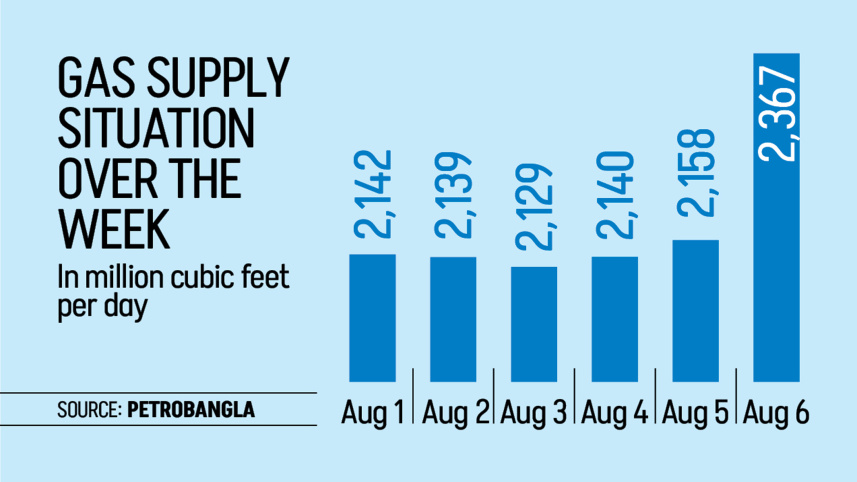
After about half a month, the FSRU at Cox’s Bazar was partly repaired on Thursday. By Friday, the terminal, operated by Excelerate Energy, was able to supply about 115 million cubic feet of gas a day to the national grid, according to Petrobangla.
Mazharul Alam Milon, administrative officer of ABM Fashion Ltd in Gazipur, told The Daily Star that the factory reopened yesterday after a three-day closure.
“Work is continuing in all our sections, and the workers have also turned up as usual. Although the factory is fully operational, we are still facing a gas shortage,” he said.
Masud Kabir, managing director of Gazipur-based sweater exporter Motex Fashion, said yesterday that he could now buy two to three lorry loads of gas bottles a day, compared with one lorry load every two to three days last week.
Masud said he buys gas in bottles from nearby CNG filling stations because his factory does not have a direct gas connection.
Mohd Khorshed Alam, chairman of Little Star Spinning Mills Ltd, said his mill was currently running at 60 percent capacity as the gas supply had improved somewhat. However, he said further improvement is needed to meet existing work orders.
Mohammad Amzad Hossain, superintendent of Gazipur Industrial Police (Industrial Police-2), told The Daily Star by phone yesterday afternoon that most factories in Gazipur have reopened.
“The remaining factories will reopen tomorrow [today],” he said.
Mohammad Hatem, president of the Bangladesh Knitwear Manufacturers and Exporters Association (BKMEA), said the gas supply has improved, but it is too early to say how much factories have recovered.
“It may take a few more days for full operations,” he said.
For apparel manufacturers, the disruption comes at a critical time as they work to ship Christmas orders to Western markets. Delays could force them to use costly air freight or offer discounts to compensate foreign buyers.
“The company will have to face the expensive air shipment or big discounts from the foreign buyers,” said the senior official of the Gazipur-based textile and apparel group.
BGMEA Vice President Shehab Udduza Chowdhury said gas supplies have improved since Thursday but remain inadequate.
 For all latest news, follow The Daily Star's Google News channel.
 “Still, we have to run the factories with diesel generators for at least four hours, for which the cost of production is increasing,” he told The Daily Star over the phone.
Nazma Akter, president of the Sommilito Garments Sramik Federation, said some garment factories remained closed for as long as five days, but the situation has started to improve.
She urged the government to give priority to supplying gas to mills and factories, saying millions of workers and shipments of goods depended on the industry.
Md Towhidur Rahman, president of the Bangladesh Apparels Workers Federation, also urged the government to monitor gas supplies at the factory level so that it could take appropriate measures.
Comments