The enduring legacy of the 2nd Bangladesh Liberation War Course
The War of Liberation comes but once in the history of a nation. Our beloved motherland, Bangladesh, also bathed in the blood of millions of martyrs in its struggle for freedom from the Pakistani oppressors.
On 25 March 1971, when the marauding Pakistan Army suddenly swooped upon the innocent and unarmed people of the country under the cover of darkness, especially at key locations in Dhaka city—Dhaka University, the Rajarbagh Police Lines, and the EPR Headquarters at Peelkhana—killing thousands of people, it effectively ignited the fire of the War of Liberation across the country.
Disoriented and dismayed for a day or two by the extent of the cruelty and mayhem, the Bangali members of the armed forces, the police, the Ansars, and the common people of the country, inspired by the radio announcement of Major Ziaur Rahman (later Shaheed President Ziaur Rahman), regained their bearings and began to confront the enemy with whatever they could lay their hands on.
The War of Liberation had begun in full swing. It was the time for a litmus test; it was time to discover where one's heart lay; it was a time to display one's patriotism by fighting for the country's liberation or by looking the other way. It was an article of faith, of loyalty, and a supreme display of patriotism. Our War of Liberation, while producing some cowards, collaborators, and mere spectators, also produced a group of brilliant sons and daughters of the soil who not only fought the enemy but also laid down their lives for the cause of the nation.
As the War of Liberation gathered momentum, the paucity of officers in the Mukti Bahini was felt acutely, and the Provisional Government decided to expand the officers' corps by recruiting competent and capable candidates from among the freedom fighters who had already gained some battlefield experience by that time. There were two batches of officer cadets: the 1st Bangladesh Liberation War Course (BLWC) and the 2nd Bangladesh Liberation War Course (formerly known as the 1st SS and the 2nd SS).
At the beginning of June 1971, a selection process was held to identify officer cadets from across the various battlefronts and sectors. Sixty-one candidates were chosen to join the temporary military academy established at Murtee in Jalpaiguri, India. Training for the 1st War Course began in the final week of June 1971.
The search for new cadets continued in the field, and a further 70 cadets had been selected by August 1971. By then, all of them were actively engaged in combat on different battlefronts, having received local training at various sector and sub-sector headquarters and other training camps. However, when the decision was taken to send them to Murtee, the First War Course was already midway through its training. It was, therefore, decided that they would undergo training as the 2nd War Course after the passing-out of the 1st War Course. Until then, the selected cadets remained deployed in their respective operational areas.
The 1st BLWC received their commissions on 09 October 1971 and, after reporting to their respective sector headquarters, joined the battlefronts during the third and fourth weeks of October. Cadets selected for the Second War Course were withdrawn from the battlefields and sent to the Murtee Academy during the first week of November 1971.
Murtee is a plain in the Dooars forest at the foothills of the Himalayas, with tea gardens on three sides and the River Jaldhaka on the other. It is a 2 km-long and 1 km-wide strip of rocky plain. It is situated in the northern part of Jalpaiguri district in West Bengal, India, about 15 km from the Darjeeling and Bhutan borders. Murtee served as an airstrip for the Allied Forces in the Second World War and as a military training camp for the Indian Army in the 1962–63 Sino-Indian War. During the Liberation War of Bangladesh, a training camp named Mujib Camp, with two wings—the Mujib Wing for training freedom fighters and the Bhasani Wing for training officer cadets—was established at Murtee.
In the final seven to eight weeks of the Liberation War, as the Mukti Bahini gradually shifted from guerrilla warfare to conventional military operations, the officers of the First Bangladesh Liberation War Course assumed crucial responsibilities as company commanders and subsector commanders, helping to steer the war towards its inevitable conclusion.
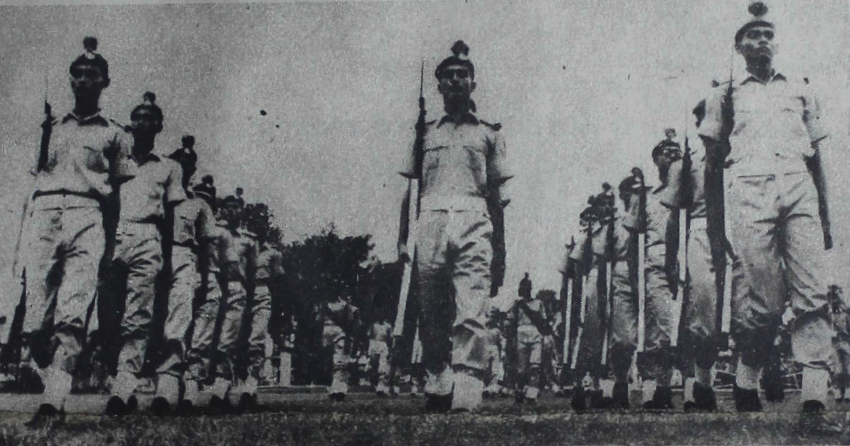
When the war broke out on 3 December 1971, these officers fought with exceptional courage on the eastern front alongside, or under the command of, other Bengali freedom fighter officers who had revolted from the Pakistan Army. Fighting in coordination with the Allied Forces, they achieved remarkable success. The fact that the Pakistani forces were defeated and compelled to surrender after only thirteen days of fighting against the Allied Forces stands as testimony to how effectively the freedom fighters had worn them down through relentless guerrilla attacks over the preceding eight months.
When fighting alongside the Joint Forces, two officers from the 1st BLWC embraced martyrdom: Second Lieutenant Ashfaqus Samad, Bir Uttam, and Second Lieutenant Khandakar Azizul Islam, Bir Bikram. Twenty officers of the 1st BLWC and seven officers of the 2nd BLWC received gallantry awards (BP-21, BB-5 and BU-1).
Although the officers of the 2nd BLWC remained actively engaged on the battlefront until the first week of November 1971, they were unable to participate in the final phase of the war because they were undergoing training at the Academy. This is a matter that continues to pain most of them to this day.
Upon completing their training, the 70 officer cadets of the 2nd BLWC returned to the country on 5 February 1972. After a few days of leave, 59 of them reported back and were attached to infantry battalions for On-the-Job Training (OJT). The remaining 11 returned to their respective colleges, universities, or previous professions.
As the need arose to maintain political stability and law and order, the Bangladesh Army was deployed in various parts of the country. Various ultra-left revolutionary organisations became involved in violent activities, including political assassinations, the seizure of police outposts and police stations, and the looting of armouries. To combat these activities, 10 East Bengal Regiment from Saidpur Cantonment was deployed in the Rajshahi and Natore region. They fought with exceptional courage until the insurgents surrendered and peace was restored in the Rajshahi region. Five officer cadets of the 2nd BLWC—namely Aminul Islam, Ferozur Rahman, Syed Abul Bashar, Motahar Hossain, and Ashraf Ud Doula—participated in the operation as members of the battalion. During a direct engagement, Officer Cadet Ashraf Ud Doula (who later served as an Ambassador, Secretary to the Government, and Major) lost one of his legs, while two soldiers embraced martyrdom.
About one and a half months after the surrender of the Pakistani forces in Dhaka, Second Lieutenant Selim of the 1st BLWC, along with several soldiers of the 2nd East Bengal Regiment, embraced martyrdom on 30 January 1972 during the operation to liberate Mirpur. Around the same time, filmmaker Zahir Raihan disappeared there while searching for his missing brother, journalist Shahidullah Kaiser. Under the leadership of freedom fighter officers of the 2nd East Bengal Regiment, Mirpur was eventually cleared of hostile forces.
The officer cadets of the 2nd BLWC were brought to the Battle School, which had been temporarily established in Dhaka Cantonment, during the first week of June 1972.
The Commander of 46 Infantry Brigade, Lt Col M Ziauddin Ahmed, Bir Uttam, served as the ex officio Commandant of the Battle School. The instructors were Maj Moinul Hussain Chowdhury, Bir Bikram, Commanding Officer of 2 East Bengal Regiment; Maj Syed Faruqur Rahman of 1st Bengal Lancers; Maj Nazrul Haque, Bir Protik; and Capt Hafiz Uddin Ahmed, Bir Bikram. The Adjutant was Capt SHMB Noor Chowdhury.
The Battle School successfully carried out its immediate mission. The officers, men, and all support staff deserved appreciation for this accomplishment under very trying conditions. It also provided ample food for thought for the Army leadership as to how and when to organise and establish the required training institutions in the Bangladesh Army. The Battle School stood as a model of a successful initiative and the precursor of the military academy that was to come.
A total of 64 officer cadets, including six cadets who had escaped from the Pakistan Military Academy and participated in the Liberation War, joined the training at the Battle School. After eight weeks of rigorous training, 47 cadets took part in the passing-out parade and were granted commissions on 05 August 1972. Cadet Muddassir Hussain Khan was the Senior Under Officer (SUO) who received the Sword of Honour.
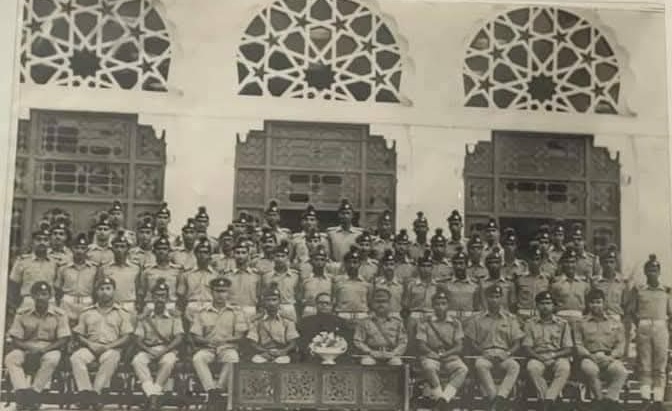
After being commissioned, the officers were posted to their respective battalions, which were then in a deplorable condition. The soldiers lacked proper uniforms and had no boots. During the bitter winter, they had to perform night duty wrapped in blue blankets supplied by the Red Cross. Apart from their personal weapons carried over from the battlefield, the battalions possessed no heavy weapons or ammunition. There was virtually no furniture and no transport except for one or two old Jeeps dating back to the Second World War, one Dodge pick-up truck, and one or two three-ton trucks. Whenever the battalions had to be deployed outside the cantonments in aid of the civil power, the Army had to rely on civilian trucks for transportation. This was, by and large, the situation prevailing in almost all the battalions at that time. Each officer had to shoulder two or three responsibilities simultaneously, such as those of Adjutant, Quartermaster, Company Commander, and others.
To deal with these fragile circumstances following independence, the Bangladesh Army was deployed nationwide. The first operation involved anti-smuggling duties. Large quantities of jute were being smuggled from Bangladesh into neighbouring countries. Working alongside the then Bangladesh Rifles (BDR), the Army succeeded in bringing the smuggling situation under control.
This was followed by Food Movement Duty. The Army was deployed at Chattogram and Mongla ports, as well as along damaged roads, bridges, and ferry crossings throughout the country, to ensure that food supplies were transported swiftly and without disruption on a priority basis. This operation continued for approximately two months.
The most challenging assignment, however, was the campaign to recover illegal arms, known as Operation Devil's Due. It was launched, most likely, in December 1973. For this operation, the Police and the Jatiya Rakkhi Bahini were placed under the operational command of the Army. One infantry battalion was deployed in two or three districts. A maximum of six or seven officers, comprising PMA-commissioned freedom fighter officers and officers from the 1st and 2nd Bangladesh Liberation War Courses, served in each infantry battalion. Despite these limitations, a large number of illegal weapons were recovered during the operation. As a result, the activities of various insurgent groups were substantially reduced and brought under control. Several thousand illegal firearms, along with a large quantity of ammunition, were recovered.
In short, the members of the 1st and 2nd Bangladesh Liberation War Courses devoted themselves wholeheartedly to building both the Bangladesh Army and the country. They devoted their labour, intellect, and unwavering dedication to overcoming countless hardships in the service of the nation.
It is important to remember that, unlike today, there was no modern equipment, no mobile phones, no wireless communication sets, and no proper road network. The officers themselves had yet to receive adequate professional training. Nevertheless, even before 1975, these 110 officers from the two Bangladesh Liberation War Courses, together with a handful of freedom fighter officers who had revolted from the Pakistan Army, played a pivotal role in safeguarding the country's independence and sovereignty. They laid down their lives, suffered permanent injuries, and worked tirelessly to protect the nation through some of its most difficult and uncertain years.
During the period from 1976 to 1981, officers from the First and Second Bangladesh Liberation War Courses undertook the demanding responsibilities of Grade-2 Staff Officers at various brigades, divisions, and Army Headquarters. At that time, Bangladesh did not yet have a Staff College. Consequently, most of these officers performed such important staff duties without having completed a Staff Course.
The officers of these two courses who had left the Army voluntarily, been denied commissions, or lost their jobs prematurely came together to establish a social platform to maintain close contact and camaraderie among themselves, while also providing financial support to fellow foundation members and the families of deceased members in need. With this objective in mind, they established an organisation, the Bangladesh Liberation War Courses Foundation (BLWCF), in the mid-1980s. The foundation has an executive committee elected every two years, and the posts of President and General Secretary rotate between the two courses.
Since its inception, the foundation's members have gathered regularly four times a year: on Foundation Day on 9 October, commemorating the commissioning of the 1st BLWC; on Fellowship Day on 5 August, celebrating the commissioning of the 2nd BLWC; on Victory Day; and at the Independence Day dinner, where members of the foundation and Liberation War veterans attend with their families.
The Bangladesh Army, which today enjoys immense respect and has earned an outstanding reputation at home and abroad through its service in United Nations peacekeeping missions, stands on foundations laid in the 1970s through the courage, hard work, and sacrifice of the officers of the two Bangladesh Liberation War Courses. Despite immense odds and limited resources, they helped build the Army from its earliest days and defended the sovereignty of the nation against subversive and separatist forces. Their contribution deserves due recognition.
The article is written by Members of the 2nd Bangladesh Liberation War Course.
Send your articles for Slow Reads to slowreads@thedailystar.net. Check out our submission guidelines for details.
Reading Ardhakathanak / What a 17th-century merchant's autobiography reveals about Mughal governance
The blind spots of Bangladesh studies
Rediscovering Santal history through Scandinavian archives
Asma Abbasi: The essence of orange
Tigers and the empire: A history of hunting, power and resistance
25th Death Anniversary / A life so full: Remembering Ahmed Sofa
Bengal's forgotten slave trade: Portuguese, Arakanese and Dutch trafficking networks
Mufazzal Haider Chaudhury and the idea of Bangladesh