


Fuel crisis drives e-bike demand in Bangladesh

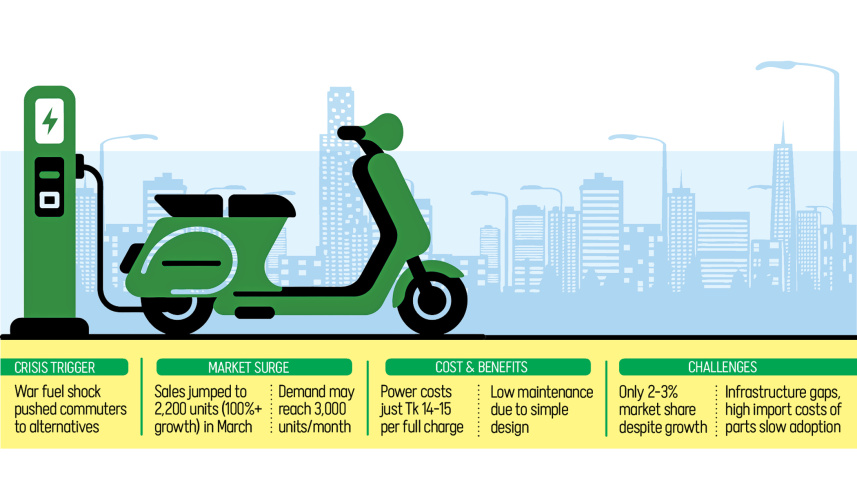
In Dhaka’s congested streets, a single trip means battling traffic and parking struggles. In March, a fuel crisis emerged due to the US-Israel war on Iran, adding to the plight of vehicle owners and raising the need for alternatives.
Mohammad Emrul Kayes, a Supreme Court lawyer, said he recently bought an electric motorcycle (e-bike) from Runner Motors Limited. The aim of this purchase was not to replace his car or a petrol-run motorbike.

“For me, it was about solving everyday hassles I face while buying fuel,” he stressed.
Frustration born from waiting in long queues without knowing when or if he will get the chance to refuel his car’s tank drove him to make the purchase, which promises convenience.
“The e-bike changed that. It’s quick, simple, and stress-free,” Kayes said.
His decision reflects a quiet shift in urban mobility amidst the fuel crisis.
Industry data shows a sharp increase in monthly sales of e-bikes just as the fuel crisis started. Sales surged from an average of 800 to 1,000 units to around 2,200 units in March, marking over 100 percent growth.
Sales are expected to reach 3,000 units if the current trend continues, market insiders said.
Several local and international brands have entered the burgeoning EV market in Bangladesh. Among them are Runner, Walton, and Pran-RFL.
Nazrul Islam, managing director of Runner Group, stressed the urgency of shifting away from fossil fuels and leaning towards renewable energy.
Runner currently offers 12 models of Yadea-branded e-bikes, priced between Tk 90,000 and Tk 315,000 depending on features.
“E-bikes offer a clear advantage,” Islam said.
He added that households using solar power could charge and run EVs for years at minimal cost, unlike fuel-powered alternatives dependent on imports.
E-bikes are structurally simpler than internal combustion engine vehicles, requiring only a motor and battery, he explained, resulting in significantly lower maintenance costs.
“In many cases, maintenance is almost negligible,” he said.
Highlighting two-wheelers as central to Bangladesh’s EV transition, Islam cited their affordability, convenience, and suitability across both urban and rural areas.
Despite these benefits, adoption remains slow, with annual sales ranging between 12,000 and 16,000 units across the industry. In the country’s motorbike market, e-bikes occupy just a 2 to 3 percent share.
Concerns over charging infrastructure, battery life, and range persist.
However, Islam downplayed these issues, comparing the charging of EVs to mobile phone use. A full charge costs around Tk 14 to Tk 15 and can be done overnight.
He added that evolving battery technology, particularly solid-state batteries, could further accelerate adoption.
 For all latest news, follow The Daily Star's Google News channel.
 Walton, the electronics giant, sells seven models of TAKYON E-Bike.
“In March, when fuel shortages intensified at refilling stations, demand jumped by as much as 85 percent,” said Md Touhidur Rahman Rad, chief business officer at Walton Digi-Tech Industries Limited.
Although the market remains small compared to fossil fuel motorcycles, e-bike demand has been growing steadily at 10 to 15 percent annually over the past three years.
He said the fuel crisis has clearly accelerated adoption, as e-bikes offer a practical alternative.
“On a single charge, riders can travel between 80 and 130 kilometres, depending on the model,” he said.
Kamruzzaman Kamal, marketing director at Pran-RFL Group, said sales of its RYDO e-bikes increased by about 60 percent after fuel shortages emerged.He stressed the need for a balanced policy framework, as high import duties on parts raise costs for local producers, while cheaper imports of finished goods create pricing pressure.
Kamal also highlighted the lack of charging infrastructure, urging government support to accelerate adoption.
Comments