


Gas crisis eating into workers’ incomes
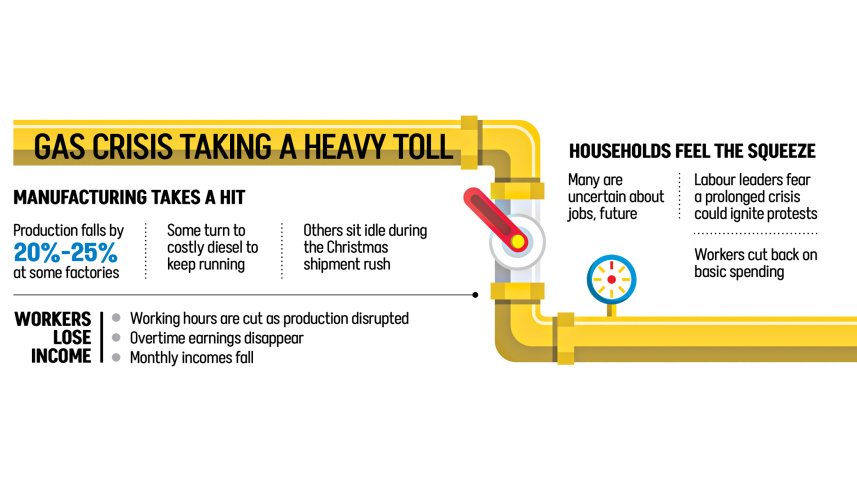
Even a month ago, machine operator Alauddin could earn more than Tk 15,000 a month, including overtime. Now, the 40-year-old garment worker at Choydana area in Gazipur struggles to earn even his basic pay of Tk 10,000.
And the fall in monthly income due to the ongoing acute gas and power crisis has its own implications.

“I used to eat rice for lunch; now I eat bread and bananas,” said Alauddin, requesting that his employer not be named.
His experience is increasingly common among garment workers in Gazipur, one of the country’s biggest industrial cities.
Asma Akter, who works at a factory at Konabari, told The Daily Star last week that her monthly income had also fallen by half.
“I used to earn Tk 20,000 a month, but now I get Tk 10,000. Working hours have been reduced, and there is no overtime now,” she said.
The squeeze comes at a difficult time for garment workers. For Asma, who lives in Gazipur with her children and family, the loss of income has made it harder to cope with rising living costs.
During the August to December period, factories would normally be running almost round the clock to meet Christmas shipment deadlines, with workers earning extra through overtime.
But a gas crisis that has lasted for more than a month is disrupting production across industrial belts. The crunch followed an accident at a floating liquefied natural gas (LNG) terminal in Cox’s Bazar. Supplies improved slightly in the second week of August before gas pressure in supply lines fell again to almost zero.
Manufacturers say the shortage is disrupting production, raising costs and making it harder to meet delivery deadlines. For workers, it is also cutting into their incomes.
PLENTY OF ORDERS, REDUCED WORKING HOURS
Around noon on Sunday last week, several garment workers were sitting at a roadside tea stall at Ambagh of Konabari. It was an unusual sight in an area where factory floors normally remain busy until late evening.
The workers said they were spending time outside because there was little or no work at their factories.
A short distance away, the dyeing machines at MM Knitwear Ltd were found largely silent and idle.
Nurul Haque, production director of the company, said gas shortages occurred in previous years too. But the latest situation has deteriorated sharply over the past month, with virtually no gas available now.
“This is making it extremely difficult to run the boilers. We are spending around Tk 20 lakh on diesel every day to meet urgent shipment deadlines,” he said.
MM Knitwear is using diesel to keep production going and meet delivery commitments, but the additional cost is becoming difficult to absorb.
“If this continues, it will not be possible to absorb the additional costs for long. If production falls because of the gas crisis and wages cannot be paid on time, worker unrest may erupt. There is also a risk that buyers may move away from Bangladesh,” said Nurul.
There are currently 2,674 active apparel and industrial factories in Gazipur city, according to Industrial Police data. Most manufacturers said they have enough work orders, but are struggling to ship them on time.
M Naimul Hoque, manager of human resources at DBL Group, said the company has adequate work orders ahead of Christmas.
 For all latest news, follow The Daily Star's Google News channel.
 “There is no shortage of foreign orders for other items too. But we are struggling with the delivery due to the gas crisis,” said Hoque.
DBL Group employs around 36,000 workers in its ready-made garment segment.
Another large manufacturer Ananta Group has four factories in Gazipur employing around 18,000 workers.
Mazharul Islam Milon, the company’s HR manager, said the gas crisis at the factories has become more severe.
The company is using diesel to run gas-dependent production sections. Its factories now need around Tk 7 lakh to Tk 8 lakh worth of diesel every day just to operate the washing machines.
“Overall, the situation is bad,” he said.
WORKERS FACE AN UNCERTAIN FUTURE
Mohammad Sakhawat Hossain, deputy managing director of Titas Gas’s Gazipur office, said, “We are trying to manage with whatever gas we are receiving. However, what we are getting is very little compared with the demand.”
Industrial Police Superintendent Amzad Hossain said production at factories had fallen by around 20-25 percent because of the gas shortage.
He said factories in Gazipur have so far avoided a major crisis by extending the use of shifts and distributing workers accordingly.
Ashrafuzzaman, central organising secretary of the National Garment Workers Federation Bangladesh, said owners continue to bear higher operating costs, wages and allowances even when production is suspended.
“If the situation does not improve quickly, many owners may be forced, against their wishes, to take difficult decisions such as declaring layoffs or shutting down factories to reduce losses,” Ashrafuzzaman said.
That could further deepen the pressure on workers already struggling with falling incomes.
Syed Sultan Uddin Ahmmed, executive director of the Bangladesh Institute of Labour Studies (BILS), said the government should introduce a rescue programme for workers and employers affected by production disruptions.
He said the government should identify how many workers have lost their jobs or seen their incomes fall and take measures to support them.
“We are talking about solving the gas problem, but we are not paying enough attention to the problems caused by the gas shortage. The workers who are losing income because of it also need support,” said Sultan, who led the Labor Reform Commission during the interim government.
He said prolonged disruption could have wider social consequences, including growing discontent, poverty, malnutrition and people being forced to change professions.
“When a working person loses a job or income, the impact spreads through the whole society. He has to pay house rent, and his children have to go to school. The person who receives that rent also has a family, children to educate and parents to care for. So, the effect multiplies,” he said.
He called for a universal social security system that would provide temporary support to people who become unable to meet their basic needs, regardless of the reason.
[The Daily Star Senior Reporter Jagaran Chakma has contributed to this report]
Comments