


Inflation climbs above 9% in April

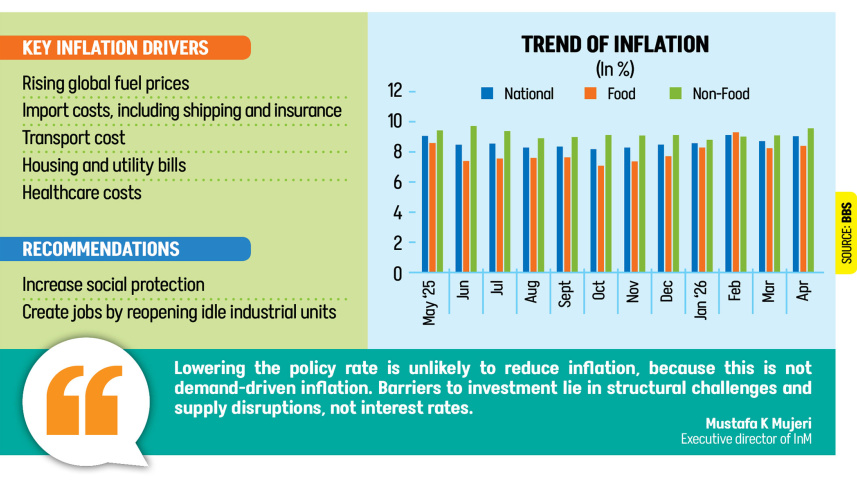
- Inflation climbs to 9.04 percent in April
- Fuel price hikes drive non-food cost surge
- Economists warn of further price pressure ahead
Inflation climbed back above 9 percent in April, reversing the easing seen in March and signalling renewed pressure from fuel price hikes and higher import costs amid the Middle East war.
Point-to-point inflation stood at 9.04 percent last month, up from 8.71 percent in March, according to data released by the Bangladesh Bureau of Statistics (BBS) yesterday.

The increase was driven by both food and non-food items. But non-food inflation rose more sharply to 9.57 percent in April from 9.09 percent a month earlier, indicating sustained increases in the costs of fuel, transport, and other services.
Last month, food inflation edged up to 8.39 percent from 8.24 percent in March.
Economists say higher fuel prices, along with rising import costs, are behind the renewed price pressure.
“The rise in inflation is largely driven by higher international prices; it is essentially supply-driven, import-cost-driven inflation,” said Zahid Hussain, former lead economist of the World Bank’s Dhaka office.
“It is not just fuel prices; others like shipping costs and insurance premiums have also risen. So, the cost of imports has increased, which feeds into services and other sectors,” he added.
Within the non-food category, transport and energy recorded notable increases. The transport index rose 1.83 percent month on month.
“The transport figure is particularly striking, showing a month-on-month increase of 1.83 percent, nearly 200 basis points,” said the economist.
He said the rise reflected market prices that had not yet been fully captured in official fuel data.
Hussain said that before petroleum prices were formally adjusted in mid-April, diesel was already selling at Tk 130 to Tk 135 in the open market, compared with the official rate of Tk 100, with long queues and widespread hoarding.
“Since transport operators have been buying diesel at Tk 130 to Tk 135 while the official rate was Tk 100, the increase has been reflected there. But in the fuel category itself, the full effect has not yet been reflected,” he said.
A similar gap exists for liquefied petroleum gas (LPG), which trades Tk 100 to Tk 200 above official rates in the open market. Because consumer price index calculations depend on official prices, Hussain said this difference has created a statistical blind spot.
“The 9 percent inflation we are seeing actually contains a kind of ‘suppressed’ or ‘unreflected’ component,” he said.
“Inflation was already there, but it did not show up in official statistics because the price adjustment had not yet been formally made.”
He said inflation could rise further in May as the full impact of April fuel price adjustments feeds through to wholesale and retail markets.
“When diesel prices increase, transport costs go up, wholesale prices increase, and then retail prices go up. This transmission process is not instantaneous,” he said.
Mustafa K Mujeri, executive director of the Institute for Inclusive Finance and Development, also cited the US-Israel war on Iran as a factor.
“Geopolitical tensions have pushed up transport costs, insurance premiums, and overall import expenses. This is affecting both food and non-food items,” he said.
He said non-food inflation was more exposed because of its heavier reliance on imports, with higher shipping costs and supply chain disruptions pushing up production costs.
 For all latest news, follow The Daily Star's Google News channel.
 Mujeri said there is little sign of near-term relief. “If the current situation continues, the chances of inflation coming down are very slim. We are operating in a highly uncertain global environment, and that is fuelling inflation rather than easing it,” he said.
On policy, he said conventional monetary tools have a limited effect when inflation is driven by external factors.
“Lowering the policy rate is unlikely to reduce inflation, because this is not demand-driven inflation,” he said, adding that barriers to investment lie in structural challenges and supply disruptions, not interest rates.
In October 2024, the Bangladesh Bank, in its fight against price pressures, raised the policy rate to 10 percent and has kept it unchanged since.
Mujeri called for targeted support for vulnerable groups and steps to revive domestic production.
“Reopening idle industrial units could be effective -- they can be brought back into operation relatively quickly and at lower cost, while also creating employment,” he said.
Comments