


Listed firms’ profitability drops to at least 4-year low

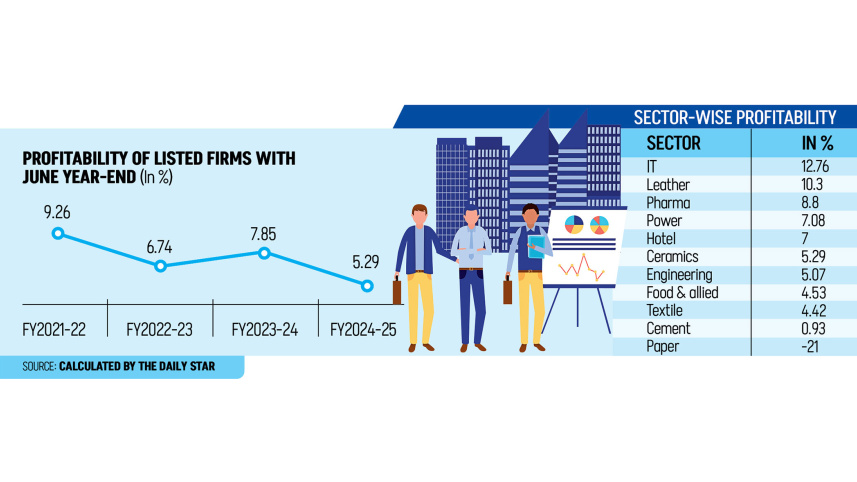
The last fiscal year 2024-25 (FY25) was hard for listed companies. During the period, firms saw their profitability fall to the lowest level since post-Covid, squeezed by inflation that outpaced sales growth, rising borrowing costs, political upheaval and limited public spending.
According to an analysis by The Daily Star based on published company data, in FY25, the net profit margins across 153 listed firms fell to 5.29 percent from 7.85 percent a year ago. In FY23, profitability was 6.74 percent, down from 9.26 percent in FY22.

“The economy has been going through a high inflationary period for the past couple of years, which has multiple effects on corporate profitability,” said SM Rashedul Hasan, managing director and CEO of UCB Asset Management.
High inflation squeezes people’s real wages, reducing their overall purchasing power and demand. As a result, firms’ sales drop. When sales fail to grow faster than the inflation rate, profitability suffers as overhead costs rise.
Explaining further, he said, “A firm cannot reduce manpower, but it has to raise salaries above the inflation rate. If sales do not increase at the same pace, overhead costs rise, which ultimately drags down profitability.”
Last year, sales growth of listed firms was 5.8 percent, while inflation exceeded 8 percent.
“Another factor that heavily impacted profitability was higher interest rates. Although sales were under pressure, interest costs rose last year, directly hitting profitability,” he added.
EXCLUSIONS AND SECTOR PERFORMANCE
Although 158 companies have published financial reports so far, five June-ending firms -- DESCO, Titas Gas, Jamuna Oil, Padma Oil, and Meghna Petroleum -- were excluded from the overall accounts because their profits or losses were due to extraordinary reasons, which could bias the results.
The fuel oil trio -- Padma Oil, Jamuna Oil, and Meghna Petroleum -- recorded the highest profitability of 229 percent in FY25, mainly because profits were several times higher than turnover. Massive income from bank deposits also boosted their profitability, which is why the sector was not included in the overall calculation.
Among other sectors, IT posted 12.76 percent, leather 10.3 percent, pharmaceuticals 8.8 percent, power 7.08 percent, and luxury hotels 7 percent. Ceramic showed 5.29 percent, engineering 5 percent, food and allied 4.53 percent, textiles 4.4 percent, and cement the lowest at 0.93 percent.
“Stubborn inflation has reduced people’s spending, especially in the construction sector,” said Rashedul, adding that this contributed to low profitability in construction-related industries.
The paper sector posted a negative 21 percent, mainly due to heavy losses at Bashundhara Paper Mills.
The company said its losses were due to several macroeconomic factors, including fluctuations in foreign exchange rates, sharp rises in raw material prices, import restrictions, reluctance of financial institutions to issue Letters of Credit (LCs), a rise in bank interest rates from 9 percent to 14.5 percent, and limited availability of US dollars.
These unavoidable political and economic challenges, the company said, prevented it from opening LCs for essential raw materials, leading to significant operational disruptions and financial losses.
Difficulties in opening LCs caused periodic interruptions in manufacturing and construction supply chains. Volatility in the foreign exchange market added to the problem, as the average rate of around Tk 118 per USD significantly increased the local-currency cost of imported clinker, gypsum, slag, fly ash, and other essential raw materials.
Most companies faced similar challenges. The broader industrial sector also struggled with energy shortages and intermittent power supply, which affected both large and small manufacturers and raised operating costs due to greater reliance on alternative energy sources.
POLITICAL UNCERTAINTY AND MACROECONOMIC RISKS
“Usually, in years around elections, corporates struggle to achieve higher profitability because some uncertainty remains amid political chaos,” said Rizwan Rahman, former president of Dhaka Chamber of Commerce & Industry.
He added that government development projects slowed last year, impacting many sectors retrospectively.
 For all latest news, follow The Daily Star's Google News channel.
 “Although a political transition has taken place, there is still huge tension over fuel supply and prices due to the US-Israel war on Iran. Mismanagement and panic buying have worsened the situation,” Rahman said, warning that profit growth may remain low in the current fiscal year.
Regarding the outlook, Rashedul said, “A major risk of further depreciation of the local currency is looming amid the US-Israel war on Iran.”
He added, “Higher fuel prices and limited foreign earnings could put pressure on the country’s foreign exchange reserves, leading to a weaker local currency against the US dollar.
“If this happens, companies with large foreign loans will be affected, and the country could face prolonged high inflation. Except for export-oriented firms, most companies would feel the impact.”
Comments