


Loans under court stay jump eightfold in three years

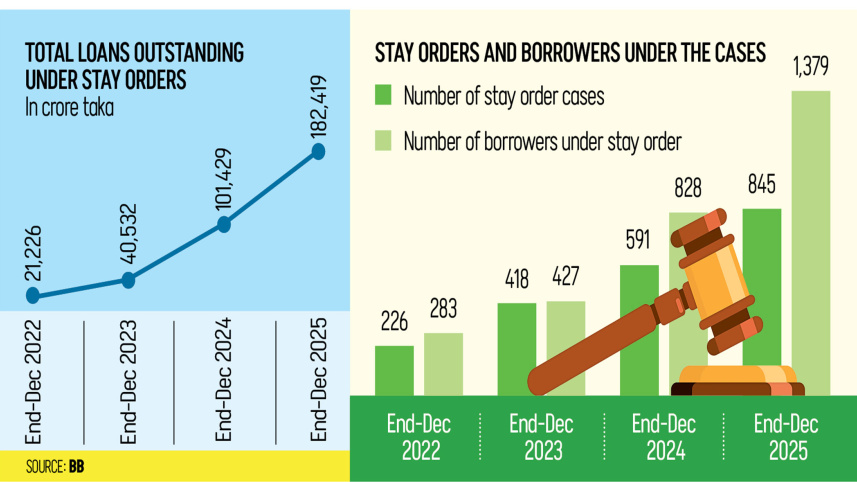
Bank loans tied up under court stay orders jumped more than eightfold over the three years to the end of 2025, reaching Tk 182,419 crore, according to a Bangladesh Bank (BB) report.
The amount rose by 80 percent from Tk 101,429 crore in 2024 to Tk 182,419 crore by the end of 2025, showing a sudden increase in borrowers seeking court protection.

This upward trajectory began from a base of Tk 21,226 crore at the end of 2022. The growth shifted from steady to explosive during the 2023-2024 period, when the value of funds blocked by stay orders more than doubled in just twelve months.
This momentum peaked in 2025, with the final 80 percent surge completing an eightfold expansion of frozen capital over the full three-year window.
Meanwhile, the number of stay order cases rose nearly fourfold, from 226 in 2022 to 845 in 2025, as more borrowers turned to the courts.
The sharp rise in loans under stay orders comes as the country’s banking sector is already struggling with a record volume of bad loans, adding to pressure on an already fragile financial system.
The central bank said the steady rise in loans under stay orders is delaying recoveries and putting pressure on liquidity and earnings of banks.
“The persistent growth in loans under stay orders suggests considerable stress on the banking sector’s liquidity and earnings,” said the BB in its Financial Stability Report 2025.
It recommended faster disposal of banking cases and policy measures to remove legal bottlenecks, saying this would help strengthen financial stability.
At the end of 2025, defaulted loans stood at Tk 557,217 crore. Unclassified rescheduled loans totalled Tk 268,733 crore, while written-off loans reached Tk 83,479 crore. All three increased during the year.
Mati Ul Hasan, managing director of Mercantile Bank PLC, said banks are making a concerted effort to recover defaulted loans. Some borrowers are seeking stay orders to block those efforts.
“A stay order means that all our recovery proceedings come to a halt,” he said. “If we take steps to auction a property and a stay order is issued, we cannot proceed until it is vacated.”
“This is a major challenge to loan recovery. The overall effect is that our cash flow is affected, and funds remain blocked, reducing our capacity to extend new loans.”
Barrister Shamim Khaled Ahmed said many defaulters obtain stay orders from the High Court to stop banks from classifying them as defaulters. However, not all stay orders involve defaulting borrowers.
“In some cases, bank directors also seek stay orders,” he said.
“But the number of stay orders related to loans is growing because there are only two courts dealing with banking matters. We should increase the number of courts to speed up the settlement of these cases. The longer the delay, the more serious the damage to the banking sector,” he said.
Fahmida Khatun, executive director of local think tank Centre for Policy Dialogue (CPD), said the increase shows another weakness in the banking sector, which is already burdened by a high volume of non-performing loans.
“It looks like Bangladesh is dealing with several issues simultaneously, including officially recognised NPLs, major gaps in provisions, loans that have been written off but still have not been recovered, and a rapidly increasing number of loans under judicial stay orders,” she added.
Fahmida said the stay order issue is especially important from a governance perspective.
“Courts play a vital role in protecting honest borrowers’ rights, and not every borrower requesting a stay should be viewed as intentionally defaulting.”
 For all latest news, follow The Daily Star's Google News channel.
 However, when such a large amount of bank credit is tied up under stay orders, the wider economic impact can be serious, she added.
“Lengthy legal proceedings can slow down recovery efforts, weaken the rights of creditors, and encourage strategic borrowers to use litigation as a way to delay repayment.”
The CPD executive director said capital is another concern. If banks cannot set aside enough provisions for deteriorating assets, their reported capital might not truly reflect the financial losses in their loan portfolios.
She said recognising these losses and setting aside enough reserves could reveal capital weaknesses in some banks. So, this issue goes beyond just loan recovery. It is really about maintaining financial stability.
Syed Mahbubur Rahman, managing director and CEO of Mutual Trust Bank PLC, said the growing number of defaulters has also led to more borrowers seeking stay orders.
“While I understand that going to court is a fundamental right, there should be a provision requiring borrowers to make a down payment of a certain portion of the loan before obtaining a stay order. This would discourage many borrowers from going to court,” he added.
Mashrur Arefin, chairman of Association of Bankers, Bangladesh (ABB), said the growing use of writ petitions has shifted from protecting the constitutional rights of aggrieved parties to becoming an operational tool for serial defaulters.
He said the practice generally follows three stages.
First, borrowers obtain a High Court stay order on their Credit Information Bureau records, allowing them to maintain their reputation, continue banking activities and even secure fresh loans.
Second, when banks move to auction mortgaged properties to recover dues, borrowers seek another stay order, making it much harder for banks to convert collateral into cash.
Finally, banks become caught in lengthy legal proceedings between lower courts and the High Court, delaying recovery efforts for three to four years and allowing cases to pile up, he said.
“The ultimate victim is the financial ecosystem. With time being taken that way, the value of recovery reduces, legal costs go up, liquidity gets locked, and credit discipline suffers,” said Mashrur, who is also managing director and CEO of City Bank.
Comments