


Overseas jobs fall to five-year low amid Middle East uncertainty

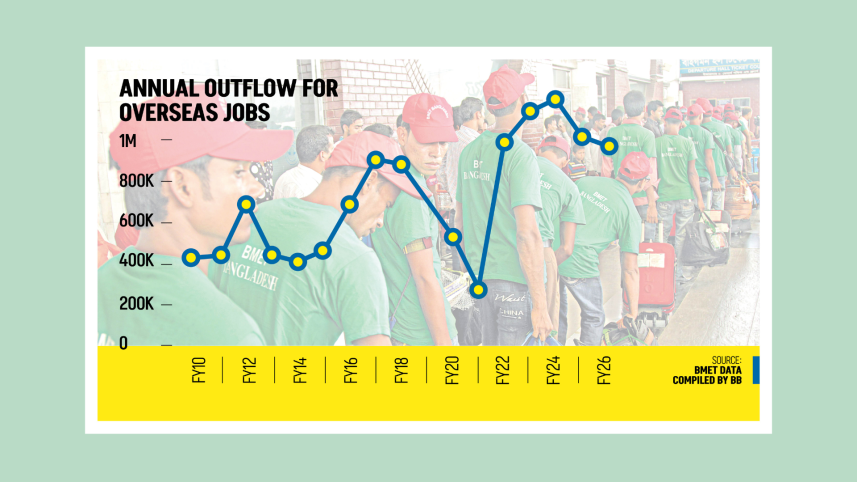
The number of Bangladeshis leaving for overseas jobs fell to a five-year low in the recently concluded fiscal year 2025-26 as demand from the Middle East weakened amid uncertainty following the US-Israel war on Iran.
More than 9.69 lakh people left Bangladesh for overseas jobs during the last fiscal year, down 5 percent from a year earlier, according to data from the Bureau of Manpower, Employment and Training (BMET).

The number of Bangladeshis taking up jobs overseas has been declining over the past two years. The weak outlook for the current fiscal year has also raised concerns about a slowdown in remittance inflows, which have helped shield the economy from external shocks in recent years.
“We have been seeing a slowdown in the outflow since March because of the war and the disruption of flights to Middle Eastern destinations,” said Shariful Hasan, associate director of the migration programme and youth platform at BRAC.
He said around 1 lakh people had been going abroad for jobs each month in recent years. That flow has now been affected.
Between FY2015 and FY2025, more than 86 lakh people left Bangladesh for overseas jobs. The Middle East accounted for three-quarters of all overseas employment during that period.
In FY2024, Bangladesh sent nearly 12 lakh people abroad for work, the highest number on record.
“The region has been the main source of jobs for Bangladesh’s migrant workers and of remittance inflows for the last four decades,” said Shariful. “However, the war-induced uncertainty has affected investment and employment in the major destination countries -- Saudi Arabia, Qatar and the United Arab Emirates.”
There are 60-70 lakh Bangladeshi nationals working in the region, and a large proportion of them do not have permanent jobs, he added.
“The Iran war has shaken the confidence of many foreign investors in Qatar and Dubai,” he said. “What we are seeing is that many workers are returning. If the war continues, the impact will be more visible.”
“So, if we cannot make a breakthrough in creating alternative employment destinations, there will be an impact on remittance,” he said.
Bangladesh received a record of more than $35 billion in remittances in FY2025-26. In July, remittance inflows rose 15 percent from a year earlier but remained below $3 billion for the second consecutive month, according to Bangladesh Bank data.
Ali Haider Chowdhury, a former secretary general of the Bangladesh Association of International Recruiting Agencies (Baira), said Saudi Arabia is the only market currently recruiting Bangladeshi workers.
“The rest of the destinations are virtually closed,” he said. “Good news is that the opportunity for migrant workers in Malaysia is going to open. If that happens, more jobs will be created.”
Shameem Ahmed Chowdhury Noman, proprietor of recruiting agency Sadia International, said Prime Minister Tarique Rahman’s recent visit has created an opportunity to reopen the Malaysian labour market. There is a demand for 2-3 lakh workers in the Southeast Asian country.
Recruitment could begin as early as September, he added.
Noman, a former secretary general of Baira, said there is also demand for workers in Eastern Europe, but Bangladesh faces problems with visa processing.
“It takes up to five months for visa issuance. The foreign affairs ministry should look into this. Jobs for migrant workers will increase if the visa process is made easy,” he said.
“The Middle East as a traditional market will remain. We need to explore Eastern Europe, Far East and Pacific countries such as New Zealand,” he said. “We have plenty of job markets. But we should create quality workers. We have to modernise training facilities and establish labs so that workers can learn practically.”
He urged the government to invest in the sector.
 For all latest news, follow The Daily Star's Google News channel.
Comments