


Tax return filing rate falls in FY26 to multi-year low

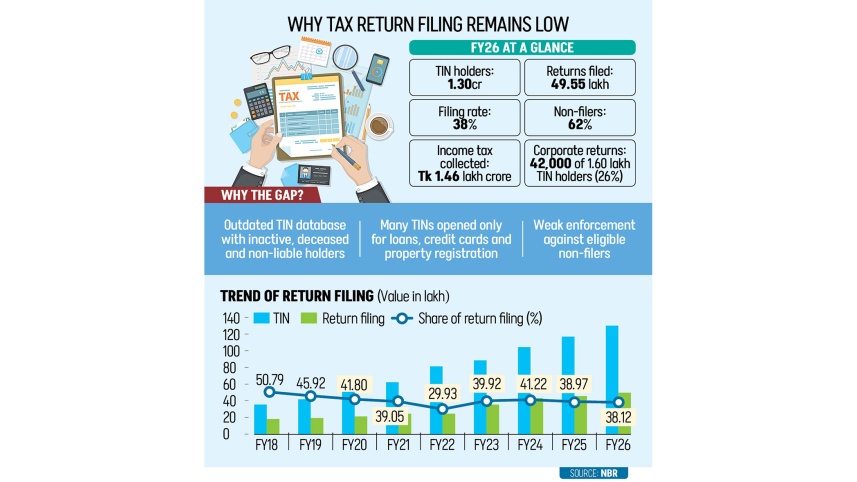
Although the deadline for filing income tax returns was extended four times until March, the return filing rate fell in fiscal year 2025-26 from a year earlier.
It was also the lowest in nearly a decade, except in FY22, when the economy was emerging from the Covid-19 pandemic, which disrupted personal incomes and business activity.

Only about 38 percent of registered taxpayers, including companies, filed income tax returns in FY26, highlighting a persistent gap between taxpayer registration and compliance despite a growing number of taxpayer identification number (TIN) holders.
Tax experts and business leaders attribute the low filing rate to two factors: an outdated and inflated TIN database containing many inactive registrants, and weak enforcement that leaves many eligible taxpayers outside the tax net.
To improve compliance, the National Board of Revenue (NBR) has introduced year-round return filing under the new Income Tax Act, strengthened enforcement and, most recently, offered a tax rebate of up to 5 percent for early filers.
Whether those measures will significantly improve compliance remains to be seen, experts say.
NBR data show the number of TIN holders rose 11 percent to 1.30 crore by June 2026 from 1.17 crore a year earlier. Yet only 49.55 lakh returns were filed, meaning nearly 62 percent of registered TIN holders did not submit returns despite repeated deadline extensions.
Income tax collection nevertheless rose 13.2 percent year-on-year to Tk 1.46 lakh crore in FY26 from Tk 1.29 lakh crore.
The stronger growth in tax revenue despite weaker return filing suggests collections still rely heavily on tax deducted or collected at source and advance tax payments rather than voluntary compliance.
The corporate picture is similar. Of 1.60 lakh corporate TIN holders, only 42,000 filed returns in FY26, up from 39,659 a year earlier.
Corporate income tax contributes about a quarter of total tax revenue. Yet collections amount to only 1.5 to 1.8 percent of GDP, roughly half the level in peer economies, according to the Organisation for Economic Co-operation and Development (OECD), and below several small Latin American and Caribbean economies.
The shortfall leaves the government more dependent on VAT, customs duties and borrowing, with the burden ultimately falling on ordinary people.

WHY COMPLIANCE LAGS
Both Kamran T Rahman, president of the Metropolitan Chamber of Commerce and Industry (MCCI), and Snehasish Barua, director of SMAC Advisory Services Limited, attribute much of the mismatch to an outdated database.
Many TINs were issued not because their holders had taxable income, but because a TIN is required to buy land, register property, open a bank account, obtain a credit card or secure a loan, Kamran said.
Others belong to people who have since died, left the country or become inactive, yet their records have never been removed.
“The database should be updated regularly so that inactive TINs are removed. That will give a more realistic picture of the country’s active taxpayer base,” he told The Daily Star on Saturday.
The two, however, differ on priorities.
Kamran said even the return-filer count overstates compliance because many returns show zero tax due. The priority, he argued, should be expanding the pool of active taxpayers rather than increasing the number of TIN holders, or “the burden will keep falling on existing compliant taxpayers.”
Snehasish, by contrast, said cleaning up the database alone would not solve the deeper problem. A large pool of eligible taxpayers remains outside the net, and the real solution is enforcing existing rules, particularly the mandatory Proof of Submission of Return (PSR) requirement under Section 264 of the Income Tax Act.
 For all latest news, follow The Daily Star's Google News channel.
 City corporations renewing trade licences, banks accepting large term deposits or opening letters of credit, and chambers issuing memberships should require a PSR wherever the law mandates it.
“The NBR needs to first run awareness sessions and then work closely with these institutions to enforce the existing provisions.”
Both Kamran and Snehasish were sceptical that the NBR’s year-round filing option and incentives for early filers would move the needle.
“People who already file returns will continue to do so,” Snehasish said.
“The incentives may encourage some small taxpayers, but they are unlikely to persuade habitual non-filers or large taxpayers.”
Kamran agreed. He said that without a fully digitised tax administration and firmer enforcement, the tax net is expanding, but the pace is still too slow.
NBR’S POSITION
Md Rafiqul Islam Chowdhury, NBR member for tax survey and inspection, pushed back against interpreting the low filing rate as evidence of widespread tax evasion, echoing concerns raised by Snehasish and Kamran about the TIN database.
A significant share of TINs, he said, likely belongs to people who have died but whose records have not been purged, or to people who obtained TINs for credit cards or bank loans without ever having a filing obligation.
Rafiqul said business closures in recent years have also contributed to the low filing rate, as many taxpayers have since become inactive.
He added that thousands of teachers and other professionals were brought into the tax net through administrative drives, but many may no longer be filing returns.
To improve compliance, the NBR has introduced year-round return filing under the new Income Tax Act and strengthened enforcement. Tax offices can now simultaneously issue notices requiring taxpayers to file returns and impose penalties on non-filers.
Rafiqul expressed optimism that year-round filing, stronger enforcement and incentives for early filers would encourage more taxpayers to submit returns in the coming years as Bangladesh seeks to raise its tax-to-GDP ratio, one of the lowest in South Asia.
Comments