


Time to scale solar power is now

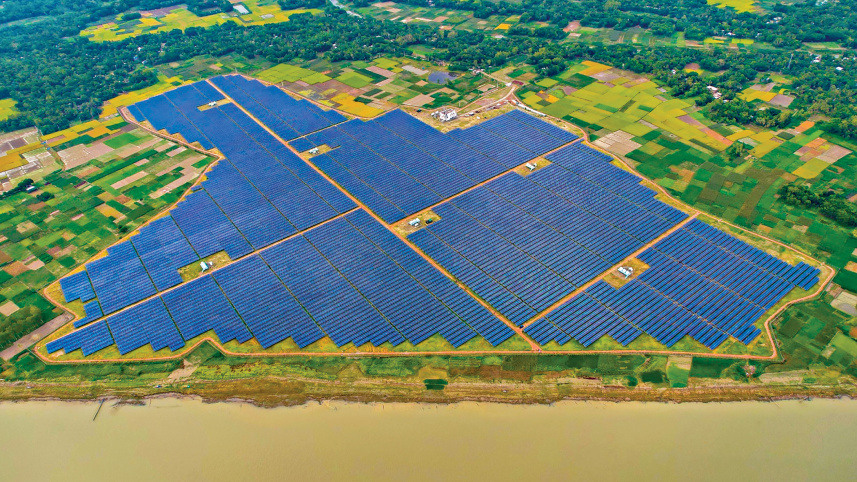
Solar power is often discussed as a policy ambition in Bangladesh, one which has become more pertinent given the ongoing global energy uncertainty and price volatility.
Bangladesh’s energy security depends on how quickly renewable ambitions translate into real projects -- spearheaded by solar.

Developing around 5,000 Megawatt peak (MWp) of solar could require over Tk 35,000 crore in generation investment, excluding land and supporting infrastructure -- making bankable projects and investor confidence essential.
In Bangladesh, 1 MWp of solar capacity can generate roughly 1.4 million kilowatt-hour (kWh) annually, highlighting solar’s potential contribution to the national power supply.
International experience shows that countries can scale solar from negligible levels to 20–30 per cent of installed capacity within a decade or even faster when supported by clear policy frameworks, bankable procurement structures and coordinated infrastructure planning.
Despite repeated policy commitments and long-term energy planning, solar deployment in Bangladesh has remained limited -- and this is solely because of an incomplete implementation framework.
In several cases, projects were awarded without confirmed land access, grid interconnection or developers demonstrating the financial and technical capability required to deliver utility-scale projects.
As a result, many projects lacked the capacity to achieve financial closure or progress to construction within expected timeframes.
Solar prices are influenced by technology costs but, in Bangladesh, are primarily driven by financing conditions, land constraints, infrastructure requirements and project risks.
While concessional financing is available, the challenge is deploying it at scale. Lower financing costs require reducing project risk through bankable power purchase agreements (PPAs), strong payment security and credible project pipelines.
Institutions such as Infrastructure Development Company can play a role through blended finance and credit enhancement structures, particularly if scaled and aligned with utility-scale project requirements, while foreign exchange risk mitigation can help unlock international capital.
The transition toward competitive solar tenders represents an important step forward.
Successful projects require key fundamentals from the outset. Developers should demonstrate secure land rights, confirm sites are dispute-free and obtain preliminary grid interconnection approval.
Financial capability should be supported by credible commitments from experienced institutions, with bid bonds and performance guarantees discouraging speculative participation.
Once a project is awarded, clear and enforceable timelines should govern each stage of development.
Power purchase and implementation agreements should be executed within three months of award, followed by financial closure withinsix months of PPA signing. Construction should then be completed within 12–18 months, depending on project size and site conditions.
Delays at any stage should trigger defined penalties, including encashment of performance guarantees.
Without disciplined timelines, projects risk remaining in prolonged development phases without progressing to construction.
Land and grid access remain two of the biggest barriers to scaling solar in Bangladesh.
Utility-scale solar is inherently land intensive: every 1,000 MWp of ground-mounted capacity typically requires roughly 2,200–2,300 acres. In a densely populated country, securing suitable sites becomes a major challenge. The ‘solar park’ model offers a practical solution.
 For all latest news, follow The Daily Star's Google News channel.
 Under this approach, government agencies prepare land and supporting infrastructure such as roads, drainage and substations before leasing plots to private developers.
By addressing land and grid constraints upfront, solar parks can significantly reduce development risk, lower costs and accelerate project timelines. Targeted fiscal incentives can help accelerate investment during the early stages of solar expansion.
Policies such as tax holidays, reduced or zero import duties on solar modules, inverters and key balance-of-system components and accelerated depreciation for renewable energy assets can significantly lower capital costs.
Because much solar equipment is imported, such measures can materially improve project economics and support more competitive tariffs. Rooftop solar offers a fast-track pathway for expansion. Approximately 6,000 square metres of roof space can support around 1 MWp of solar capacity.
Large factory rooftops provide suitable space for distributed generation, while net metering and third-party PPAs can enable deployment without upfront investment.
As solar capacity grows, complementary technologies such as battery storage will help manage intermittency and support grid stability.
Bangladesh has both the demand and the opportunity to scale solar power rapidly. The challenge now is execution.
The author is a strategic consultant across technology, media and infrastructure industries
Comments