


War pain spreading fast across industries


When the United States and Israel launched attacks on Iran on February 28, the first signs of trouble in Bangladesh were felt at airports. Flights to several Middle Eastern destinations were suspended, leaving migrant workers stranded and creating chaos at Dhaka airport.
Within days, the strain began to show elsewhere. Long queues formed at refuelling stations as fuel supplies tightened.

By April, a month into the Middle East war, the fallout had begun to seep into everyday life. Kitchen items such as green chillies and tomatoes now arrive in the same polythene bag, as the cost of producing single-use bags has risen.
Yesterday, authorities increased the price of cooking gas cylinders, a move that will filter through to food prices, from biscuits to biryani in fine dining restaurants.
The Middle East is the country’s key source of fuel oil, liquefied natural gas, fertilisers and petrochemicals. Amid the war, oil and gas suppliers in the Gulf have either raised prices or suspended deliveries altogether.
For a country heavily reliant on imported energy and chemical inputs, the disruption is biting hard. Freight rates have climbed, shipping schedules have become erratic, and manufacturers say that rising raw material costs could slow production across sectors.
Export-oriented industries were among the first to feel the shock.
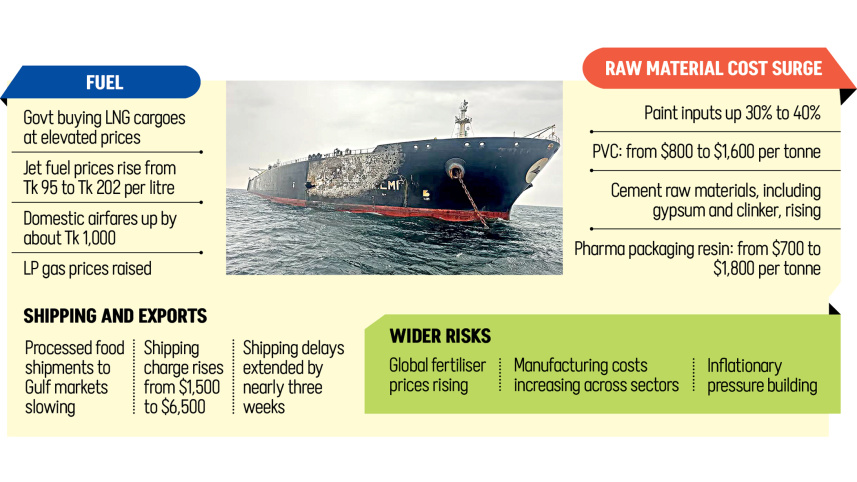
Shipments of processed food and agricultural products to Gulf markets have suffered as freight charges surged fourfold and new orders slowed.
Before the war, sending a container of processed food from Chattogram port to the Middle East market cost about $1,500. Manufacturers say rerouting has pushed that figure to roughly $6,500.
The aviation sector is also under pressure.
Jet fuel prices in the international market have surged from around $0.62 to $1.32 per litre amid supply uncertainties. In Bangladesh, prices have jumped from Tk 95 to about Tk 202 within a short period.
To offset the increase, airlines have raised domestic airfares by about Tk 1,000 on several routes, said Kamrul Islam, general manager of US-Bangla Airlines.
Paint manufacturers are grappling with similar challenges.
Mohsin Habib Chowdhury, director and chief operating officer (COO) of Berger Paints, said about 25 percent of the industry’s raw materials come directly from the Middle East, with another 30 percent indirectly linked to the region.
Supplies are “drying up fast”, he said.
Chowdhury said freight costs have risen by $1,000 to $2,000 per shipment, and lead times have stretched by nearly three weeks. At the same time, prices of key ingredients have increased by 30 to 40 percent, leaving companies little room but to adjust prices.
Even then, he said, there is a risk of supply shortage.
Steel producers face a different but equally serious squeeze.
Sumon Chowdhury, secretary general of Bangladesh Steel Mill Association, said disruption to shipping routes through the Strait of Hormuz has led to container shortages and delays.
Freight costs have almost doubled from about $1,200 to $2,200 per shipment. Scrap prices in global markets have increased by $70-$90 per tonne.
 For all latest news, follow The Daily Star's Google News channel.
 “Although raw materials for steel are not directly sourced from the Middle East, the sector is being hit by cascading global supply chain disruptions,” he said, adding, “Manufacturers are still supplying products at older rates using existing inventory, but domestic prices have already started to rise.”
The plastic industry, which supports nearly 30,000 businesses, is also under a severe strain.
Shamim Ahmed, president of the Bangladesh Plastic Goods Manufacturers and Exporters Association, said prices of key inputs such as PET, polypropylene and PVC have soared in line with oil market volatility. PVC alone has nearly doubled from around $800 to about $1,600 per tonne.
Bangladesh imports more than 1.2 million tonnes of resin each year. The price surge has pushed many factories to break even, with some already shutting down.
Shamima Akhter, director of corporate affairs, partnerships and communications at Unilever Bangladesh Limited, said the conflict has created significant operational challenges because of the company’s reliance on imported inputs.
“A substantial part of our portfolio depends on inputs sourced from the region,” she said, adding that Linear Alkyl Benzene, a key ingredient used in detergent production, has been particularly affected by supply disruptions and global shortages linked to the crisis.
Akhter said higher costs for raw and packaging materials, volatile fuel prices and delays in international freight are driving up procurement and operating expenses.
“These factors are driving up procurement and operational costs, which may impact the production and supply of high-volume FMCG [Fast-Moving Consumer Goods] products,” she said.
Cement makers are also feeling the heat.
Mohammed Amirul Haque, managing director of Premier Cement Mills PLC, said prices of clinker, limestone and gypsum sourced from the Middle East have risen by 30 to 40 percent. Gypsum has increased from about $21 to nearly $30 per tonne, while clinker has climbed from $42 to as high as $54 per tonne.
Manufacturers have raised prices by Tk 10 to Tk 15 per bag, and retail prices have increased by Tk 25 to Tk 30.
Haque said private companies have limited capacity to absorb such shocks, making adjustments unavoidable.
Abdul Muktadir, president of the Bangladesh Association of Pharmaceutical Industries, said limited operations by major international airlines have disrupted supply chains, while rising fuel prices have sharply increased transport costs.
Most raw materials used in drug production are petrochemical-based, he said. The cost of resin for packaging has more than doubled from about $700 to $1,800.
Manufacturers are now using their existing inventories. As new consignments arrive at higher prices, production costs are expected to rise further, he added.
Sazzadul Hassan, chairman and managing director of chemical company BASF Bangladesh Limited, said the chemical industry is under particular strain because it depends on gas both as fuel and as feedstock.
He said the pharmaceutical industry, which imports nearly 90 percent of its active pharmaceutical ingredients, is also facing mounting pressure. Prices of key inputs such as paracetamol and metformin have jumped by 50 to 90 percent.
Any prolonged disruption, Hassan said, would threaten the supply of essential medicines.
He mentioned the country’s readymade garments sector, heavily dependent on imported synthetic fibres, dyes and finishing chemicals, is also exposed. As lead times lengthen and input costs surge, export competitiveness risks being eroded.
“The war may be taking place thousands of miles away, but its economic shockwaves are already coursing through Bangladesh. Prices are rising, supply chains are fraying, and businesses are bracing for a prolonged period of uncertainty,” said Hassan.
Comments