


What does the war mean for remittances?

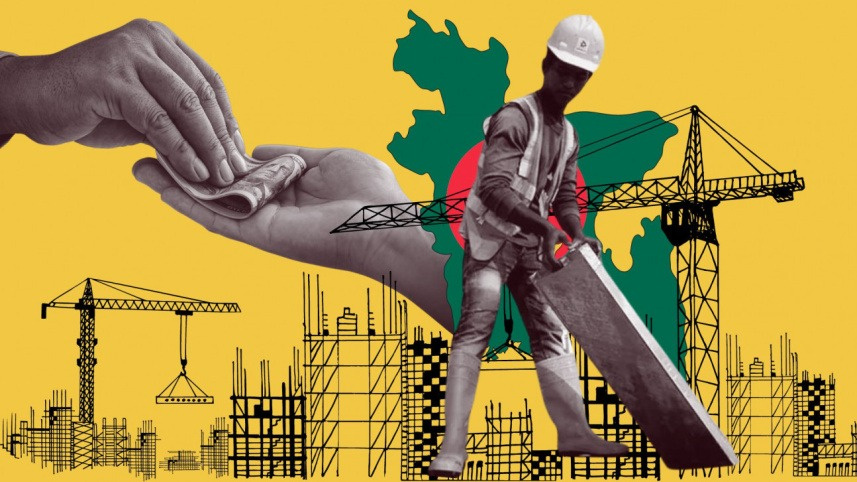
The ongoing military escalation involving the United States, Israel, and Iran is disrupting global transport routes, airspace access, and economic activity in the Gulf region. For Bangladesh, where labour migration to and remittance inflows from the Middle East are crucial, the conflict poses serious economic risks.
Labour migration has long been a key income source for millions of families, with remittances serving as the country’s second-largest growth driver after exports. Since 2000, remittances have risen sharply, peaking at around 10 percent of GDP and contributing 1-1.5 percent to annual growth, while supporting household spending, foreign exchange reserves, and the balance of payments.

The conflict has already led to the cancellation of 335 flights and suspension of key routes connecting Bangladesh to Gulf countries. Thousands of Bangladeshi workers on leave are unsure when they can return to their jobs, while many outgoing migrants remain stranded despite spending large sums to secure employment abroad.
“This is especially difficult for outgoing workers. Many spend between Tk 3 lakh and Tk 4 lakh on recruitment, visas, and travel,” said Shariful Hasan, associate director of BRAC’s Migration and Youth Programme. “If departures are delayed and visas expire, employers may hire workers from other countries. This leaves migrants with debt and no job abroad.”
Bangladesh’s labour migration system relies on continuous mobility. Migrants usually take short leave and return quickly to maintain their contracts, but prolonged travel restrictions put many at risk of losing their jobs.
In 2025, the country received a record $32.8 billion in remittances, with nearly 47 percent coming from Middle Eastern countries.
Since fiscal year 2025, 8.6 million migrants found jobs abroad, with Saudi Arabia employing 48 percent of them. Overall, Middle Eastern nations—including Saudi Arabia, Oman, Qatar, the UAE, and Kuwait—accounted for 75 percent of all overseas employment, according to the Bangladesh Economic Review 2025.
Migration expert Asif Munier said, “The main concern is not whether workers can send money home, but whether they will continue to earn. If economic activity slows or stops due to security concerns, many migrant workers may lose wages.
“This is especially true in informal sectors, where many Bangladeshis work in small shops, construction sites, transport services, and other temporary jobs.”
He added, “These workers are often paid daily or weekly and have limited job protection. If businesses slow or close temporarily, income drops immediately, reducing remittance flows. This could be significant in the UAE, Kuwait, Bahrain, and parts of Saudi Arabia.”
“These income shocks could gradually affect rural economies in Bangladesh, where remittances support household spending, education, healthcare, and small investments,” Munier said.
“About 20 to 25 districts strongly rely on remittances for economic activity. Lower remittances could reduce spending in local businesses, housing construction, and agriculture. Over time, this could also pressure Bangladesh’s foreign currency reserves, which depend on remittances alongside garment exports.”
RISING FUEL COSTS AND ECONOMIC RIPPLE EFFECTS
The conflict has pushed global oil prices up due to fears of supply disruptions in the Middle East. Bangladesh, which imports most of its fuel, faces rising costs. Higher fuel prices raise the import bill, widen the trade deficit, and increase production and transportation costs, adding to inflation.
However, the link between oil prices and employment in the Gulf is complex. Historically, higher oil prices increased government revenues in Saudi Arabia, the UAE, and Kuwait, often leading to more spending on infrastructure and development projects, creating jobs for migrant workers.
“If prices remain high but conflict does not escalate, Gulf governments may increase spending, potentially creating new opportunities for foreign workers, including Bangladeshis,” Munier said.
In the short term, he stressed, informal sector workers are the most vulnerable. “Security restrictions, closures, or reduced activity can leave workers without income. Unlike formal employees, many informal workers do not get paid if work stops. They are the most exposed group in the current crisis.
“If the conflict continues, immediate effects include lower income for these workers and reduced remittances to Bangladesh.”
Abdul Hai Sarker, chairman of the Bangladesh Association of Banks, and Selim Raihan, professor of economics at the University of Dhaka and executive director of SANEM, said the impact on remittance inflows will depend on how long the conflict lasts and how the situation develops.
Raihan said, “If economic activities slow down, Bangladeshi workers will face job or income losses. In the short term, remittances could temporarily rise as some workers send savings home due to uncertainty. But this should not be seen as a positive sign.”
 For all latest news, follow The Daily Star's Google News channel.
 On the medium-term outlook, Raihan warned, “If the war prolongs, the economies of those countries may shrink. That would reduce employment opportunities for migrant workers. Many returning workers may struggle to find jobs when the domestic economy is already under stress.”
Mohammad Fakhrul Islam, former joint secretary general of the Bangladesh Association of International Recruiting Agencies, said the crisis affects both workers abroad and those preparing to travel.
“One group is migrants already in the Middle East. Another group is workers on leave in Bangladesh who cannot return because flights have been cancelled,” he said. “Some have finished medical tests and other formalities, but the conflict situation has stopped their departure.”
Fakhrul Islam noted that many Gulf companies have slowed or suspended operations. “If companies do not operate, they often do not pay wages. Without income, workers cannot send remittances to Bangladesh.”
He suggested Bangladesh explore alternative labour markets. “The government should look for new markets in East Asia and some European countries,” he said.
Comments