


Wheat imports exceed FY25 total with 2.5 months to go

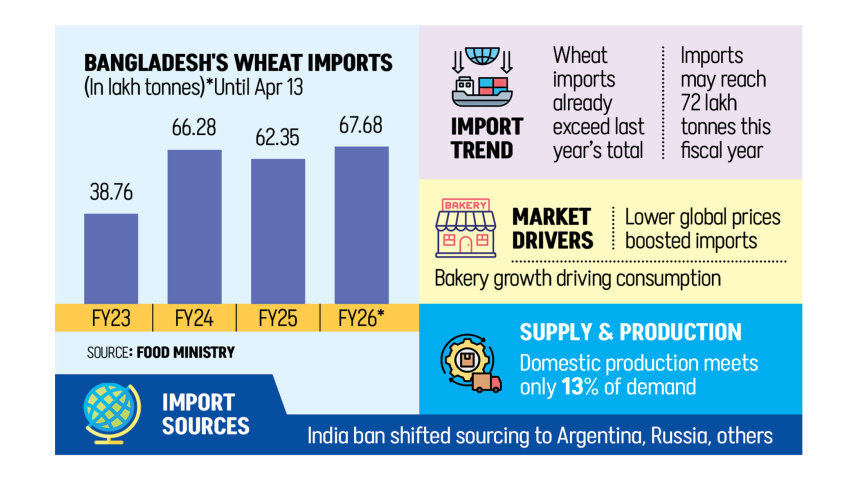
Bangladesh has imported a large volume of wheat within nine and a half months of this fiscal year, exceeding the total amount imported in the previous year.
This hike was driven by lower global prices, shifting food consumption patterns, and efforts to narrow the trade gap with the United States, importers said.

According to data from the Directorate General of Food, a total of 62.35 lakh tonnes of wheat were imported in the fiscal year 2024-25 (FY25), combining both government and private sectors.
On the other hand, a total of 67.68 lakh tonnes of wheat was imported during just the July-April period of the current fiscal year 2025-26 (FY26).
Wheat imports in FY26 may reach 72 lakh tonnes, a recent assessment of the Ministry of Food said, reflecting good domestic demand and market conditions.
LOWER PRICES, HIGHER DEMAND
Md Aminul Islam, managing director of Nabil Group, attributes this rise in imports to relatively lower prices in the international market a few months ago. As a result, imports arrived at significantly lower rates.
The fall in global wheat prices encouraged many importers to bring in shipments during the November-December period, said an official at a leading commodity importing and processing company.
Prior to November shipments, wheat was priced at around $275-$280 per tonne. However, during the November-December period, the price dropped to approximately $255 per tonne, the official added.

In Bangladesh, wheat is the second most significant cereal after rice. Local production accounts for approximately 13 percent of the national demand, according to a recent report by the US Department of Agriculture (USDA).
The report forecasts marketing year (MY) 2026-27 wheat harvested area and production at 290,000 hectares and 10.5 lakh tonnes, the same as MY 2025-26 estimates.
A lack of improved varieties has led to a gradual decline in both wheat acreage and production over time. Wheat blast disease, which reduces yields significantly, is one reason for stagnant production, the USDA said.
Meanwhile, food, seed and industrial consumption of wheat in MY 2026-27 is forecast to be 80 lakh tonnes, USDA reports.
Anup Kumar Saha, executive director of Akij Insaf Group, one of the country’s wheat importers, said population growth and improved living standards have contributed to higher food demand.
At the same time, he observed that rice consumption has remained largely stable or has slightly declined.
While current data shows imports have not reached unusually high levels, they may eventually settle around 73 lakhs to 74 lakh tonnes, he suggested.
IMPORT AND CONSUMPTION DIVERSIFICATION
Traditionally, Bangladesh has sourced the majority of its wheat from India due to geographical proximity, the USDA said in the report.
Since India banned wheat exports in May 2022, Bangladeshi importers have sought alternative sources. In the MY 2025-26, Argentina emerged as one of the major wheat suppliers to Bangladesh, as it offers lower prices.
 For all latest news, follow The Daily Star's Google News channel.
 The other major wheat suppliers to Bangladesh include Canada, Ukraine, Russia, the United States, and Brazil, it said.
Bangladesh imports soft wheat primarily from Russia, Ukraine, and other European Union countries, which is mainly used for making cakes, cookies, pastries, and other baked goods.
Abul Bashar Chowdhury, chairman of BSM Group, one of the leading importers of consumer goods, said that rice prices are currently comparatively high, so people are leaning towards wheat as an alternative.
In developing countries, consumption typically increases with economic growth, and demand for wheat rises as it is widely used in fast food and bakery products, unlike rice, which is mainly consumed as steamed rice or a limited range of traditional dishes, he said.
He pointed out that between this year and last, the price of low-grade wheat in the international market has fallen to around $245. After adding cost and freight (CNF) in Chittagong Port, the price stands at about $450.
In contrast, even the lowest-grade rice is not available below $500, he said. Such a price gap is unusual and may have contributed to increased wheat consumption, he surmised.
Chowdhury further added that the government’s efforts to address the trade imbalance with the United States may have led to an increase in government-level imports compared to last year.
Comments