


Young workers in climate-vulnerable districts 21.7% less likely to have decent jobs: Study
Young people working in climate-vulnerable districts are 21.7 percent less likely to hold a decent job than their peers elsewhere in Bangladesh, according to a new study.
The gap holds across sectors, gender and age, and was statistically robust, claimed the study.

The findings were presented today at a dissemination workshop titled “Just Transition in Bangladesh: Economic Security and Transition Support for Young People”, jointly organised by the South Asian Network on Economic Modeling (SANEM) and ActionAid Bangladesh at a hotel in Dhaka.
The study surveyed 625 workers aged 15-35 across nine districts and four sectors -- agriculture, readymade garment (RMG), construction, and transport. It argued that while Bangladesh has committed to a “just transition” to a low-carbon economy, mechanisms to deliver it remain absent.
Government officials, employers’ associations and civil society representatives discussed the findings, pressing for national skills training aligned with emerging and declining jobs, better data on informal workers, and inclusion of polytechnic students and marginalised groups in future research.
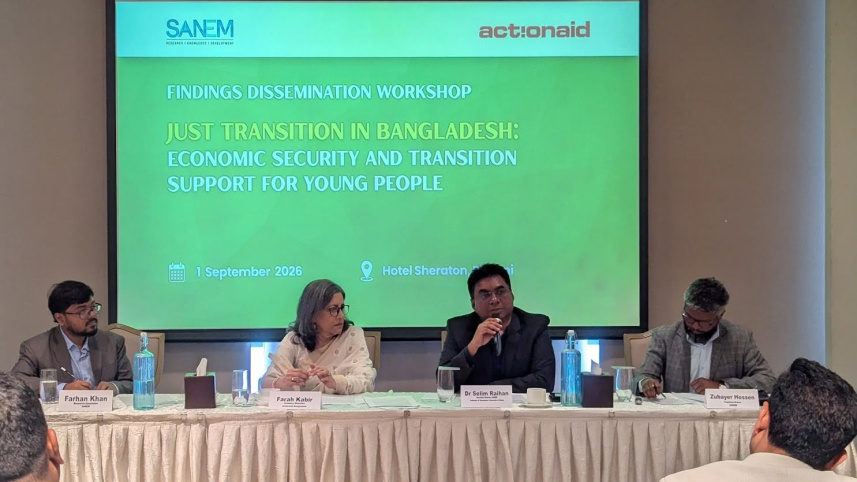
“Training alone is not enough if it is not linked to real jobs,” said Farah Kabir, country director of ActionAid Bangladesh, who chaired the event. She called for vocational training relevant to employers, stronger social protection for informal and construction workers, and meaningful youth involvement in shaping the transition.
The study found construction workers have almost no wage or injury protection, with compensation for workplace deaths capped at Tk 2 lakh, often unpaid. Construction and transport workers reported the highest exposure to hazards. Among transport workers, 94 percent reported dust exposure, 93 percent noise, and 89 percent heat.
Transport ranked lowest on livelihood security -- combining income stability, contract status and social protection.
Garment workers fared best. After adjusting for earnings, age, district and gender, a young garment worker was 55.5 percent more likely to hold a decent job than one in transport, mainly due to higher rates of written contracts.
When asked what support they wanted during a transition, young workers across all sectors overwhelmingly chose cash support and job matching, the study said.
 For all latest news, follow The Daily Star's Google News channel.
Comments