


Bangladesh to get slight tariff edge over China, Vietnam in US

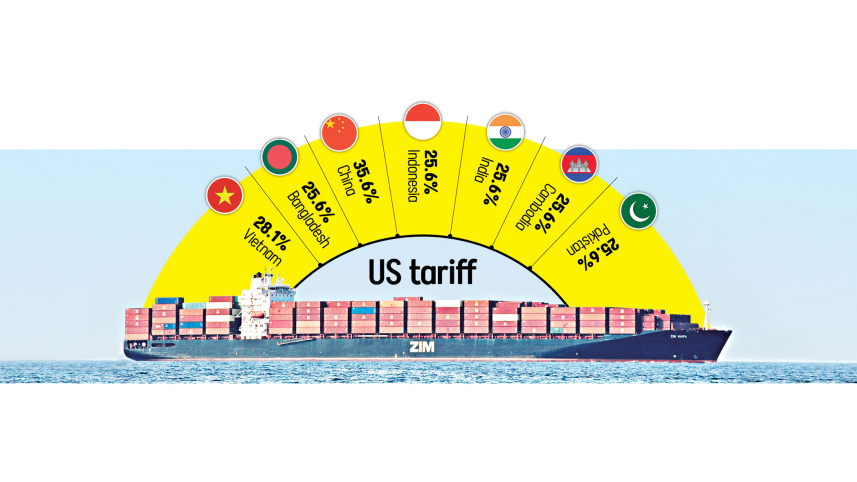
Bangladesh will get a small benefit in garment exports to the US as its effective final tariff rate is slightly lower than those faced by China and Vietnam, two major competitors in the global apparel supply chain.
The US on July 24 imposed a new 10 percent duty on exports from Bangladesh to the American market, citing imports of goods produced with forced labour. With that, the country’s effective tariff rate now stands at 25.6 percent.

Meanwhile, China currently faces an effective tariff of 35.6 percent on garment exports to the US, including the 7.5 percent surcharge imposed in 2020, while Vietnam faces a rate of 28.1 percent.
An effective tariff rate is the overall import duty after taking into account all applicable US tariffs and surcharges on a product.
India, Indonesia, Pakistan and Cambodia face the same 25.6 percent duty as Bangladesh, according to data from the Tariffs Tool, a resource for estimating US import duties and understanding the tariff landscape.
The tariff rates were verified by Research and Policy Integration for Development (RAPID), a research organisation based in Dhaka.
While the lower rate compared with China and Vietnam gives Bangladesh a competitive advantage, local garment exporters and economists say the benefit may be limited because the difference is not large and other factors, such as the ongoing energy crisis, are affecting production and shipments.
AK Azad, chairman of Ha-Meem Group, which ships the majority of its garments to the US, said the lower effective tariff rate could benefit Bangladesh, although the domestic energy crisis is affecting production.
Azad said that US retailers are not considering the duty but are instead asking for timely shipment of goods as production at industrial units is being affected.
“The government should resolve the energy crisis soon so that the local exporters can enjoy the benefit of lower rate to the American market,” he added.
MA Razzaque, chairman of RAPID, said that US tariff policy remains uncertain as the current US administration changes the rates frequently.
“Moreover, the difference in tariffs on Bangladesh compared with China and Vietnam is not too much. So, Bangladesh may not benefit much from the lower tariff rate compared to its key competitors in the US market,” he said.
“Overall, the tariff has been increased, and this is the fact,” he said, adding that because of the increase, US buyers would either reduce the price of garments or ask local suppliers to share part of the additional 10 percent duty imposed recently.
Razzaque said China has created some connector destinations such as Vietnam and Mexico through which it can do good business by producing garments and shipping them to the US. Bangladesh has no such connector destinations yet.
“But it is true that numerically, Bangladesh’s tariff is lower than China and Vietnam, which matters less now,” he said.
However, Inamul Haq Khan, senior vice-president of Bangladesh Garment Manufacturers and Exporters Association (BGMEA), is hopeful that Bangladesh will benefit from the lower tariff.
Garment exports from Bangladesh to the US totalled $4.01 billion in the January-June period of this year, down 5.75 percent year-on-year, according to data from the Export Promotion Bureau.
Inamul said that although shipments to the American market are gradually rebounding recently, Bangladesh’s garment exports to the US might not increase much because of the lower rate.
He also said the energy crisis has been affecting production significantly.
Mohiuddin Rubel, founder and CEO of Bangladesh Apparel Voice, said buyers look at the total landed cost of garments rather than tariffs alone.
 For all latest news, follow The Daily Star's Google News channel.
 “The rate advantage only becomes a lasting one when we manage our capabilities better than competitors,” he said.
That means securing adequate energy, ensuring efficient port handling and keeping other costs under control, he added.
“Bangladesh also needed to shift towards non-cotton products and make use of its clean record,” he said.
Comments