


Dollar gets its mojo back - but only by default
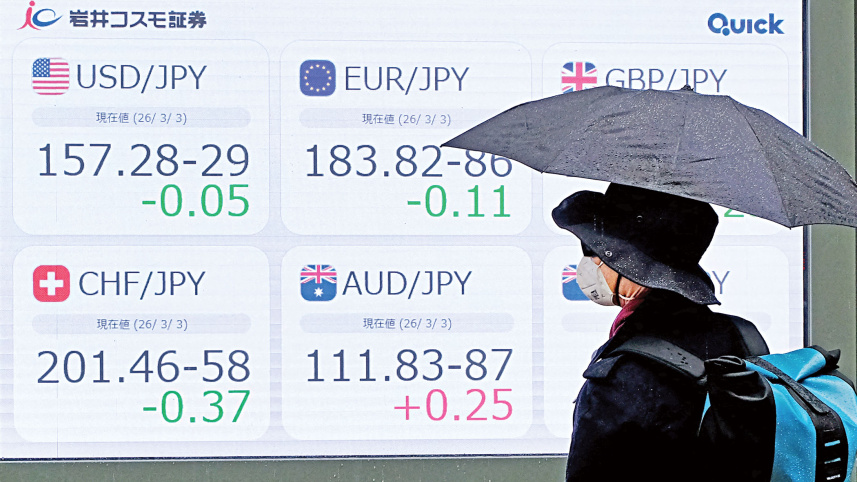
While it’s tempting to assume the dollar’s long-lost “safety” bid has returned since the weekend Iran attacks, it’s not as clear-cut as it seems and owes more to relative energy plays. Yet the implications of the market response may be just as powerful.
Ever since Donald Trump’s return to the White House last year, the dollar has waned even during periods of market anxiety and volatility, due in large part to US economic policy uncertainty and both domestic and geopolitical upheaval.

Reversing years of dollar over-valuation is a key tenet of the Trump administration’s economic plan. But the greenback’s diminished haven role in times of global political or financial stress suggests foreign investors - already up to their eyeballs in US assets - have changed their behaviour.
So it was remarkable that the dollar jumped across the board after last weekend’s extraordinary bombing campaign by US and Israeli forces against Iranian targets, including the assassination of Supreme Leader Ali Khamenei and the wave of regional violence that’s followed.
The crux of the move hinged more on the inevitable energy price dynamics rather than any dash for dollars per se. In fact, it was more a default move out of the currencies of economies worst hit by an outsized and protracted energy price squeeze.
DOLLARS BY DEFAULT
With the US now a net exporter of total petroleum and energy products in general, the initial 10 percent surge in world oil prices on Monday hurt other major currencies much more due to fears of a major demand hit if the supply hiatus persists for several weeks or even months.
That’s why other traditional havens such as Japan’s yen , caught no safety bid this time around and plunged over 1 percent against the dollar on Monday given Japan’s big energy import bill and the fact that about a third of its energy imports comes through the Strait of Hormuz.
China too is a big consumer of oil now stuck in those contentious waterways, particularly deeply discounted Iranian crude that’s sanctioned in the West and now also in limbo. The recently high-flying yuan turned tail on Monday and dropped 0.8 percent as the situation unfolded.
“This isn’t a friendly outcome for the Northern Asian currencies,” said Societe Generale currency strategist Kit Juckes, adding that the most important indication from Trump so far has been that the US action will take weeks, not days.
For Europe, the calculation is compounded by its exposure to natural gas after the shipping attacks effectively closed the Hormuz route, a conduit for 20 percent of worldwide liquefied natural gas shipments and up to 30 percent of crude oil.
Benchmark European gas prices surged by almost 50 percent at one point on Monday to their highest in more than a year, closing up 35 percent and prompting the European Union’s gas supply group to schedule an emergency meeting for Wednesday.
A line chart of the price of the European gas benchmark contract in euros per megawatt hours (MWh) since October 1, showing increasing volatility since January.
A line chart of the price of the European gas benchmark contract in euros per megawatt hours (MWh) since October 1, showing increasing volatility since January.
The US supplied 58 percent of the European Union’s LNG last year. Qatar, which accounted for 6 percent of the bloc’s imports, shut down its production plants on Monday after attacks from Iran.
The euro fell 1 percent against the dollar to its lowest in more than a month.
The Swiss franc’s long-standing and often unwelcome haven status remains in play - but it’s complicated by the Swiss National Bank’s battle against deflation and its restated commitment to intervene to sell francs to cap the unit.
READY RECKONERS?
As to the overall economic hit from an oil spike worldwide, Barclays economists assume every sustained $10 per barrel rise in crude prices takes up to 0.2 percentage point off global growth. And if a wave of forecasts of $100-plus per barrel were to prove accurate, then that could well bite.
As it stands, however, Monday’s net Brent crude price rise of $5 to $77 per barrel will be a much more modest blow - and the moves so far would barely have any significant demand impacts on the US itself.
 For all latest news, follow The Daily Star's Google News channel.
 Calculations then turn to whether oil price pressure becomes an economic depressant or inflation aggravator. With US core inflation running above 3 percent, that could argue for more focus on the latter and for keeping US interest rates high through the year - another support for the dollar.
But, as so often with Middle East conflicts, the initial ready-reckoners on global economic hits all hinge on duration of conflict and the energy supply disruption.
Trump has indicated the military campaign will run for four or five weeks and, likely riffing off that, prediction markets such as Polymarket see a 63 percent chance Trump will call a halt by the end of this month.
And yet most of the thinking on currency reactions is not strictly calculations of dollar hoarding or cross-border dash for safety - rather they seem just like relative economic assessments emanating from energy exposure.
But for all that, it can have a powerful and looping effect.
Barclays’ rule of thumb for the dollar, for example, is that it gains between 0.5 percent and 1.0 percent for every $10 increase in oil.
If dollar‑denominated energy prices rise and stay high, pushing the exchange rate up with them, that would both worsen the energy shock for overseas economies and drive the dollar even higher in a self‑reinforcing loop.
No one would want that scenario - least of all Washington.
Comments