


Telcos may need just 10% local ownership
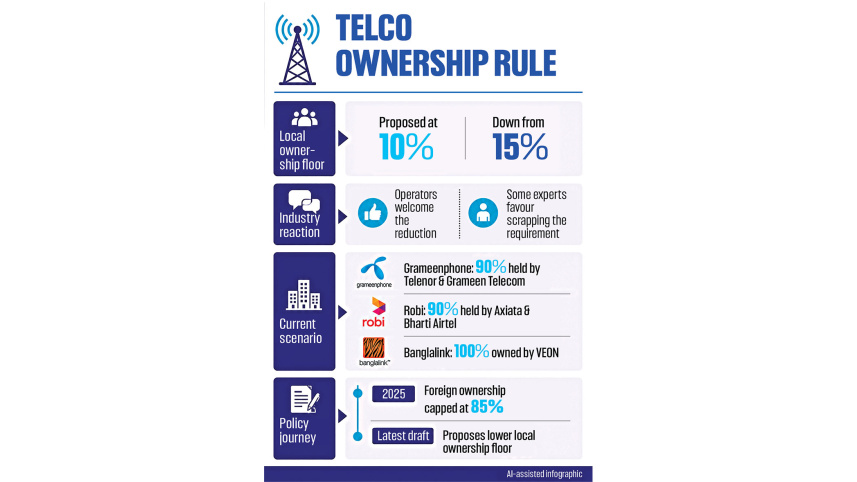
The government plans to cut the minimum local ownership requirement for mobile operators to 10 percent from 15 percent, according to the latest draft of the Telecommunications Network and Licensing Policy.
The draft, seen by The Daily Star, says operators would have to maintain the 10 percent local ownership through an approved ownership structure while maintaining substantial operations in Bangladesh.

The proposal has received mixed reactions from industry players and experts. Some have welcomed the reduction, while others say the government should remove the local ownership requirement altogether.
Shahed Alam, chief corporate and regulatory affairs officer at Robi Axiata, said the earlier restriction on foreign investment in existing telecom companies was not fully consistent with existing laws or the government’s commitments.
He said the restriction did not appear to comply with the Foreign Direct Investment Protection Act or the government’s pledge not to force existing foreign investors to sell their stakes.
“We welcome the latest move to restore and reaffirm this commitment,” Shahed told The Daily Star. “This is a positive step towards maintaining policy consistency, strengthening investor confidence and reinforcing Bangladesh’s commitment to a predictable and investment-friendly environment.”
Taimur Rahman, head of corporate and regulatory affairs at Banglalink, said the company had consistently argued that a mandatory local ownership requirement could discourage foreign investment.
Greater local participation could be encouraged, he said, but it should not be compulsory.
He also called for meaningful consultation with telecom operators before any policy changes are finalised.
Major Gen (retd) Md Emdad Ul Bari, chairman of the Bangladesh Telecommunication Regulatory Commission (BTRC), said the government would make the final decision on foreign ownership.
“Fundamentally, we believe there could be majority foreign ownership at the local infrastructure layer, while ownership at the international layer should remain with local operators,” he said.
The ownership structures of the country’s three private mobile operators show their strong reliance on foreign investment.
At Grameenphone, Telenor owns 55.8 percent and Grameen Telecom 34.2 percent, while the remaining 10 percent is held by public and institutional investors, according to BTRC data.
Malaysia’s Axiata and India’s Bharti Airtel own 61.82 percent and 28.18 percent of Robi respectively. The rest is held by general investors.Banglalink is fully owned by Dubai-based VEON. Meanwhile, state-owned Teletalk has less than 3.5 percent of the mobile subscriber market.
A YEAR-LONG DEVELOPMENT
In September 2025, the interim government approved the Telecommunications Network and Licensing Policy, limiting foreign ownership in the network access licence category, which covers mobile operators, to 85 percent.
The move effectively required at least 15 percent local ownership. Robi and Banglalink had criticised the proposal and called for the requirement to be removed.
In July 2025, the CEOs of Axiata Group, Telenor Asia and VEON wrote to the interim government, urging it to reconsider the restrictions. They warned that applying the foreign ownership limit to existing investments could hurt future investment and slow the sector’s growth.
After the policy was approved, BNP leaders called for a review.
At an event in November 2025, Amir Khosru Mahmud Chowdhury, who now heads the planning and finance ministry, said the policy needed to be reviewed to protect the interests of citizens, the country and investors.
 For all latest news, follow The Daily Star's Google News channel.
 At the same event, Jahiruddin Swapan, then a member of the BNP chairperson’s advisory council and now the prime minister’s political adviser, said the policy gave foreign investors an advantage because of their technological capabilities and left local entrepreneurs at a disadvantage.
After taking office, the BNP-led government proposed raising the local ownership requirement to 20 percent, according to industry officials familiar with the matter.
The proposal, however, faced opposition from telecom operators and Malaysian government officials, the sources said.
The Daily Star could not independently verify the claims.
The government has now settled on a 10 percent threshold in the latest draft.
Abu Nazam M Tanveer Hossain, a telecom expert, welcomed the move.
“Encouraging local ownership can deepen domestic participation in the digital economy and should be a positive long-term objective,” he said.
However, he said the requirement needed to take into account the different ownership structures of Bangladesh’s mobile operators and the sector’s heavy reliance on foreign capital.
“Any mandatory threshold must therefore be carefully calibrated. Telecom remains highly capital-intensive and dependent on sustained foreign investment,” he said.
A 10 percent requirement, he added, offers a better balance between encouraging local participation and avoiding a policy that could discourage investors.
Comments