


A US quincentennial will also hinge on immigrants
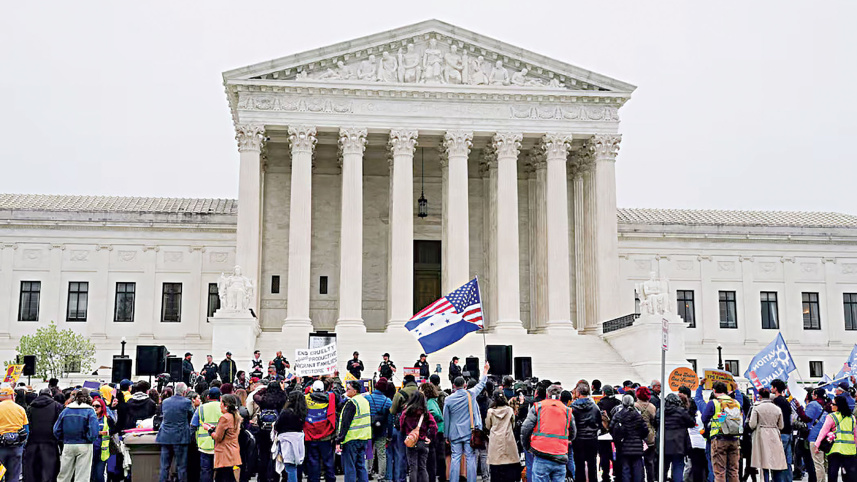
The not-so-secret formula to 250 years of US success is immigration. As the country prepares to commemorate the anniversary of its Declaration of Independence, however, Washington powers that be are using every tool available to crack down on this essential component of the American experiment. Entrepreneurship, higher education and healthcare all rely on welcoming newcomers from other nations. A festive quincentennial party in 2276 depends on nurturing these demographic and economic trends.
The benefits of accepting migrants are as self-evident as stated truths, like all men are created equal, in the founding document signed in Philadelphia. Enslaved Africans, brought inhumanely across the ocean against their will, built the southern US economy in the years before the Civil War. Europeans for the most part provided the labor to develop northern industrial powerhouses such as New York and Chicago.

Asian workers constructed US railroads, western cities and shipyards in the 1800s. Arrivals from Latin America and the Caribbean supplied the backbone of agriculture and manufacturing, not to mention the first US Treasury secretary, Alexander Hamilton.
Following a surge of asylum seekers during the Biden administration, which led to spikes in immigrant populations, President Donald Trump initiated a harsh reversal last year. Although many of his restrictive efforts face legal challenges, they include ending protections for millions seeking to escape persecution at home.
One policy imposes $100,000 fees for specialized H1-B visas, another essentially ends refugee admissions except for white South Africans. Highly publicized deportation campaigns, often at odds with court orders, are trying to make foreign-born communities unsustainable.
There have been regular periods of ebb and flow in American history. Between 1920 and 1965, for example, nativist fears led to tight quotas: 70 percent of available immigration slots were reserved for British, Irish and German citizens. Landmark legislation signed by President Lyndon Johnson reopened the gates. By 2024, the foreign-born population had returned to 15 percent, the same level as in 1910, from a nadir of less than 5 percent in 1970.
Immigration laws changed largely because of the dire need for more labor. Some controversial plans, like the Bracero program that invited guest agricultural workers from Mexico, were not designed to create permanent immigration. Tens of millions seeking US jobs over the past 60 years have nevertheless stayed and begat generations of new Americans, in part thanks to the US’s constitutional guarantee of birthright citizenship, which the Supreme Court upheld on June 30.
The US economy has thrived with their presence. Immigrants produce higher rates of entrepreneurship than natives: they are 80 percent more likely, per capita, to start a new venture. In addition to the millions of small businesses to their names, overseas-born inventors like Sergey Brin, Jensen Huang and Elon Musk helped start trillion-dollar Google, Nvidia and SpaceX, respectively. Immigrants are also more likely to have advanced educational degrees and higher rates of workforce participation. Moreover, in the rapidly aging United States, they account for all labor force growth since 2000.
These enviable features are endangered by Trump, who says he’s trying to help the forgotten native-born population. The lost economic activity from a dearth of immigrants will be far more painful. Higher education provides one example. Public colleges are often engines of growth for entire counties or states. They are now jeopardized by having fewer overseas students, whose falling enrollment created an estimated loss of $1.1 billion in revenue and 23,000 jobs during the 2025-26 school year, according to NAFSA, an association of international educators.
The potential damage extends far beyond universities. Trump-introduced restrictions are hitting the heart of the US economy: technology and advanced manufacturing, healthcare, agriculture, construction, logistics and hospitality. Roughly a quarter of doctors, surgeons and hospital support staff are immigrants, with typically higher rates in rural areas, where recruiting is harder and educated young people tend to move away for other opportunities. Many healthcare systems located far from major towns would collapse if not for their ability to recruit immigrants.
Similar shortages exist in other industries, including construction, which has roughly 1 million fewer skilled workers than during the housing boom that ended in 2008. A lack of staff leads to higher labor costs and longer project delays, frustrating the explosion in demand for data centers to power artificial intelligence. The country’s housing supply gap is also about 4 million, and a strained workforce is one factor standing in the way of new homes.
Controversies over job scarcity and ethnic clashes lead to immigration policies that don’t abide by cost-benefit analyses. Many of these existential issues are likely to be worse from a dearth of people, especially young ones with ambition. Long-term trends can answer concerns about immigrants being inflationary or that US growth can persist without them. US fertility, at 1.6 births per woman, lags the 2.1 replacement rate, meaning any population growth is down to immigration alone, compared with the shrinkage across Asia and Europe.
Openness has bought the United States valuable time to grapple with demographic changes. Despite anti-immigrant rhetoric, data indicate that US newcomers are net-positives for social safety nets given their propensity to stay in the labor force. Perversely, those who arrive illegally tend to be the biggest helpers because most of them have payroll taxes deducted from their checks but are unable to claim benefits.
These programs, particularly Social Security payments to senior citizens, will become insolvent much faster without more immigrants replenishing the workforce and paying taxes. With the federal insurance fund on track to run out by 2032, it’s an especially odd time to be kicking out reliable contributors.
At least the country’s brief history is on its side. Strict barriers to entry have typically been followed by more openness. The next wave of immigration will undoubtedly be different than the ones before it, with international crises and population trends determining the precise mix. The Bosnian community in St. Louis, a Vietnamese influx in Houston and Salvadorans moving to the nation’s capital provide a glimpse of how such trends evolve. A July 4 party that celebrates diversity-fueled prosperity will be better-savored with bratwurst, kebabs, carne asada, peri peri chicken and char siu than just boring old hot dogs.
 For all latest news, follow The Daily Star's Google News channel.


Comments