


Bad weather, storage crisis turn record onion harvest into losses



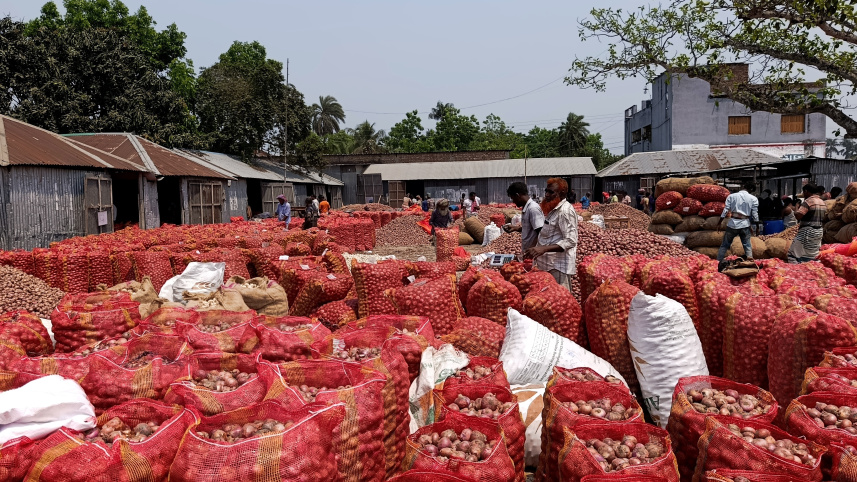
Rapid spoilage from heat and rain, and a chronic shortage of storage facilities have combined to push farmers in major producing regions of Pabna and Faridpur deep into losses this season, following record yields.
Farmers say they are being forced to sell their harvests at throwaway prices. While production costs for most range between Tk 1,000 and Tk 1,200 per maund, prices at the farm gate have fallen as low as Tk 600 per maund.

According to data from the Trading Corporation of Bangladesh (TCB), the essential cooking item retailed at Tk 35-45 per kilogramme (kg) on Wednesday, down from Tk 40-45 a week earlier.
TOO MUCH ONION
The harvest this season has been unprecedented. In Pabna alone, onion cultivation covered 54,335 hectares and produced 9,95,367 tonnes of onions, the highest ever recorded in the district, according to Ashikur Rahman, a sub-assistant agriculture officer at the local Department of Agricultural Extension (DAE).
Nationwide, the DAE estimates total output will reach 49 lakh tonnes this season against domestic demand of around 45-46 lakh tonnes, leaving a surplus of roughly 3-4 lakh tonnes with no clear outlet.
Shahadat Hossain, senior market officer at the Department of Agricultural Marketing in Faridpur, said current prices are almost half of what they were a year ago, driven entirely by the higher output.
He expressed hope prices would recover within one to one-and-a-half months, but for many farmers, that window may already be closing.
WEATHER MAKING IT WORSE
The onion planting season in Bangladesh begins in October and the crops are harvested in late-April to mid-June and hits the market early monsoon.
Farmers who tried to hold their stocks back from the market hoping for better prices have found the weather working against them. Heat and rain are causing onions to rot faster than they can be sold, and ongoing power shortages are disrupting aeration machines that farmers rely on to slow spoilage.
Md Montu Khan, a farmer from Ulat village in Pabna’s Sujanagar upazila, cultivated 8 bighas of land and produced over 600 maunds this season. When harvest-time prices of Tk 700-800 per maund fell short of his production cost of Tk 1,000, he held back his stock. It was a decision that compounded his losses.
“Because the onions are rotting rapidly due to heat and excessive rain, I am forced to sell each maund for just Tk 600 to Tk 700,” he said, with over 400 maunds still unsold.
“I am uncertain if I can sell the rest before it all goes rotten.”
Md Shahaduzzaman, deputy director at Faridpur DAE, said onions this season were larger than usual, meaning higher water content and a shorter storage life, adding further pressure on farmers to offload quickly.
NO STORAGE, NO OPTIONS
For farmers who avoided weather damage, the absence of proper storage facilities has left them with no leverage over when or at what price they sell.
Md Mafiqul Islam, a farmer from Khowar village in Saltha upazila in Faridpur, put it plainly. "We are forced to sell our onions at low prices because we have no proper storage facilities.”
Sohrab Ali, from Ghughudah village in Pabna’s Santhia upazila, planted a hybrid variety on two bighas and achieved a bumper yield of 70 maunds per bigha, but hybrid onions spoil faster than local varieties, leaving him no room to wait for prices to improve.
"I was forced to sell early, meaning I couldn't even recover my production costs," he said.
 For all latest news, follow The Daily Star's Google News channel.
 Uttam Shil, a grower from Pangsha upazila in Rajbari, said two months of storage costs have added to his losses on top of a 10-15 percent reduction in saleable weight as onions deteriorate in traditional storage.
Poor storage conditions cause onions to lose weight, while around 10 to 15 percent of the produce are damaged, resulting in losses instead of profits, he added.
GOVERNMENT RESPONSE
Agriculture Minister Mohammed Amin Ur Rashid acknowledged that production has outpaced domestic demand and that inadequate storage is central to farmers’ losses.
"Many farmers still rely on traditional storage methods, which are failing during the monsoon due to high humidity. As a result, onions are becoming soft or rotting, forcing farmers to sell quickly,” he told The Daily Star.
He said the government has begun expanding scientific onion storage, targeting 10,000 to 15,000 storage facilities in major producing areas including Greater Faridpur, parts of Natore and Rangpur.
“We are also providing aeration machines at little or no cost to help farmers move away from traditional storage methods. About 1,100 aeration machines have already been distributed, and we plan to provide around 15,000 in total,” he said.
Once the programme is completed, the minister expects that a large quantity of onions will be able to be stored using these improved facilities.
“We are collecting scientific reports from the district, upazila, union, and village levels, and within five to seven days I expect to have more detailed information,” he said.
“This year’s challenge is temporary. I hope this storage problem will be resolved within the next year,” he added.
The proposed FY2026-27 budget commits to expanding cold storage and cold chain facilities for perishable goods, reducing post-harvest losses through agricultural mechanisation and improved packaging, and developing modern storage facilities in both the public and private sectors.
A specialised cold storage facility is also planned for the Barendra region.
Comments