


Bangladesh FDI rose 45% in 2025: UNCTAD
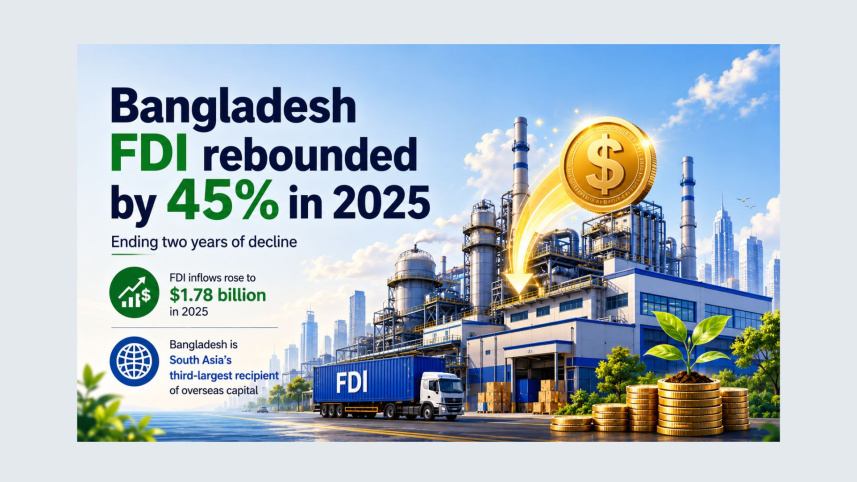
Bangladesh saw a rebound in foreign direct investment (FDI) inflows in 2025, becoming the third-largest recipient of overseas capital in South Asia after India and Pakistan, according to the World Investment Report (WIR) 2026, released today.
FDI inflows into Bangladesh rose 45 percent to $1.78 billion in 2025 from $1.23 billion a year earlier, ending two consecutive years of decline, according to the report by the United Nations Conference on Trade and Development (UNCTAD).

The latest WIR shows that global foreign direct investment rose 6 percent to $1.6 trillion following declines over the previous two years. "However, growth remains fragile and uneven."
Inflows increased by 11 percent to $723 billion in developed economies, compared with 2 percent growth in developing economies. The increase was concentrated in Europe, supported by flows through financial centres and investment hubs.
On the other hand, FDI inflows to developing economies rose 2 percent to $901 billion in 2025, while developing Asia remained the largest recipient among developing regions.
Africa, Latin America and the Caribbean, and structurally weak and vulnerable economies showed diverse trends, according to the report.
Inflows rose marginally to $644 billion in developing Asia, masking divergent trends. Inflows declined in East Asia, including China, but rose in South-East Asia, South Asia, West Asia and Central Asia, UNCTAD said.
South-East Asia became the largest recipient sub-region, while India drove strong growth in South Asia, with inflows up 44 percent, helping drive growth across the region. Total inflows into South Asia climbed to $46.1 billion in 2025 from $34.1 billion a year earlier.
India remained the region's dominant investment destination, attracting $38.9 billion in FDI in 2025, up 44 percent from $27.1 billion in the previous year, supported by strong investments in manufacturing, services and supply-chain diversification.
Pakistan received the second-highest amount of foreign investment—$1.85 billion in 2025—though inflows fell from $2.67 billion in 2024. Yet it still remained marginally ahead of Bangladesh.
Among the smaller South Asian economies, the Maldives continued to outperform relative to its size, attracting $857 million in foreign investment in 2025, up from $806 million a year earlier, largely driven by tourism projects.
Nepal's FDI inflows fell to $44 million from $57 million, while Bhutan received just $9 million, unchanged from the previous year.
UNCTAD said developing Asia remained the world's largest destination for foreign direct investment among developing regions in 2025. But the region's significance increasingly lies not only in the volume of investment it attracts, but also in where that investment is going.
The WIR 2026 said Asia is not only attracting investment. "It is increasingly shaping where future industries are being built, even as investment patterns within the region change."
China remained one of the world's largest FDI recipients despite a decline in inflows from about $116 billion to $105 billion, while continuing to attract commitments in higher value-added activities, research and development, and pharmaceutical manufacturing, the report added.
The UNCTAD report said that around the world, investment is increasingly flowing into sectors linked to semiconductors, digital infrastructure, artificial intelligence, advanced manufacturing and energy-transition technologies.
Many Asian economies are entering this period with important advantages, including established manufacturing capacity, supplier networks, large consumer markets, growing industrial ecosystems and deep integration into regional production networks.
"But these advantages are uneven, and not all economies can compete for the same projects. These strengths have helped the region to benefit from changes in global investment patterns, even as competition for capital becomes more intense."
Looking forward, UNCTAD said the next phase will be more competitive.
"Success in attracting investment is becoming harder to take for granted. Governments across the world are using industrial policies, including incentives and other tools, to attract projects linked to future growth industries. Investors, meanwhile, are becoming more selective about where they commit long-term capital."
 For all latest news, follow The Daily Star's Google News channel.
 For Asian economies, the challenge is no longer simply attracting foreign investment. It is remaining competitive in a world where capital, technology and industrial capabilities are increasingly concentrated in sectors seen as strategic.
"Asia remains central to the new investment landscape, but the next phase will depend on which economies can connect foreign investment to industrial upgrading, jobs, supplier networks and broader regional development."
The overall outlook also remains clouded by trade policy uncertainty and geopolitical tensions.
Comments