


Data colonialism and the human soul: The ethical and legal battle for AI privacy in Bangladesh
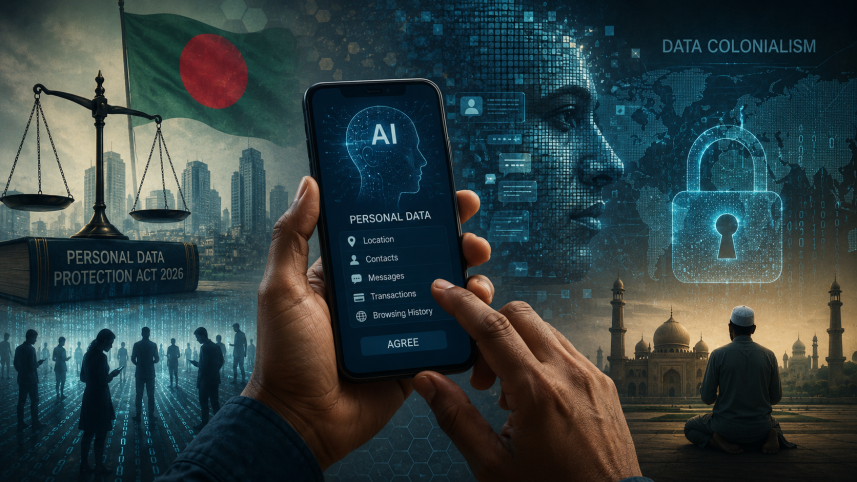
The rapid integration of artificial intelligence (AI) into daily life has sparked intense debates globally, most recently captured in a candid dialogue between US Senator Bernie Sanders and an advanced AI entity. While their conversation reflects the political and corporate anxieties of the Western world, the implications of their warning hit dangerously close to home for developing nations.
Bangladesh, currently undergoing a massive digital transformation, stands at a critical crossroads. As millions of citizens connect to the internet via smartphones, their personal information is being aggressively harvested to feed predictive algorithms. This subtle, data-driven undercurrent presents a complex web of legal, moral, ethical, and religious challenges that the nation must urgently confront.

From a legal perspective, the country is scrambling to build statutory seawalls against a rising tide of digital exploitation. The recent enactment of the Personal Data Protection Act 2026, which evolved from the 2025 ordinance, marks a historic shift by finally recognising citizens' personal data as their own property. However, a significant gap remains between the text of the law and its implementation on the ground.
Millions of smartphone users in both urban centres and rural villages routinely click "accept" on long, unintelligible terms-of-service agreements written in complex English. They inadvertently hand over their browsing history, real-time geographic location, financial transaction records, and communication logs to global tech conglomerates and domestic applications alike.
Even though the legal framework now imposes financial penalties on non-compliant corporations rather than issuing toothless regulatory warnings, the mechanisms to monitor predictive profiling remain vastly underdeveloped. There is no fully functional, independent data protection authority equipped to audit how corporate algorithms use this data to manipulate market prices or control consumer access.
This legal vulnerability quickly bleeds into profound ethical and moral dilemmas. When algorithms profile citizens, they reduce human beings with free will to predictable, commodity-driven entities. In the context of local e-commerce, ride-sharing, and mobile financial services, corporate algorithms quietly execute dynamic pricing, charging different rates to different individuals based on their deduced economic vulnerability. This compromises the principle of fairness.
On a broader societal scale, the moral fabric of communities is threatened by the microtargeting of misinformation. The socio-political landscape, still healing from historical unrest and deep institutional mistrust, is highly susceptible to AI-generated narratives. If algorithmic profiling is weaponised to identify individuals experiencing financial anxiety or social isolation, malicious actors can feed them customised, inflammatory content designed to exploit those exact fears. This fragments the shared social reality necessary for national stability, turning neighbour against neighbour through invisible, automated manipulation.
Furthermore, these data-harvesting practices conflict deeply with the religious values held by the majority of the population. In Islamic tradition, which forms the moral foundation for the vast majority of Bangladeshis, the concepts of Amanah (trust) and Haya (modesty and privacy) are sacred.
Collecting a person's private habits, preferences, and movements in secret, without explicit and informed consent, violates the fundamental Islamic prohibition against spying, backbiting, and unauthorised intrusion into the private lives of others. Religious ethics dictate that any transaction or agreement must be transparent and mutually agreed upon, without deception.
The current practice of hidden corporate profiling, whereby an algorithm knows more about an individual's private anxieties than the individual's own family members do, represents a profound betrayal of trust. It treats human behaviour as raw material for financial gain, an ideology completely at odds with religious stewardship and communal harmony.
Bangladesh, as a consumer nation rather than a major producer of technology, faces a stark reality. Western tech giants hold a monopoly on advanced generative models and massive data repositories. This creates a form of digital colonialism, whereby the intimate habits and cultural nuances of the people are exported to train foreign models over which local authorities have no jurisdictional control.
The domestic push to build localised linguistic datasets, such as advanced Bengali natural language processing tools, is a step towards digital sovereignty. Yet, without rigorous enforcement of local data residency requirements, the intellectual and personal capital of the nation's youth will continue to be exploited for foreign corporate profit.
So, should Bangladesh impose a moratorium on AI infrastructure expansion or strict data limitations? This presents a painful trade-off for a developing economy. Halting technological expansion could stifle the industrialisation of vital sectors such as ready-made garments, agriculture, and financial services, which rely heavily on automation to remain globally competitive. However, unbridled growth without structural safeguards guarantees the erosion of human dignity.
The path forward demands that the nation aggressively enforce its new data laws, require absolute transparency from technology providers, and establish rigorous algorithmic audits. Technology must never be viewed as a neutral force. If left unregulated, it becomes a weapon of behavioural control that undermines the rule of law, mocks religious morality, and threatens society's collective future.
Syed Almas Kabir is the chairman of the Bangladesh ICT & Innovation Network (BIIN).
 For all latest news, follow The Daily Star's Google News channel.
Comments