


250 years of US independence: Do Americans know or care about their founding principles?

During my Dhaka University days, I was an active participant in the anti-Vietnam War demonstrations on campus and around the city. This occurred much more extensively in the US, where massive demonstrations became the norm that, sometimes, in the late 60s and early 70s, included the burning of the US flag. As a freedom fighter and having just won our own War of Independence in 1971, the concept of a flag had tremendous appeal for me. So, burning any nation’s flag seemed unacceptable. However, I was quite impressed by the way it was tolerated in the US.
Many years later, in 1989, when I was a Unesco staff member and was planning to return to Bangladesh and launch an English newspaper, I read about a landmark verdict by the US Supreme Court—Texas v. Johnson—that held that burning the national flag as a political protest was protected by the First Amendment of the US Constitution as a part of “freedom of expression”. I immediately made an extensive study of this amendment and was amazed by its contents, which granted freedom of religion, freedom of speech, freedom of the press, freedom of assembly, and many other related freedoms.

In response to flag burning, Congress passed a “Flag Protection Act of 1989” which was, again, struck down by the US Supreme Court in United States v. Eichman.
Following these verdicts, I totally fell in love with the First Amendment, which, for a man planning to launch a newspaper, was like a dream. The famous comments of Thomas Jefferson that, “The basis of our governments being the opinion of the people, the very first object should be to keep that right; and were it left to me to decide whether we should have a government without newspapers or newspapers without a government, I would not hesitate a moment to prefer the latter.” Such a powerful and all-encompassing statement in favour of the free press has rarely been uttered since.
Whatever critical views I had about the US, the First Amendment and Jefferson’s comment stayed dominant in my mind as it does today. Tragically, that is being eroded in the US itself at present. Journalists are being termed the “worst” type of people and many are being called corrupt without any evidence. This is something the world was not prepared to see in the very country that contributed so much to the development of the free press.
America’s most powerful attraction—freedom of thought—is under stress today. The US universities that are among the most respected in the world, and which act as the most powerful image-builders and create an irresistible pull-factor for the brightest minds in the world, are now being denigrated, termed corrupt and antisemitic.
A violent attack on the Capitol, the centre of legislation in the US, and subsequent exoneration of all the mobsters convicted of violent crimes, including the killing of some policemen, has greatly eroded the US’s respect for law. Letting loose ICE (Immigration and Customs Enforcement) forces on US citizens, which resulted in the death of at least eight, as identified by news organisations, shattered public confidence in the basic “right to life” as enshrined in the US Constitution.
The transformation of the fundamental identity of the US as a multicultural society—one that is the product of migrants from all over the world from its very inception—to a far narrower perspective is raising disturbing questions about rising racism in the very country that was eulogised as “the melting pot” of the world. The gradual diminishing of “checks and balances” of centres of power and the accompanying erosion of institutional autonomy have all led to an erosion of the US image, inflicted by its own actions.

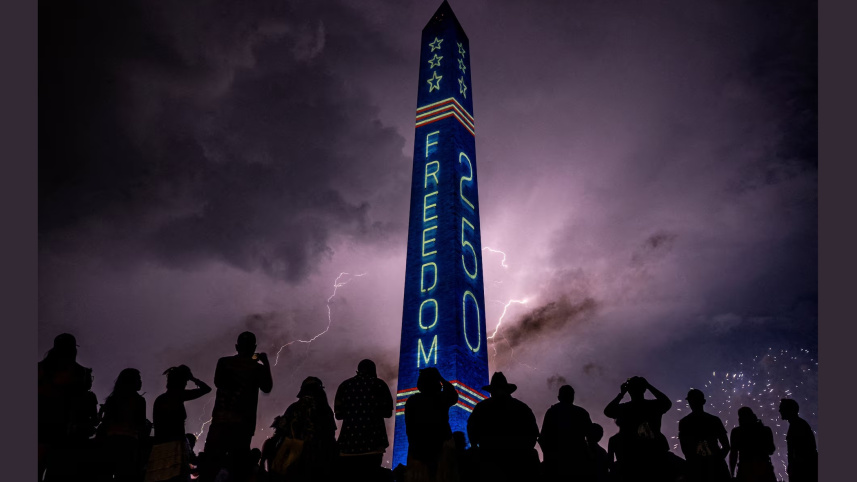
There appears to be nothing much to celebrate about the 250 years of US independence because Americans themselves seem to have forgotten as to why the world admired them so much in the past. I am not certain, let alone all Americans, that all congressmen, senators, administration leaders, and officials are fully aware of the principles enshrined in the Declaration of Independence of 1776 and the US Constitution, which came into effect in 1789 after being drafted by the Constitutional Convention, where figures such as James Madison, Benjamin Franklin, Alexander Hamilton and George Washington, among others, played pivotal roles. It is among the pioneering documents to establish three autonomous branches of the government—legislative, executive, and judicial—and a system of elaborate checks and balances of all centres of power. The first ten amendments, known as the Bill of Rights, ratified in 1791, continue to be among the most inspiring and worthwhile documents ever to be adopted in any constitution.
What makes the founding principles of the United States so significant is that they emerged in a world dominated by monarchies, empires and dynastic rule. It was also the age of colonialism. By 1791, Britain ruled the Province of Quebec and other territories in North America, as well as parts of the Caribbean, and was rapidly expanding its rule in India through the East India Company. Spain ruled most of Latin America, Mexico, Florida and the Philippines. Portugal controlled Brazil and maintained trading posts in Africa and Asia. France retained colonies in the Caribbean. Save for the Dutch Republic and Swiss Confederacy, nothing remotely resembling a representative government existed anywhere.
Compared to the time, the leaders of the American independence and the framers of the US Constitution were stunningly democratic, incredibly far-sighted and incomparably pro-people. It marked the beginning of the setting up of representative and accountable governments in the rest of the world. The ideas enshrined in these documents influenced the French Revolution, independence movements in Latin America, and anti-colonial movements everywhere. Even our own Declaration of Independence in 1971 borrowed extensively from the ideas and principles contained in the US’s case.
However, there existed a central paradox of the values and principles. Universal equality coexisted with slavery. Disenfranchisement of the Indigenous peoples and of women and dispossession of native Americans created an example of ignominious double standards.
This contradiction has been a defining feature of US history, the greatest example of which was the continuation of slavery that lasted nearly a hundred years after independence, till the Civil War (1861 to 1865). This betrayal of the founding principles was demonstrated most strikingly by the treatment meted out to the Indigenous people—the Native Americans. The declaration itself termed them as “merciless Indian Savages” reflecting prevailing racial and colonial attitudes carried out through frequent lynching, dispossession from their lands, eliminating their homes and basically destroying them as a people. Slavery was only abolished through the adoption of the 13th Amendment in 1865. Native Americans were granted citizenship only in 1924. Racial segregation lasted till the other day.
Women’s right to vote was granted through the 19th Amendment as late as 1920, two years after the start of World War I and decades after continuous suffrage movements led by women.
Fast-forwarding to the world that emerged after World War II, the US emerged as the richest and most powerful global change maker. The destruction of fascism and the complete defeat of Nazi military ambitions (and the ghastly holocaust of the Jews) brought about a magnificent opportunity to build democracy and global prosperity under US leadership.
But the advent of the Cold War changed everything. The ideological competition between the capitalist and socialist blocs led to US support for authoritarian, brutal and corrupt regimes during the Cold War, only because they were anti-communist. The US supported General Ayub’s coup in Pakistan in 1958, thus destroying the prospect of democracy in Pakistan, only because he promised to be a part of US’s anti-communist strategy. Wars in Vietnam, Afghanistan, Iraq, Libya and Syria strengthened what President Eisenhower termed the advent of the “military-industrial complex.”
After World War II, it is estimated that the US has conducted more than 50 significant military interventions, ranging from short operations lasting several days to long wars lasting decades. The Congressional Research Service has documented 469 instances of the use of US armed forces abroad since 1798, ranging from brief interventions to full-scale wars, including the Mexican- American wars, the Spanish-American War, the Philippine-American War, and invasions of Granada and Panama. The Vietnam War and the War in Afghanistan that continued for several decades greatly corroded the US’s standing as a military power. The invasion of Iraq and Libya, based on a lie that those countries possessed “weapons of mass destruction” (WMD), presented the US as a warmongering country.
According to some research, the US maintains about 120-130 major overseas military installations in roughly 50 countries and territories. Broader estimates, including smaller facilities, logistics hubs and cooperative security sites, put the total at around 750 military sites across about 80 countries and territories.
 For all latest news, follow The Daily Star's Google News channel.
 At its birth in 1776, the US represented democratic and moral values. Today, it is more enamoured with its military might and its capacity to intervene, manipulate and interfere in other countries’ affairs. The period from 1945 to 1991 saw a dramatic expansion of US influence. It controlled around half of the world’s industrial output, had the world’s strongest military, and made its “dollar” the world’s leading currency. It provided leadership in creating the United Nations, IMF, WB and NATO. In the latter decade—from 1990 to 2000—the US dominance continued. However, since 2001, a relative decline has started. While it remains powerful today, its competitive edge is in decline.
While most of the world accepted the long-term support of the US to the Israeli regime, its assistance in carrying out a genocide on the Palestinians living in Gaza has raised fundamental questions about US’s present goals. Hamas deserved to be condemned for its attack on Israel in October 2023, but can that be used to justify the subsequent killing of over 73,000 people and the injuring of more than 170,000? Can it also justify depriving the people of Gaza of food, water, electricity and medical services? This has been going on for nearly three years now, with only meagre assistance to the residents of Gaza. It stands out among the worst atrocities committed since World War II. The US’s supply of arms, ammunition, and funds for this genocide raises serious questions about its global policies and moral standing.
The impact of the current attack on Iran is gradually coming to light, and how it served the US national interest is a question that Americans must ask themselves.
I want to conclude by raising another question. Who is an American? According to one estimate, the US population is about 57.5 percent white, 20 percent Hispanic, 13.7 percent African Americans, 6.7 percent Asian and 1.4 percent Native Americans. In terms of ancestry, and not race, the US population consists of Germans, Irish, English, Mexican, Italian, African American, Polish, French, Indian, Chinese, Filipino, Vietnamese, Puerto Ricans, etc. This is a magnificent asset. No country in the world can ever come even near such diversity.
So, the question is, will the US emerge stronger by strengthening its internal bond or by creating cracks in the mosaic that has made the greatest contribution to its being what it is today?
This, we think, is the most relevant question on their 250th anniversary.
Mahfuz Anam is the editor and publisher of The Daily Star.
Views expressed in this article are the author's own.
Follow The Daily Star Opinion on Facebook for the latest opinions, commentaries, and analyses by experts and professionals. To contribute your article or letter to The Daily Star Opinion, see our guidelines for submission.
Comments