


Navigability crisis hits Payra port, foreign ship arrivals drop


- Navigability crisis reduces foreign vessel arrivals
- Rapid siltation undermines costly dredging efforts
- Coal imports disrupted, costs and delays rise
- Terminal, bridges under construction to improve access
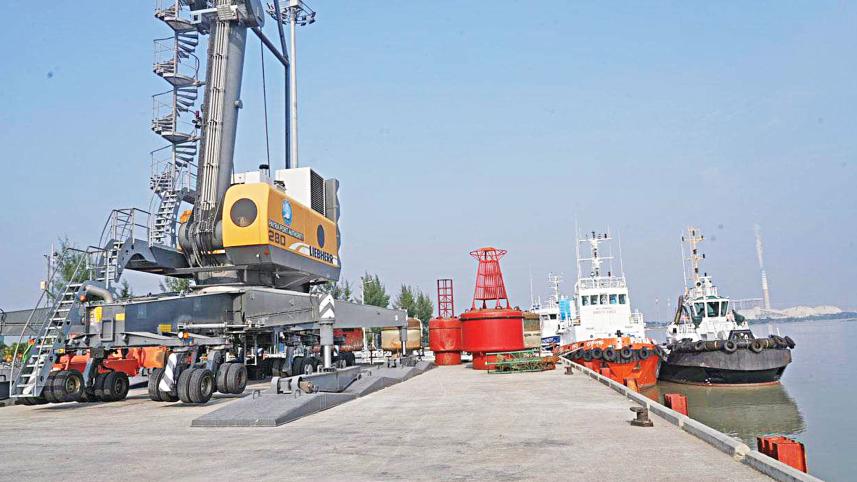
Payra port, the country's third seaport after Chattogram and Mongla, is facing a navigability crisis that has disrupted vessel movement and sharply reduced foreign cargo ship arrivals over the past year, raising concern among stakeholders.
Established under the Payra Port Authority Act on November 19, 2013, at Itbaria union in Kalapara upazila, Patuakhali district, the port began operations on August 13, 2016.
It started modestly with 10 ships in the fiscal year (FY) 2016-17 but grew steadily, handling 1,014 ships and 5.074 million tonnes of cargo in FY2023-24, a 33 percent increase from the previous year. Since opening, 5,401 ships, including 529 foreign vessels, have unloaded cargo, generating around Tk 2,346 crore in government revenue.
However, conditions deteriorated in the last fiscal year. In FY2023-24, 123 foreign vessels berthed at Payra, bringing 4.048 million tonnes of cargo and Tk 33.22 crore in revenue. In FY 2024-25, arrivals fell to 85 vessels, cargo imports dropped by 1.277 million tonnes, and revenue fell by Tk 8.6 crore.
Port officials and users attribute the decline to worsening navigability in the 75 km-long Rabnabad channel.
In 2021, Belgian firm Jan De Nul was hired for capital dredging at a cost of Tk 6,500 crore to deepen the channel to 10.5 metres, allowing large vessels to berth directly at the port's jetty. The dredged channel was handed over in April 2024, but heavy siltation reduced its depth within six months.
Port records show that only around 100 mother vessels berthed after dredging before navigability problems returned. As of December, the channel's average depth is about 6 metres at high tide and 5.9 metres at low tide, blocking larger vessels.
"Despite capital dredging, rapid siltation has reduced the channel depth to below 6 metres. If mother vessels cannot berth directly, users may gradually stop using the port," said Md Mamunur Rashid, director of the Bangladesh Shipping Agents' Association.
Major port users include the 1,320 MW Payra Thermal Power Plant and RPCL-Norinco International Power Limited (RNPL), both importing around 12,000 tonnes of coal daily.
Shallow waters now force coal-carrying mother vessels to anchor off Kutubdia near Chattogram port, with coal transferred to the plants by smaller lighter vessels, increasing time and cost.
RNPL Supervising Engineer Ashraf Uddin said, "We import coal every month using six to seven mother vessels, each carrying around 60,000 tonnes. Due to the navigability crisis, we now need 150 to 180 lighter vessels to bring coal from Kutubdia. Each lighter takes at least two days to reach the plant, which raises costs and affects power generation."
Payra port Chairman Rear Admiral Masud Iqbal acknowledged the crisis, saying, "The channel's maintenance dredging has been insufficient, leaving it too shallow for larger vessels to navigate.
He added that a detailed project proposal, including hiring a capable dredging company and purchasing two dredgers, has been submitted to the government and is awaiting approval from the Executive Committee of the National Economic Council.
Payra port Assistant Director (Administration) Md Azizur Rahman said, "Several projects are underway to maintain navigability and ensure vessel safety, including dredging the Rabnabad channel and procuring two dredgers to reduce long-term costs."
He added that port infrastructure is progressing: the first terminal's jetty is 97 percent complete, the yard 96 percent, and a six-lane road 86 percent finished. Two bridges over the Andharmanik River, costing Tk 950 crore, are expected to be completed by February 2026, connecting the terminal directly with the Dhaka-Kuakata highway.
Development of the terminal on the Rabnabad River began on October 27, 2022. Initially approved in 2019 at Tk 3,982 crore, the project cost has risen to Tk 5,427 crore, and the completion deadline has been extended to December 2026, turning an originally planned 18-month project into a seven-year undertaking.
 For all latest news, follow The Daily Star's Google News channel.
Comments