


Out of the tea gardens


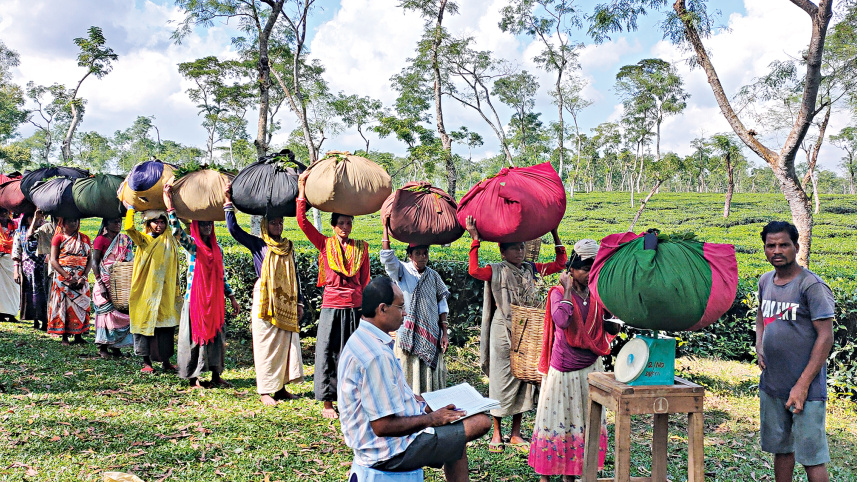
In the history of her family, Chompa Naidu, 30, is the first to leave the Longla Tea Garden of Kulaura, Moulvibazar, for higher education in another country. Up until her, most of them spent their whole lives inside the gardens, plucking leaves.
Even two generations ago, no one in her family thought of going to school. The order of things was to work. “Many couldn’t even write their own names,” says Chompa’s grandmother, Thandharana Naidu, 81. “Education was a luxury.”

A whole day’s work would get her Tk 5. Failure to meet the target meant a wage cut. “No work meant no pay. Work was relentless. It didn’t matter if it rained or we got sick. There was no chance to dream,” she recalls.
Tea workers remain one of the most deprived communities in Bangladesh. They have no rights to the remote, hilly land they live on. Access to education, healthcare and water is minimal. For a long time, they were not even allowed to vote. They remain among the lowest paid workers in the country, long trapped in a cycle of plucking tea leaves, largely excluded from the mainstream.
But a new wave is gripping the tea estates. Slow changes with every new generation have culminated in a new era. Now they can dream of leaving the gardens.
Tricked, Trapped, Exploited
The first tea workers were brought to Sylhet in the mid-1800s from the Indian states of Bihar, Jharkhand and Odisha under British colonial rule. Recruitment agents known as “arkattis” enticed impoverished villagers with false promises of easy money. Some were told that gold could be found by digging the soil.
The Labour Immigration Act of 1863 formalised the trap, establishing a legal framework for transporting labour — what many describe as a system of modern slavery. Workers were legally bound to plantations, losing their freedom to move or work elsewhere. They faced disease, poisonous snakes, wild animals and brutal treatment while being forced to build lavish bungalows for the “shahebs”.
After some 50 years of abuse, on May 20, 1921, thousands of workers set off for their homeland under the slogan Mulluk Cholo — “return to homeland”. Armed British forces stopped them. Hundreds were reportedly shot dead. Those who fled were caught, tortured and sent back to work. Returning home was no longer an option.
According to Farida Yasmin, statistics officer at the Bangladesh Tea Board, there are 116,762 registered tea workers across 166 gardens. Union leaders estimate that nearly 10 lakh people live within tea garden communities.
Kamran Tanvirur Rahman, chairman of the Bangladesh Tea Association, believes tea workers enjoy more facilities than workers in other industries.
Workers and international organisations say otherwise. A 2017 study by the International Labour Organization found 63 percent of workers at risk from working conditions – 84 percent experience headaches, 74 percent muscular pain, 71 percent back pain, 65 percent skin diseases.
In the tea gardens of Moulvibazar, Habiganj and Sylhet, the leprosy rate is one in 1,700 people — compared to the national rate of one in 57,000, according to Philip Gain, founder director of the Society for Environment and Human Development (SEHD), who has documented the exploitation of tea workers for over three decades.
Wages remain a central issue. In 2022, after a mass movement, daily wages were raised from Tk 120 to Tk 170. By 2025, they stand at Tk 187, far below the workers’ demand of Tk 300. Payment delays sometimes stretch to 20 weeks.
Kamran argues that workers receive housing, rations at Tk 2 per kilogramme, free medical care and free education. “Together, they get above Tk 500” when in-kind benefits are included.
Land ownership remains out of reach entirely. “They have no land rights. They never did,” says Gain. “The land they live on belongs to the government, leased to the companies – 20 to 40 years depending on the garden category. When leases are renewed, the government could grant rights to the workers. There has been no sign of that intention so far.”
The Winds of Change
The first major wave of change came by the time Bangladesh achieved independence. Voting rights and awareness regarding education had touched even the tea estates.
Thandharana’s daughter-in-law, Savitri Naidu, 50, studied up to HSC before financial constraints forced her to stop. There was no secondary school inside the estates – there still isn’t in most of them, only primary schools. Continuing would have meant more strain on the family. Savitri came back. She picked leaves. She raised Chompa. “She’s my pride,” Savitri says. “She’s the first from the garden to get a PhD.”
But Syed Sultan Uddin Ahmmed of the Bangladesh Institute of Labour Studies (BILS) argues that the celebration around such milestones masks a deeper failure. “This community has been part of our nation for nearly 200 years. In villages elsewhere, a PhD today is unremarkable. By that measure, a doctor from a tea garden was not even supposed to be newsworthy.”
 For all latest news, follow The Daily Star's Google News channel.
 “The backwardness and discrimination against them are so acute that it should be a source of shame for the nation – that an entire community has been kept confined like this. Not just physically, within the garden boundaries. We have confined their thinking too: that nothing more is possible, that their children can at best become labourers, or if lucky, a low-level clerk. They must be freed from that,” he says.
A 2025 study of tea garden schools, published in the European Journal of Inclusive Education, found that seven in ten parents in these communities cannot read, that most girl students feel unsafe travelling to school, and that more than half of all tea garden children report hostility from classmates and teachers.
Gain notes that this year, children from tea gardens enrolled in 33 universities – but adds that the quality of education inside the gardens remains poor. Many schools have one teacher per class; some pay teachers daily wages.
Language compounds the barrier. “Many children do not speak Bangla fluently, and mainstream society,” he says, “tends to be hostile toward them.”
Chompa grew up inside the gardens with the same constraints. But with help and hard work, she achieved milestones that many can’t.
In 2007, she sat a competitive exam and won admission to Camellia Duncan Foundation School, a residential institution for the children of garden workers. She completed her SSC in 2012 with a GPA of 5, her HSC in 2014 with the same, while receiving a monthly scholarship from the Dutch-Bangla Foundation. An Indian Council for Cultural Relations scholarship took her to India, twice. She is now completing her PhD at Andhra University.
“My mother believed deeply in the transformative power of education,” Chompa says. “Though resources were scarce, she ensured that my studies continued. Whatever I have achieved is not mine alone. It is rooted in her resilience and the encouragement of my family, teachers, mentors and well-wishers.
“A turning point came when I enrolled at Camellia Duncan Foundation School, which provided free education, accommodation and exposure beyond the estate.”
Tapan Dutta, divisional president of Bangladesh Trade Union Kendra (TUC) for Chattogram and a former member of the interim government’s Labour Reform Commission, notes that some material changes are also visible.
Transportation and housing have improved since the pre-independence era, he says, though from a very low baseline. “The roads used to be broken, full of holes and mud. Now they have better ones. Many now take loans from NGOs to buy motorcycles and transport people from one garden to another. This has become a popular source of income.”
Ahmmed of BILS is direct about what still needs to change. “The garden-based education system is in a sorry state. There are no skill development centres. Special health facilities must be ensured. Above all, space must be created for them to practise their social and cultural heritage. Discriminatory laws must be repealed or amended. They must be brought into the mainstream.”
Roots, Routes, Resilience
Like Chompa’s mother, a growing number of tea workers have recognised that education leads to better jobs, and better jobs to financial stability.
Take the case of Bijay Rudra Paul of Dhamai Tea Garden. He could not afford to sit his SSC in 2000 or 2001. He finally sat it in 2002, with money he earned working as a bicycle mechanic, while supporting his family. He enrolled in college in 2006 on a para-teacher’s salary of Tk 500 a month, doing private tutoring on the side. He passed his HSC in 2008, joined a government job in 2009 and completed his MSS while working.
In 2010, he established Chhota Dhamai Ideal Academy, where around a hundred students now study. He later launched the Shila Merit Scholarship Project, named after his mother, tracking A+ students from 92 tea gardens across Moulvibazar and rewarding them from his own pocket.
Pranesh Goala, son of a tea worker, has been elected chairman of Kalighat Union three consecutive terms. “This would have been almost impossible 40 years ago. The people of the tea gardens are no longer just voters; they are now part of leadership and decision-making.”
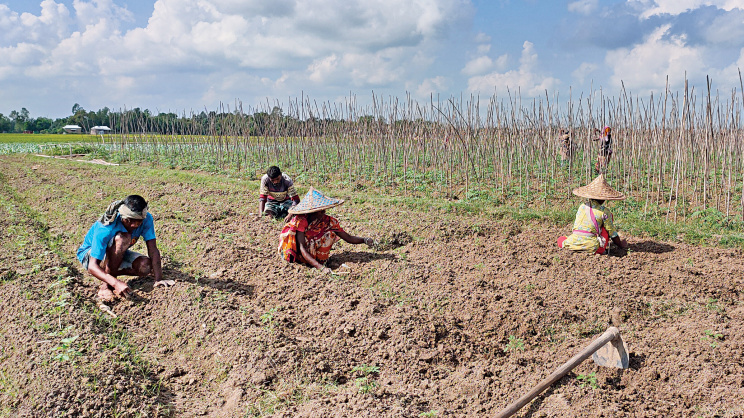
But many remain confined to a meagre existence, finding ways within it or beyond. Kanai Lal Bhar of Palkichara Tea Garden cultivates vegetables on rented land. “If we depend only on the garden wage, the future is dark,” he says. Subash Rabidas, from Kaliti Tea Garden, took a factory job for a fixed monthly salary.
Maloti Ghatual of Begumkhan Tea Garden works outside the plantation cutting soil when garden work dries up. “I want them to live a more secure life than mine,” she says of her children.
Sohag Chhatri, 35, is plain about it: “Our generation has to learn multiple jobs at once. Otherwise, it is difficult to survive.”
Gain puts it in generational terms: “This is the fifth generation of tea garden families. Change is happening — but measured against national progress, they remain far behind.”
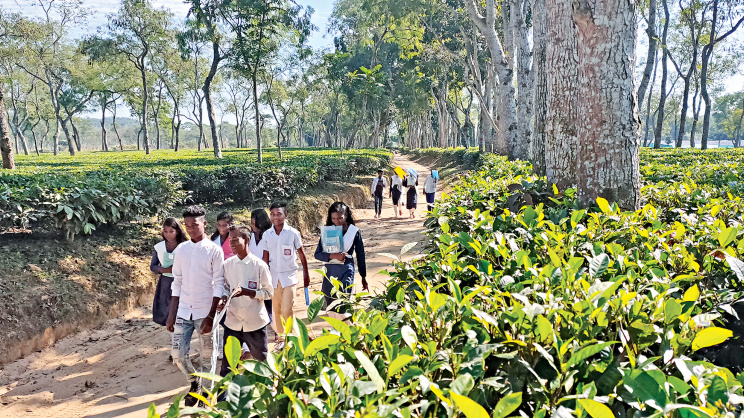
Most are still deprived of their basic rights. But now, every morning, uniformed teenagers walk the sandy path between the tea rows toward the school, moving through the same green canopy their grandparents worked beneath.
Comments